New evidence puts 'Snowball Earth' theory out in the cold
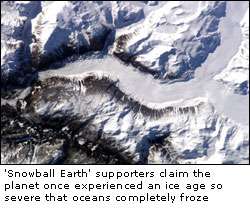
The theory that Earth once underwent a prolonged time of extreme global freezing has been dealt a blow by new evidence that periods of warmth occurred during this so-called 'Snowball Earth' era.
Analyses of glacial sedimentary rocks in Oman, published online today in Geology, have produced clear evidence of hot-cold cycles in the Cryogenian period, roughly 850-544 million years ago. The UK-Swiss team claims that this evidence undermines hypotheses of an ice age so severe that Earth's oceans completely froze over.
Using a technique known as the chemical index of alteration, the team examined the chemical and mineral composition of sedimentary rocks to search for evidence of any climatic changes. A high index of alteration would indicate high rates of chemical weathering of contemporary land surfaces, which causes rocks to quickly decompose and is enhanced by humid or warm conditions. Conversely, a low chemical index of alteration would indicate low rates of chemical weathering during cool, dry conditions.
The researchers found three intervals with evidence for extremely low rates of chemical weathering, indicating pulses of cold climate. However these intervals alternate with periods of high rates of chemical weathering, likely to represent interglacial periods with warmer climates.
These warmer periods mean that, despite the severe glaciation of this time in Earth history, the complete deep-freeze suggested by 'Snowball Earth' theories never took place, and that some areas of open, unfrozen ocean continued to exist. Leader of the study, Professor Philip Allen of Imperial College London's Department of Earth Science and Engineering, explains:
"If the Earth had become fully frozen for a long period of time, these climatic cycles could not exist – the Earth would have changed into a bleak world with almost no weather, since no evaporation from the oceans could take place, and little snowfall would be possible. In fact, once fully frozen, it is difficult to create the right conditions to cause a thaw, since much of the incoming solar radiation would be reflected back by the snow and ice. The evidence of climatic cycles is therefore hostile to the idea of 'Snowball Earth'."
Professor Allen adds that understanding how Earth's climate has changed in the past provides important data for current climate change models. He says:
"This isn't just curiosity about the past - we are living in a time of climate change and there is a huge debate going on over what the natural variability of the climate is. Knowledge of climate change in deep time provides clues to the way in which our climate system works under extreme conditions. But these extreme conditions were probably not a full global freeze. It is equally important to understand a picture of global climate retaining open ocean between the tropics."
This challenge to the 'Snowball Earth' opens intriguing questions about how the Earth came so close to climate disaster but managed to avoid it, according to Professor Allen.
"This was the most severe glaciation experienced by the planet over the last billion years, and the big question is - how can ice get all the way to the tropics but not finish the job?" he says. "The total icy shutdown that we came so close to would have dealt a severe blow to early life and most likely would have resulted in a completely different evolutionary pathway. The reasons for Earth's near-miss with global refrigeration remains an important scientific question to resolve."
The team's findings come from analyses of sedimentary rock from the Huqf Supergroup, Oman's oldest sedimentary sequence that spans around 200 million years of the Neoproterozoic era.
Source: Imperial College London


