Gold catalysts are 'hot' because their electrons are heavy, chemist proposes
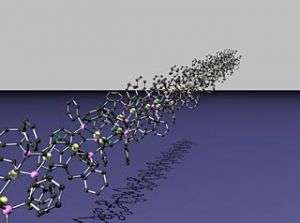
A University of California, Berkeley, chemist has found a mother lode of new and unique gold-catalyzed reactions by applying Einstein's theory of relativity to the rare and precious metal.
Catalysts are metals that speed up chemical reactions, such as when the platinum in a car's catalytic converter instantly converts polluting engine exhaust to oxygen, nitrogen, carbon dioxide and water.
Dean Toste, a UC Berkeley associate professor of chemistry, was one of the first chemists to experiment with gold as a catalyst. He opened the door for others interested in gold's versatility and in the potential to generate chemicals of interest for the chemical and pharmaceutical industry more efficiently and using less toxic precursors.
"This is a really hot area," Toste said. "If you look at the most-cited articles in the Journal of the American Chemical Society, many are about gold catalysis.
"With this class of gold catalysts, you can develop a number of unprecedented reactions that have never been seen before."
In a review article appearing in yesterday's (March 22) issue of Nature, Toste discusses the new field and proposes a new theory for why gold has such unusual, and practical, catalytic properties. So far, the hypothesis has successfully predicted the behavior of gold catalysts in new chemical reactions.
"Our hypothesis really allows us to approach catalysis in a new way, melding the two fields of theoretical chemistry and synthetic chemistry," Toste said.
At the heart of his hypothesis is the special theory of relativity, proposed by Albert Einstein 102 years ago and typically thought of as applying only to cosmological questions. But late UC Berkeley chemist Kenneth Pitzer showed some 70 years ago that the theory comes into play in chemistry as well. Other researchers have used so-called relativistic quantum mechanics to explain gold's yellow color and why mercury is a liquid instead of a solid.
Toste now takes this explanation a step further, crediting special relativity with making gold - and perhaps the related and widely used catalyst platinum - act as both an acceptor and a donor of electrons in a catalytic reaction. Typical metal catalysts do one or the other, but not both.
One of the key tenets of relativity is that nothing can travel faster than the speed of light. The reason for this is that objects become heavier, or more massive, the faster they go, with the mass approaching infinity as the object approaches the speed of light.
In an atom, where electrons race around the nucleus like buzzing bees, the velocity of an electron doesn't get anywhere near the speed of light until the atomic nucleus fills up with lots of positively charged protons - the negatively charged electrons have to move faster to keep from being pulled into the highly positive nucleus. This occurs in the transition metals of the periodic table of elements, metals ranging from tantalum and tungsten to platinum and gold. In a gold atom, with 79 protons in the nucleus, the 79 electrons whip around the nucleus at about half the speed of light.
The net effect is that gold's electrons are much heavier and are pulled in closer to the nucleus, lowering the energy levels and making the atom more compact. According to this hypothesis, gold's s shells, which are its lowest energy spherically symmetric electron shells, contract. This shields the electrons in outer, asymmetric p and d orbits from the nuclear charge, allowing them to expand slightly. In gold, the contraction of the outermost (6s) shell and the expansion of the next-inner (5p) shell reduces the energy difference between the two to the equivalent of a photon of blue light. This allows gold to absorb blue light and, thus, look yellow. Silver, because it exhibits a much less dramatic relativistic effect, is unable to absorb any visible light and is totally reflective.
Toste proposes that this same shielding effect allows the more tightly bound s shell to easily accept electrons from other molecules, while the partly shielded d shell can easily donate electrons to a reaction.
Thus, gold is able to participate in reactions both as a donor and as an acceptor of electrons, which makes it particularly useful in catalyzing reactions at carbon-carbon bonds, the backbone of all organic molecules. According to Toste, a gold atom can attach to carbon loosely, with a single bond or a double bond, allowing flexibility in reactions that can lead to novel organic molecules.
Using this model, he has accurately predicted the products in various organic reactions. For example, a gold atom attached to the chemical phosphine and dispersed homogeneously in a liquid can efficiently convert alkynes to pyrroles, which are ring structures found in many drugs. Gold-phosphine catalysis also can create an unusual carbon triangle called cyclopropane that is used in industrial organic synthesis.
"We can make cyclopropanes without the need for explosive diazo compounds," Toste said.
Toste predicts that gold catalysts also will be very useful in producing chemicals with a specific handedness, that is, a left-handed molecule, but not its right-handed or mirror image. Such stereoselective reactions are becoming more important because many drugs come in right- and left-handed forms, but only one form is effective in the body. The most efficient synthesis would produce only the effective form, not its ineffective mirror image. He is tuning the phospine attached to gold to affect this stereoselectivity.
"The future of gold catalysis still involves a lot of theoretical work, and we need to understand more about how it works," Toste said. "But already, some of these reactions are being used by medicinal chemists, and it's a really exciting field."
Source: University of California - Berkeley


