Molecular Tools Make the Cut
March 25th, 2007 Molecular Tools Make the Cut

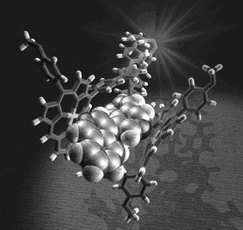
The scissors-like molecular machine extends or folds in response to different wavelengths of light. Credit: Takuzo Aida

Researchers in Japan have developed a pair of molecular-scale scissors that open and close in response to light. The tiny scissors are the first example of a molecular machine capable of mechanically manipulating molecules by using light, the scientists say.

The scissors measure just three nanometers in length, small enough to deliver drugs into cells or manipulate genes and other biological molecules, says principal investigator Takuzo Aida, Ph.D., professor of chemistry and biotechnology at the University of Tokyo.

“Chemists and biochemists may also use the scissors to precisely control the activity of proteins,” Aida says. He presented details of the new technique today at the 233rd national meeting of the American Chemical Society.

Scientists have long been looking for ways to develop molecular-scale tools that operate in response to specific stimuli, such as sound or light. Biologists, in particular, are enthusiastic about development of such techniques because it would provide them with a simple way to manipulate genes and other molecules.

“It is known, for example, that near-infrared light can reach deep parts of the body,” says Kazushi Kinbara, Ph.D., associate professor of chemistry and biotechnology at the University of Tokyo and co-investigator of the study. “Thus, by using a multi-photon excitation technique, the scissors can be manipulated in the body for medicinal applications such as gene delivery.”

The scissors-like molecular machine uses a photo-responsive chemical group that extends or folds when light of different wavelengths falls upon it.

Just like "real" scissors, the molecular scissors consist of a pivot, blades and handles. The pivot part of the scissors is a double-decker structure made of chiral ferrocene, with a spherical iron (II) atom sandwiched between two carbon plates. The three-piece unit creates a shaft that allows the scissors to rotate and swivel.

Driving the motion are two handles strapped with photo-responsive molecules called azobenzene, which not only has the ability to absorb light, but comes in two isomeric forms: a long-form and short-form. Upon exposure to UV light, the long-form of azobenzene is converted into the short-form. Exposure to visible light transforms the short-form into the long-form.

When UV and visible light are used interchangeably, the length of the azobenzene decreases and increases, which drives the handles in an open-close motion. The movement activates the pivot, followed by an opening-closing motion of the blades.

Attached to the scissors’ blades are organometallic units called "zinc porphyrin." When the zinc atom in the zinc porphyrin binds with a nitrogen-containing molecule, such as DNA, the zinc and nitrogen act like magnets, securing a firm grip on the molecule.

“As the blades open and close, the guest molecules remain attached to the zinc porphyrin, and as a result, they are twisted back and forth,” Kinbara says.

In a recent study, the scientists demonstrated how the light-driven scissors could be used to grasp and twist molecules. The group is now working to develop a larger scissors system that can be manipulated remotely. Practical applications still remain five to 10 years away, the scientists say.

Source: ACS


print this article email this article download pdf blog this article bookmark this article     Digg this Stumble it share on Facebook share on Reddit add to delicious save to Yahoo! bookmarks
4.6/5 after 21 votes


March 25th, 2007 all stories
Chemistry /

Comments: 0
Rank: 4.6/5 after 21 votes

  • Stumble this up

  • Digg this

  • Share it:
  • share on Facebook
  • share on MySpace
  • share on Slashdot
  • rss-newsfeed
  • share on Google
  • share on Reddit
  • add to delicious
  • save to Yahoo! bookmarks
  • share on Windows Live
  • Add to Mixx!
Rating: 4.6/5 after 21 votes

  • Related Stories

  • Researchers edit genes in human stem cells
    created Jun 18, 2009 | popularity not rated yet | comments 0
  • Computer Idle? Now You Can Donate Its Time to Find a Cure for Major Diseases
    created Jun 17, 2009 | popularity not rated yet | comments 0
  • Specific small RNA pathways protect germ line from transposons
    created May 05, 2009 | popularity not rated yet | comments 0
  • Lung cancer: Molecular scissors determine therapy effectiveness
    created Mar 17, 2009 | popularity not rated yet | comments 0
  • Scientists Move Optical Computing Closer to Reality
    created Aug 19, 2008 | popularity not rated yet | comments 0

Tags


  • Physicists Demonstrate Quantum Memory with Matter Qubits
    Physicists Demonstrate Quantum Memory with Matter Qubits
    Physics / General Physics
    created Jul 03, 2009 | popularity 4.4 / 5 (17) | comments 1
  • 'Holey' Nanosheets for Wastewater Dye Removal
    Nanotechnology / Nanomaterials
    created Jul 01, 2009 | popularity 5 / 5 (5) | comments 1
  • Jellyfish Robot Swims Like its Biological Counterpart
    Jellyfish Robot Swims Like its Biological Counterpart
    Electronics / Robotics
    created Jun 26, 2009 | popularity 4.4 / 5 (8) | comments 1
  • Could Maxwell's Demon Exist in Nanoscale Systems?
    Could Maxwell's Demon Exist in Nanoscale Systems?
    Physics / General Physics
    created Jun 24, 2009 | popularity 4.4 / 5 (18) | comments 29
  • Living Safely with Robots, Beyond Asimov's Laws
    Living Safely with Robots, Beyond Asimov's Laws
    Electronics / Robotics
    created Jun 22, 2009 | popularity 4.6 / 5 (52) | comments 40
  • Other News

    Scientists find molecule that regulates heart size by using zebrafish screening model

    Chemistry / Biochemistry

    created 12 hours ago | popularity not rated yet | comments 0

    Using zebrafish, researchers at the University of Pittsburgh have identified and described an enzyme inhibitor that allows them to increase the number of cardiac progenitor cells and therefore influence the size of the developing ...


    urine

    Producing hydrogen from urine

    Chemistry / Analytical Chemistry

    created Jul 03, 2009 | popularity 4.6 / 5 (34) | comments 18

    (PhysOrg.com) -- You do two things at motorway services: fill up one tank and empty another. US chemists have combined refuelling your car and relieving yourself by creating a new catalyst that can extract ...


    Scientists find a biological 'fountain of youth' in new world bat caves

    Chemistry / Biochemistry

    created Jun 30, 2009 | popularity 3.9 / 5 (27) | comments 30

    Scientists from Texas are batty over a new discovery which could lead to the single most important medical breakthrough in human history -- significantly longer lifespans. The discovery, featured on the cover of the July ...


    Stanford researchers find a quicker, cheaper way to sort isotopes

    Researchers find quicker, cheaper way to sort isotopes

    Chemistry / Analytical Chemistry

    created Jun 29, 2009 | popularity 5 / 5 (2) | comments 3

    (PhysOrg.com) -- Whether it's the summer grass that tickles your feet or the red Bordeaux smacking on your palette, nearly every part of the world around you carries special chemical markers. These markers, ...


    Oxygen key to 'cut and paste' of genes

    Oxygen key to 'cut and paste' of genes

    Chemistry / Biochemistry

    created Jul 03, 2009 | popularity 4.5 / 5 (4) | comments 0

    (PhysOrg.com) -- An oxygen-sensitive enzyme has been found to play a key role in how genes create the many different proteins that make up our bodies.