New metal crystals, formed on a cotton assembly line
March 26, 2007 Precious Metal Crystals

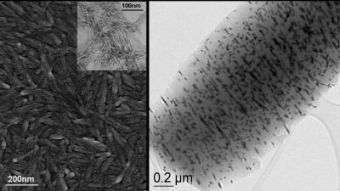
Left, an electron micrograph (TEM) of a metal, in this case platinum, deposited on cellulose. Inset, crystalline cellulose without metal. Right, TEM showing the pattern of platinum clustering along hydroxyl sites on the cellulose surface. Credit: Pacific Northwest National Laboratory

Appropriating cellulose fibers from cotton and crystallizing them, scientists at Pacific Northwest National Laboratory have grown never-before-seen configurations of metal crystals that show promise as components in biosensors, biological imaging, drug delivery and catalytic converters.

Deriving the desired chemical and physical properties necessary for those applications hinges on the uniform size of the metal crystals. Depending on the metal, they must be between 2 and 200 nanometers, Yongsoon Shin, a staff scientist at the Department of Energy laboratory in Richland, Wash., reported Monday at the national meeting of the American Chemical Society. PNNL laboratory fellow Gregory Exarhos led the research.

Exarhos called Shin’s experimental work "the first report of the efficacy of nanocrystalline cellulose templates in driving the formation of ordered metal and metal oxide nanoparticles at surfaces." Exarhos has dubbed these cellulose nanocrystals "molecular factories."

Using acid-treated cellulose fibers from cotton as a natural template, the PNNL team has been able to grow gold, silver, palladium, platinum, copper, nickel and other metal and metal-oxide nanocrystals quickly and of uniform size, Shin said. The metals display catalytic, electrical and optical that would not be present in larger or odd-sized crystals.

The acid converts the cellulose to a large, stable crystallized molecule rich in oxygen-hydrogen, or hydroxyl, groups, predictably spaced along the long chemical chains, or polymers, that comprise the cellulose molecule’s backbone. When most metal salts dissolved in solution are added in a pressurized oven and heated 70 to 200 degrees centigrade or warmer for four to 16 hours, uniform metal crystals form at the hydroxyl sites.

The researchers called this method a "green process," requiring only heat, the crystalline cellulose and the metal salts. Other attempts to get uniform nanometals have resulted in crystals of widely variable sizes that require strong, caustic chemicals as reducing and stabilizing agents.

"We have some preliminary catalytic results," Shin said, involving "coupling reactions of organic molecules for palladium and UV-irradiated degradation of organic dyes in water with selenium metals. "Smaller particles—15 to 20 nanometers—showed faster and higher catalytic conversion ratio compared to commercial catalysts."

Source: Pacific Northwest National Laboratory


print this article email this article download pdf blog this article bookmark this article     Stumble it Digg this share on Facebook retweet share on Reddit add to delicious
Rate this story - 4.5 /5 (17 votes)


March 26, 2007 all stories

Comments: 0

4.5 /5 (17 votes)
  • Stumble this up

  • Digg this

  • share this

  • hide
  • Related Stories

  • Right first time: Pioneering new methods of drug manufacture
    created Nov 11, 2009 | popularity not rated yet | comments 0
  • Tiny technology may yield major finds -- and possible perils
    created Oct 13, 2009 | popularity not rated yet | comments 0
  • Atomic Wire with Protective Sheath: Stable Metal Nanowires One Atom Wide Inside Carbon Nanotubes
    created Oct 07, 2009 | popularity not rated yet | comments 0
  • Diamonds are a laser's best friend
    created Sep 18, 2009 | popularity not rated yet | comments 0
  • High-Res View of Zinc Transport Protein
    created Sep 13, 2009 | popularity not rated yet | comments 0


  • hide
  • Relevant PhysicsForums posts

  • Catalyst External and Internal Mass Transfer
    created 10 hours ago
  • Motorcycle
    created Nov 15, 2009
  • Black bodies
    created Nov 15, 2009
  • Evaporation of liquid-metal alloys
    created Nov 14, 2009
  • More from Physics Forums - Materials & Chemical Engineering

Other News

Nanoparticles used in common household items caused genetic damage in mice

Nanotechnology / Bio & Medicine

created 11 hours ago | popularity 4.6 / 5 (14) | comments 8

Titanium dioxide (TiO2) nanoparticles, found in everything from cosmetics to sunscreen to paint to vitamins, caused systemic genetic damage in mice, according to a comprehensive study conducted by researchers at UCLA's Jonsson ...


Freezing: a phenomenon that 'jumps'

Freezing: a phenomenon that 'jumps'

Nanotechnology / Nanomaterials

created 8 hours ago | popularity not rated yet | comments 0

(PhysOrg.com) -- The freezing of suspensions of particles is not always a uniform phenomenon; in certain conditions it leads to a modification of the redistribution of particles and the growth of crystals.


carbon fiber

Ultra-Long Carbon Nanotubes Could Serve as Future Transmission Lines

Nanotechnology / Nanomaterials

created Nov 10, 2009 | popularity 4.8 / 5 (25) | comments 14

(PhysOrg.com) -- When it comes to carbon nanotubes, the majority of research so far has focused on small-scale applications. But now, a team of researchers from Rice University has created carbon nanotubes ...


Researchers turn algae into high-temperature hydrogen source

Researchers turn algae into high-temperature hydrogen source

Nanotechnology / Nanophysics

created Nov 12, 2009 | popularity 3.6 / 5 (7) | comments 5

In the quest to make hydrogen as a clean alternative fuel source, researchers have been stymied about how to create usable hydrogen that is clean and sustainable without relying on an intensive, high-energy ...


Argonne 'homegrown' hybrid solar cell aims for low-cost power

Argonne 'homegrown' hybrid solar cell aims for low-cost power

Nanotechnology / Nanomaterials

created Nov 10, 2009 | popularity 4.2 / 5 (11) | comments 3

(PhysOrg.com) -- Scientists at the U.S. Department of Energy’s (DOE) Argonne National Laboratory have refined a technique to manufacture solar cells by creating tubes of semiconducting material and then "growing" ...