Researchers find a new way to read nanoscale vibrations
March 27, 2007
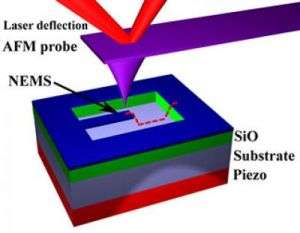
Schematic of the experimental setup. The probe of an atomic force microscope is suspended just above a vibrating cantilever. Electrostatic forces cause the probe to vibrate, and its vibration is measured by a laser beam. Credit: Craighead Research Group/Cornell
Nanomechanical oscillators -- tiny strips of vibrating silicon only a few hundred atoms thick -- are the subject of extensive study by nanotechnology researchers. They could someday replace bulky quartz crystals in electronic circuits or be used to detect and identify bacteria and viruses.
The catch is that measuring their vibrations isn't easy. It is usually done by bouncing laser beams off them -- which won't work when the nanodevices become smaller than the wavelength of the light -- or with piezoelectric devices -- those bulky quartz crystals we're trying to get rid of.
Now Cornell University researchers have come up with a very simple solution: reach out and touch them. The vibration of the tiny oscillators can be measured by "tapping" with an atomic force microscope (AFM).
An AFM uses a tiny probe that moves slowly just above a surface. Electrostatic attraction or repulsion between the atoms in the tip of the probe and those in the surface causes the probe to move up and down, creating an image of the surface so detailed that individual atoms show up as bumps. Alternatively, the AFM can be used in "tapping mode," literally bouncing off the surface.
"AFMs are all over the place," said Rob Ilic, research associate in the Cornell NanoScale Facility and lead author on a paper about the research published Feb. 23 in the online edition of the Journal of Applied Physics. "So this offers a simple way to study these structures." (Cornell, for example, has at least a dozen AFMs in various labs.) Moreover, he said, probes similar to those in an AFM can be built directly into nanofabricated devices.
This would amount to using MEMS to measure NEMS, he said. MEMS (microelectromechanical systems) are machines with moving parts measured in microns, or millionths of a meter; NEMS (nanoelectromechanical systems) are measured in nanometers, or billionths of a meter. A nanometer is about the length of three atoms in a row. When the NEMS oscillator is too small to be observed by laser light, it could still be coupled to a MEMS probe that in turn would be large enough for a laser readout.
To measure the vibration of a nanomechanical oscillator, the AFM probe moves along the length of the oscillating rod. The result is a complex bouncing interaction between the probe and the oscillator -- imagine shaking one end of a spring and watching the vibrations at the other end -- from which the frequency of vibration of the oscillator can be determined mathematically.
For the experiments just reported, Ilic and colleagues manufactured a wide variety of silicon cantilevers -- strips of silicon attached at one end with the other free to vibrate -- from 5 to 12 microns long, 1/2 to 1 micron wide and about 250 nanometers thick, which had natural vibration frequencies from 1 to 15 Mhz. The cantilevers were set into vibration by a piezoelectric device.
The experimenters first measured the resonant frequencies of the cantilevers by focusing laser beams on them and observing deflection of the reflected light, then scanned each cantilever with the AFM probe, both in tapping mode and with the probe just above the surface. They found the AFM measurements in good agreement with laser measurements, although the AFM readouts had a somewhat lower "quality factor," because the oscillator and probe were interacting. This would make the method somewhat less precise in mass detection.
Nanomechanical oscillators are often cited as potential tools for detecting bacteria, viruses or other organic molecules. An array of tiny cantilevers might be created with antibodies to many different pathogens attached to them. An experimental solution could then be washed over the array, allowing microbes to bind to the cantilevers with matching antibodies. Since the cantilevers are so tiny, an attached bacterium or virus represents a significant change in mass, which changes the frequency at which the oscillator will vibrate.
In a practical device, a MEMS probe could be mounted above each NEMS oscillator to read out which oscillators in the array show a change in frequency -- and thus identify which pathogens are present.
Source: Cornell University
-
Progress and promise in DIAL LIDAR
Feb 06, 2012 |
5 / 5 (4) |
0
-
Cassini testing part of its radio system
Jan 13, 2012 |
5 / 5 (4) |
0
-
Bright future for gaN nanowires
Nov 29, 2011 |
4.8 / 5 (4) |
0
-
Researchers ink nanostructures with tiny 'soldering iron'
Nov 07, 2011 |
4.8 / 5 (4) |
0
-
The quest for the tiny carbon nanotube
Oct 31, 2011 |
5 / 5 (1) |
0
-
Engineers build first sub-10-nm carbon nanotube transistor
Feb 01, 2012 |
4.9 / 5 (31) |
30
-
Something old, something new: Evolution and the structural divergence of duplicate genes
Jan 31, 2012 |
4.6 / 5 (7) |
1
-
The hidden nanoworld of ice crystals: Revealing the dynamic behavior of quasi-liquid layers
Jan 30, 2012 |
5 / 5 (3) |
1
-
Stock market network reveals investor clustering
Jan 27, 2012 |
3.9 / 5 (23) |
8
-
Of microchemistry and molecules: Electronic microfluidic device synthesizes biocompatible probes
Jan 26, 2012 |
5 / 5 (1) |
0
-
Understanding induced emfs
1 hour ago
-
What is the precise definition of a year?
2 hours ago
-
Universe as a cellular automaton
3 hours ago
-
Question about Newton's laws
4 hours ago
-
Gravity Question (I think) with mass and speed
7 hours ago
-
Can you manipulate any formula in Physics?
7 hours ago
- More from Physics Forums - General Physics
More news stories
New kind of solar cell could capture significantly more energy than current cells
New solar cells could increase the maximum efficiency of solar panels by over 25%, according to scientists from the University of Cambridge.
Feb 08, 2012 |
4.5 / 5 (12) |
14
|
Nanoshell whispering galleries improve thin solar panels
Visitors to Statuary Hall in the U.S. Capitol Building may have experienced a curious acoustic feature that allows a person to whisper softly at one side of the cavernous, half-domed room and for another on ...
Nanotechnology / Nanomaterials
Feb 07, 2012 |
4.3 / 5 (6) |
6
|
'Dark plasmons' transmit energy
Microscopic channels of gold nanoparticles have the ability to transmit electromagnetic energy that starts as light and propagates via "dark plasmons," according to researchers at Rice University.
Feb 09, 2012 |
4.8 / 5 (9) |
1
|
Revealing how a battery material works
Since its discovery 15 years ago, lithium iron phosphate (LiFePO4) has become one of the most promising materials for rechargeable batteries because of its stability, durability, safety and ability to deliver ...
Nanotechnology / Nanomaterials
Feb 08, 2012 |
5 / 5 (5) |
0
|
Nanotube therapy takes aim at breast cancer stem cells
Wake Forest Baptist Medical Center researchers have again proven that injecting multiwalled carbon nanotubes (MWCNTs) into tumors and heating them with a quick, 30-second laser treatment can kill them.
Nanotechnology / Bio & Medicine
Feb 09, 2012 |
5 / 5 (1) |
0
|
Walney offshore wind farm is world's biggest (for now)
(PhysOrg.com) -- The Walney wind farm on the Irish Sea--characterized by high tides, waves and windy weather--officially opened this week. The farm is treated in the press as a very big deal as the Walney ...
GPS court ruling leaves US phone tracking unclear
A US Supreme Court decision requiring a warrant to place a GPS device on the car of a criminal suspect leaves unresolved the bigger issue of police tracking using mobile phones, legal experts say.
Europeans protest controversial Internet pact
Tens of thousands of people marched in protests in more than a dozen European cities Saturday against a controversial anti-online piracy pact that critics say could curtail Internet freedom.
Europe stakes billion-dollar bet on new rocket
A pencil-slim rocket is scheduled to lift into space from South America on Monday, carrying a billion-dollar bet that Europe can grab a juicy slice of the market to place satellites in low orbit.
Study finds that anti-diabetic medication can prevent the long-term effects of maternal obesity
In a study to be presented today at the Society for Maternal-Fetal Medicine's annual meeting, The Pregnancy Meeting, in Dallas, Texas, researchers will report findings that show that short therapy with the anti-diabetic medication ...
Netflix settlement trims 14 pct off 4Q earnings
(AP) -- Netflix pressed the rewind button on its fourth-quarter earnings after settling allegations that the video subscription service violated a consumer-privacy law.