'Smart' sunglasses feature lenses that change color on demand
March 27, 2007 'Smart' sunglasses feature lenses that change color on demand

Enlarge

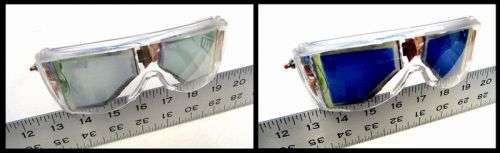
"Smart" sunglasses can be adjusted so the lenses block from 55 percent (left) to 95 percent (right) of the incoming rays. Credit: Chunye Xu, University of Washington

Get ready for the coolest, most colorful shades on the planet: Chemists at the University of Washington in Seattle say they are developing ‘smart’ sunglasses that will allow the wearer to instantly change the color of their lenses to virtually any hue of the rainbow.

Whether you like your lenses clear, red, green, blue or purple, virtually any color could be obtained instantly by tuning a tiny electronic knob in the frame, the researchers say. Their study was described today at the 233rd national meeting of the American Chemical Society.

“Through polymer chemistry, we’ve developed lenses that aren’t like anything else on the market. This could be the fashion statement of the future,” says Chunye Xu, Sc.D., a chemical engineer at the University of Washington and associate director of the University’s Center for Intelligent Materials and Systems (C.I.M.S.).

The lenses of the ‘smart’ sunglasses feature a unique type of electrochromic polymer that has the ability to change levels of darkness and color in the presence of an electric current. Researchers have been developing electrochromic polymers for decades, but Xu’s lab is one of just a few using the technology to develop improved eyewear.

Xu has developed a prototype of the eyewear that demonstrates the feasibility of these color-changing sunglasses. Powered by a tiny battery, the prototype shades currently resemble a pair of laboratory goggles with a button attached to the frame. Turning the button activates the battery and dials up the desired color, the researcher says. Ultimately, the sunglasses can be manufactured to resemble the size and shape of regular sunglasses and should cost about the same, according to Xu.

In laboratory demonstrations, Xu has shown the lenses can switch from transparent to blue, plus various shades in between, at the flip of a switch. “We are working on a multicolored device as well, but no prototype is available yet,” she says.

As the glasses require power only during switching, the device saves energy and prolongs battery life. Like regular sunglasses, they also can be coated with a protective layer to block ultraviolet light.

Fashion-conscience shoppers will have to wait a little while for this latest thing in eyewear: A practical version of the ‘smart’ sunglasses won’t be available to consumers for another one to two years, says Xu, whose lab has filed several patents related to the color-changing glasses. More testing is needed, she notes.

So far, Xu and her associates have produced the electrochromic polymers in red, blue and green. By combining the polymers of different colors into multiple layers and supplying different levels of current from the batteries in the sunglasses, a wide variety of different colors can be produced in the lenses, Xu says. Funding for the study was provided by the University of Washington.

Source: American Chemical Society


print this article email this article download pdf blog this article bookmark this article     Stumble it Digg this share on Facebook retweet share on Reddit add to delicious
Rate this story - 4 /5 (29 votes)


March 27, 2007 all stories

Comments: 0

4 /5 (29 votes)
  • Stumble this up

  • Digg this

  • share this

  • hide
  • Related Stories

  • Presto! Fast color-changing material may lead to more powerful computers (w/Video)
    created Apr 23, 2009 | popularity not rated yet | comments 0
  • MP3 Sunglasses
    created Dec 12, 2004 | popularity not rated yet | comments 0
  • Clinical trials of spray-on skin to start in US
    created 5 hours ago | popularity not rated yet | comments 0
  • Shade myths: How to really stay safe
    created Aug 21, 2009 | popularity not rated yet | comments 0
  • The Medical Minute: Melanoma - The dark side of the sun
    created May 27, 2009 | popularity not rated yet | comments 0


Other News

A sticky solution for identifying effective probiotics

Chemistry / Biochemistry

created 3 hours ago | popularity 5 / 5 (1) | comments 0

Scientists have crystallised a protein that may help gut bacteria bind to the gastrointestinal tract. The protein could be used by probiotic producers to identify strains that are likely to be of real benefit to people.


Sandia CR5

Machine Converts CO2 into Gasoline, Diesel, and Jet Fuel

Chemistry / Biochemistry

created Nov 23, 2009 | popularity 4.6 / 5 (28) | comments 18

(PhysOrg.com) -- Researchers at Sandia National Laboratories have built a machine that uses the sun's energy to convert carbon dioxide waste from power plants into transportation fuels such as gasoline, diesel, ...


New hydrogen-storage method discovered

New hydrogen-storage method discovered

Chemistry / Materials Science

created Nov 22, 2009 | popularity 4.3 / 5 (41) | comments 14

Scientists at the Carnegie Institution have found for the first time that high pressure can be used to make a unique hydrogen-storage material. The discovery paves the way for an entirely new way to approach ...


Accidental discovery produces durable new blue pigment for multiple applications

Accidental discovery produces durable new blue pigment for multiple applications

Chemistry / Biochemistry

created Nov 16, 2009 | popularity 4.5 / 5 (32) | comments 6

An accidental discovery in a laboratory at Oregon State University has apparently solved a quest that over thousands of years has absorbed the energies of ancient Egyptians, the Han dynasty in China, Mayan ...


Rescuing male turkey chicks

Chemistry / Biochemistry

created 22 hours ago | popularity not rated yet | comments 0

A novel approach to classify the gender of six-week-old turkey poults could save millions of male chicks from being killed shortly after birth, according to Dr. Gerald Steiner from the Dresden University of Technology in ...