3-D Medical Imaging Reaches the Stars
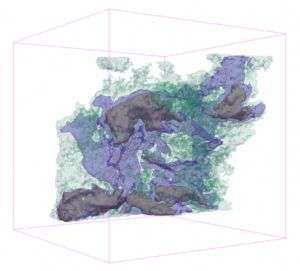
A unique collaboration created by Harvard's Initiative for Innovative Computing (IIC) has brought together astronomers, medical imaging specialists, and software engineers to adapt medical imaging software to create 3-D views of astronomical bodies.
"Once this technology is fully developed, we will be able to explore and visualize space in entirely new ways," said Alyssa Goodman, Director of the IIC and a Professor of Astronomy in Harvard's Faculty of Arts and Sciences.
Goodman discussed results from the IIC's Astronomical Medicine Project, or AstroMed, last week at the IIC's Inaugural Symposium in Cambridge, Mass.
AstroMed typifies the work of the IIC, bringing together computer scientists and their colleagues in other disciplines to develop new approaches to scientific problem-solving - in this case, solving problems common to both astronomy and medicine, particularly the visualization and analysis of large, complex data sets.
In pursuit of that goal, AstroMed researchers are working to modify existing medical imaging programs for use in astronomical research. The revised programs can generate 3-D views of cosmic structures, just as physicians generate 3-D views of anatomical structures.
Astronomical and medical research are more alike than they might seem. Astronomers and medical researchers often rely on quantitative analysis of imaging data for insight. Astronomers may be looking for nuggets of star-forming material buried in interstellar matter while doctors are looking for tumors hidden inside a brain, but the steps in their investigations are extraordinarily similar.
Until recently, researchers would have needed a powerful supercomputer to create 3-D visualizations like those of AstroMed. Now, such visualizations can be done on a laptop with Open Source programs such as "3D Slicer" and "OsiriX."
3D Slicer allows users to interact with data. Not only can a 3-D object be created - it can be rotated, zoomed and cropped using a set of intuitive tools. In astronomy, "3-D" doesn't always mean three spatial dimensions. By combining the 2-D position of gas emission mapped out on the sky with 1-D measurements of the gas's velocity along the line of sight, astronomers generate 3-D data sets with dimensions that can serve as proxies for three spatial dimensions. Using programs like 3D Slicer and OsiriX on these virtual 3-D constructions, astronomers can become virtual spacefarers, easily selecting "distances" and viewing angles in order to navigate around a gas cloud and study it from "all sides."
"Right now, this software is a tool for scientists. We are blazing a trail in the field of 3-D astronomical computer graphics," explained Michael Halle, AstroMed Project Manager. "As we refine our capabilities, we hope to develop a tool that researchers in a variety of fields reliant on 3-D data will use on everyday computers."
Initially, the AstroMed team has focused on studying dusty gas clouds in the Milky Way that are forming new stars. The team is working to analyze data from the COMPLETE survey of star-forming regions, which has collected extensive infrared and radio measurements of several star-forming complexes. Already, their work on the Perseus region has identified several previously unknown large bubbles and shells of gas, as well as more than a dozen new jets of material shooting from newborn stars.
Goodman added that while medical advances currently are helping the astronomical community, in the future, astronomers' innovations in extending and improving this software will help the medical community. "The algorithms that we develop to identify star-forming clumps in a dusty gas cloud might be used to identify possible tumors in a person's body," she explained.
The revised software also may prove useful to other data-intensive branches of science like weather modeling and geophysics.
The software and techniques developed by the IIC will contribute to the revolutionary astronomy project known as the Virtual Observatory. The Virtual Observatory will link all the world's astronomy data together, giving people around the world easy access to data from many different telescopes and observatories, at all wavelengths of the electromagnetic spectrum.
More information about AstroMed is available online at astromed.iic.harvard.edu.
The team at Harvard includes: astronomer Goodman, Dr. Michael Halle, a principal at the Surgical Planning Laboratory of Brigham and Women's Hospital and the AstroMed Project Manager at IIC; Dr. Jens Kauffman, a postdoctoral fellow at the Harvard-Smithsonian Center for Astrophysics and IIC; Michelle Borkin, Harvard College '06, now an IIC Research Associate; and Douglas Alan, an IIC Senior Software Engineer. In addition, the team is working with Dr. Nick Holliman of the University of Durham's Visualization Laboratory in the U.K. on enhancing AstroMed images using stereoscopic (3-D) displays.
The Initiative in Innovative Computing (IIC) accelerates the pace of science by fostering collaborations that span traditional academic boundaries, bringing together computer scientist and scientists in other disciplines to develop solutions to problems and develop ideas and inventions along the continuum from basic science to scientific computation to computational science to computer science.
Source: Harvard-Smithsonian Center for Astrophysics


