Harnessing new frequencies: Far infrared can be used faster wireless
Modern technology uses many frequencies of electromagnetic radiation for communication, including radio waves, TV signals, microwaves and visible light. Now, a University of Utah study shows how far-infrared light – the last unexploited part of the electromagnetic spectrum – could be harnessed to build much faster wireless communications and to detect concealed explosives and biological weapons.
"We found a way to manipulate a form of infrared radiation that is not now used for communications so that, in the future, it may be possible to use it for high-speed, short-range communication between computers and other devices," says Ajay Nahata, an associate professor of electrical and computer engineering.
The study in the March 29, 2007, issue of the journal Nature also shows the feasibility of building devices that emit and detect specific frequencies of far-infrared light – also known as terahertz radiation – to spot chemical or biological warfare agents such as anthrax bacteria and to make images of packages or people to find concealed weapons and plastic explosives, Nahata adds.
The new study was conducted by Nahata and principal author Z. Valy Vardeny, a distinguished professor of physics at the University of Utah, along with Tatsunosuke Matsui, a postdoctoral researcher in physics, and Amit Agrawal, a doctoral student in electrical and computer engineering.
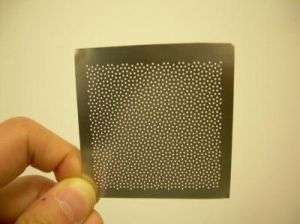
To visualize their discovery, imagine shining a flashlight through a kitchen colander, and that holes make up 20 percent of the colander's surface. Only 20 percent of the light will pass through the colander. But when the Utah researchers shined far-infrared radiation through holes punched in a thin steel foil or film, almost all of the radiation passed through the film if the holes were arranged in semi-regular patterns known as "quasicrystals" or "quasicrystal approximates."
(Crystals have repeating patterns over a short distance, such as the ordered pattern of carbon atoms in diamond. Quasicrystals have less structure, but display a pattern over a larger area. Quasicrystal approximates – a term coined by Vardeny and Nahata – also have patterns, but less so than quasicrystals. Crystals, quasicrystals and approximates all can bend or break up light or other electromagnetic waves.)
Until now, such efficient transmission of far-infrared light was achieved only when crystal patterns were used, but unwanted frequencies also were transmitted. In the new study, the researchers could select the wavelength of far-infrared light transmitted through the holes and, by tilting the films, they could switch the transmission on and off.
That shows high-frequency terahertz signals can be switched on and off to carry data in the digital code of ones and zeroes, and that it someday may be possible to build superfast switches to carry terahertz data at terahertz speeds. That is 1,000 times faster than gigahertz fiber optic lines that carry data as near-infrared and visible light, and 10,000 times faster than microwaves that carry cordless and cell phone conversations.
Talking with Terahertz: An Unexploited Part of the Spectrum
The spectrum of electromagnetic radiation ranges from short to long wavelengths (or from high to low frequency): gamma rays, X-rays, ultraviolet rays, visible light (violet, blue, green, yellow, orange and red), infrared rays (including radiant heat), microwaves, FM radio waves, television, short wave and AM radio.
Near-infrared radiation and some visible light now are used for fiber optic phone and data lines. But terahertz or far-infrared radiation – on the spectrum between microwaves and mid-infrared radiation – is not now used for communication.
"Terahertz is a new region of the spectrum for communications" because the rest of the spectrum is crowded with communication and broadcasting signals, says Nahata.
Vardeny adds: "Industry is starving for more electromagnetic frequencies," yet terahertz frequencies are unexplored. They are too high for electronics and there are technical obstacles in generating, manipulating and detecting terahertz radiation.
For electromagnetic radiation to transmit data, the signal must be turned on and off to rapidly create the binary code of ones and zeroes. Modern optical and electronic switches cannot do that fast enough to handle signals with terahertz frequencies (1,000 billion waves per second), but can handle gigahertz signals (1 billion waves per second).
No one has built terahertz switches, but Nahata says the new study shows it is possible to use terahertz radiation to carry data and thus may be possible to create terahertz-speed switches for superfast wireless communication over short distances, such as between a cellular phone and headsets, a wireless mouse and a computer, and a PDA (personal digital assistant) and a computer.
Terahertz against Terror
The study was funded as part of a three-year, $250,000 grant from the U.S. Army Research Office and by $100,000 from the Synergy program, operated by the University of Utah's vice president for research to promote interdisciplinary research.
Nahata says terahertz technology has two main uses for homeland security:
-- "Vibrational spectroscopy" uses emitters and detectors of terahertz radiation to detect materials – such as anthrax or other biological or chemical weapons – that resonate at a terahertz frequency when exposed to far-infrared light. Early terahertz devices emit numerous frequencies. The new study shows perforated films can serve as filters so future terahertz devices can use desired frequencies to zero in on specific chemical or biological weapons or concealed guns and explosives.
-- Another method uses a terahertz emitter and a camera. "Since plastics and clothing are transparent to terahertz wavelengths, metal reflects terahertz, and certain chemicals – such as plastic explosives – strongly absorb terahertz radiation at specific frequencies, this approach is being pursued for package inspection and whole-body imaging to look for concealed weapons or explosives," Nahata says. (Recently publicized scanners use X-rays or microwaves. But scanners using terahertz radiation should lack the risk of X-rays and be more precise than microwave scanners, he adds.)
How the Study was Conducted
Normally, any frequency of electromagnetic radiation or light cannot pass through holes smaller than the radiation's wavelength. A cook can see food in a microwave oven because visible light waves are smaller than the holes in the oven door's grating. But microwaves, with wavelengths larger than the holes, cannot escape to injure the cook.
The study used stainless steel film about three-quarters the thickness of a human hair. Different patterns of holes were punched in the film. The holes were one-quarter to one-half millimeter in diameter (about one-hundredth to one-fiftieth of an inch). That is smaller than the roughly 1-millimeter wavelength of far-infrared light.
Study co-author Agrawal used a computer to design patterns of holes that he expected would allow "resonance" or "anomalous transmission," meaning all the far-infrared light passes through the holes in the metal films. The researchers projected terahertz or far-infrared light onto the metal films with punched patterns. They found certain frequencies of the far-infrared radiation were completely transmitted through the films with crystal, quasicrystal and quasicrystal-approximate patterns – even though the terahertz radiation has wavelengths larger than the holes.
Vardeny says such efficient transmission occurs because the far-infrared light not only goes through the holes, but also moves electrons in the metal film, generating "surface plasma waves" that launch all the far-infrared radiation through the holes.
Source: University of Utah


