Space Data Unveils Evidence of Ancient Mega-lake in Northern Darfur
March 28, 2007
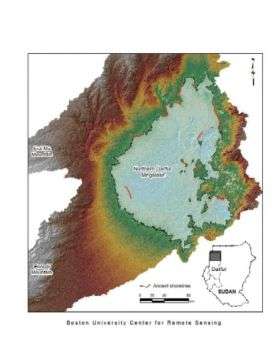
Researchers at the Boston University Center for Remote Sensing used recently acquired topographic data from satellites to reveal a now dry, ancient mega-lake in the Darfur province of northwestern Sudan. Drs. Eman Ghoneim and Farouk El-Baz made the finding while investigating Landsat images and Radarsat data. Radar waves are able to penetrate the fine-grained sand cover in the hot and dry eastern Sahara to reveal buried features.
Segments of the lake’s shoreline were identified at the constant altitude of 573 ± 3 meters above sea level. Ghoneim incorporated these segments with the Shuttle Radar Topography Mission (SRTM) data into a Geographical Information System to reconstruct the lake and the ancient river courses that led to it. At its maximum extent, the lake occupied an area of about 30,750 km2 (larger than the area of Massachusetts) and would have contained approximately 2,530 km3 when full of water in the past.
The researchers made no inferences regarding the age of the lake; however, its vast extent suggests that it existed for a long period of time when rainfall was plentiful in the eastern Sahara.
“Field investigations and samples will determine the exact age of the lake,” said El-Baz, director of the Boston University Center for Remote Sensing. “One thing is certain – much of the lake’s water would have seeped through the sandstone substrate to accumulate as groundwater.”
“This ancient lake, which represents indisputable evidence of the past rainy conditions in the eastern Sahara, will have significant consequences for improving our knowledge of continental climate change and regional palaeohydrology,” said Ghoneim.
According to the researchers, mapping the site of the former lake, named the Northern Darfur Mega-lake, will help with groundwater exploration efforts in the Darfur region, where access to fresh water is essential for refugee survival.
As proven by El-Baz in Egypt, just north of Darfur, former lakes in this part of the Sahara are underlain by vast amounts of groundwater. His earlier detection of the “East Uweinat” basin in southwestern Egypt – where the groundwater rises to 25 meters below the surface – resulted in the drilling of 500 wells to irrigate 100,000 acres of agricultural land.
“Such large sedimentary basins have potential not only in groundwater resources, but also oil and gas resources at depth,” said El-Baz.
A paper detailing the discovery will be published in an upcoming issue of the International Journal of Remote Sensing.
The Boston University Center for Remote Sensing is a research facility that was established in 1986. Researchers at the Center apply techniques of remote sensing and geographic information systems (GIS) to research in the fields of archaeology, geography and geology. In 1997, the Center was recognized by NASA as a “Center of Excellence in Remote Sensing.”
Founded in 1839, Boston University is an internationally recognized institution of higher education and research. With more than 30,000 students, it is the fourth largest independent university in the United States. BU contains 17 colleges and schools along with a number of multi-disciplinary centers and institutes, which are central to the school’s research and teaching mission.
Source: Boston University
-
Carbon storage in tropical vegetation: New map to help developing nations track deforestation, report on emissions
Jan 29, 2012 |
5 / 5 (7) |
0
-
Loch fossils show life harnessed sun and sex early on
Apr 13, 2011 |
4.8 / 5 (5) |
0
-
Fungus sweeps across the country, killing bats
Apr 07, 2011 |
5 / 5 (1) |
1
-
Study finds simple interventions reduce newborn deaths in Africa
Feb 03, 2011 |
not rated yet |
0
-
Artesunate suppositories are cost-effective intervention for severe childhood malaria
Nov 30, 2010 |
not rated yet |
0
-
Engineers build first sub-10-nm carbon nanotube transistor
Feb 01, 2012 |
4.9 / 5 (30) |
30
-
Something old, something new: Evolution and the structural divergence of duplicate genes
Jan 31, 2012 |
4.6 / 5 (7) |
1
-
The hidden nanoworld of ice crystals: Revealing the dynamic behavior of quasi-liquid layers
Jan 30, 2012 |
5 / 5 (3) |
1
-
Stock market network reveals investor clustering
Jan 27, 2012 |
3.9 / 5 (23) |
8
-
Of microchemistry and molecules: Electronic microfluidic device synthesizes biocompatible probes
Jan 26, 2012 |
5 / 5 (1) |
0
-
where gems are found in the world
3 hours ago
-
Wind Waves in Reservoir ~ Wind run-up and Wind set-up
Feb 08, 2012
-
Balance of oxygen in the atmosphere
Feb 01, 2012
-
The case for a methanol-based economy
Jan 30, 2012
-
Weather in a rotating cylinder
Jan 25, 2012
-
Importance of difference between SVP over ice and water?
Jan 19, 2012
- More from Physics Forums - Earth
More news stories
Deconstructing a mystery: What caused Snowmaggedon?
In the quiet after the storms, streets and cars had all but disappeared under piles of snow. The U.S. Postal Service suspended service for the first time in 30 years. Snow plows struggled to push the evidence ...
Space & Earth / Earth Sciences
5 hours ago |
4.7 / 5 (3) |
1
|
Researchers create 3-D laser maps that show how earthquake changes landscape
Geologists have a new tool to study how earthquakes change the landscape down to a few inches, and it's giving them insight into how earthquake faults behave. In the Feb. 10 issue of the journal Science, a team ...
Space & Earth / Earth Sciences
7 hours ago |
5 / 5 (4) |
0
|
NASA's TRMM satellite sees Cyclone Jasmine in 3-D
Data from NASA's TRMM satellite was used to create a 3-Dimensional look at Cyclone Jasmine, currently moving through the South Pacific Ocean.
Space & Earth / Earth Sciences
4 hours ago |
not rated yet |
0
Ocean microbe communities changing, but long-term environmental impact is unclear
As oceans warm due to climate change, water layers will mix less and affect the microbes and plankton that pump carbon out of the atmosphere but researchers say it's still unclear whether these processes ...
Space & Earth / Earth Sciences
7 hours ago |
not rated yet |
0
|
New views show old NASA Mars landers
(PhysOrg.com) -- The High Resolution Imaging Science Experiment (HiRISE) camera on NASA's Mars Reconnaissance Orbiter recorded a scene on Jan. 29, 2012, that includes the first color image from orbit showing ...
Space & Earth / Space Exploration
13 hours ago |
4.9 / 5 (7) |
5
|
'Dark plasmons' transmit energy
Microscopic channels of gold nanoparticles have the ability to transmit electromagnetic energy that starts as light and propagates via "dark plasmons," according to researchers at Rice University.
Ultraviolet protection molecule in plants yields its secrets
Lying around in the sun all day is hazardous not just for humans but also for plants, which have no means of escape. Ultraviolet (UV) radiation from the sun can damage proteins and DNA inside cells, leading ...
Hydrogen from acidic water: Researchers develop potential low cost alternative to platinum for splitting water
A technique for creating a new molecule that structurally and chemically replicates the active part of the widely used industrial catalyst molybdenite has been developed by researchers with the Lawrence Berkeley ...
FDA-approved drug rapidly clears amyloid from the brain, reverses Alzheimer's symptoms in mice
Neuroscientists at Case Western Reserve University School of Medicine have made a dramatic breakthrough in their efforts to find a cure for Alzheimer's disease. The researchers' findings, published in the journal Science, show t ...
Anyone can learn to be more inventive, cognitive researcher says
There will always be a wild and unpredictable quality to creativity and invention, says Anthony McCaffrey, a cognitive psychology researcher at the University of Massachusetts Amherst, because an "Aha moment" is rare and ...
New method makes culture of complex tissue possible in any lab
Scientists at the University of California, San Diego have developed a new method for making scaffolds for culturing tissue in three-dimensional arrangements that mimic those in the body. This advance, published online in ...