Warm winter also in the Arctic
March 29, 2007
Warm winter also in the Arctic

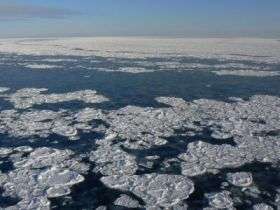
Thin ice cover at Storfjord, Spitsbergen, in March 2007. Credit: Christoph Lüpkes, Alfred Wegener Institute

Central Europe is not the only place where the past, warm winter has caused record temperatures. Unusually mild temperatures also prevented ice formation in the Arctic, specifically in the region around Spitsbergen. This is the conclusion drawn by scientists of the Alfred Wegener Institute for Polar and Marine Research and the German Aerospace Centre (DLR).

Both institutes are members of the Helmholtz Association of German research centres. They aim to span the Helmholtz-network to observe environmental changes. Measurement activities of the recent expedition were part of the project ICESAR, and accomplished in collaboration with the European Space Agency (ESA).

Arctic sea ice plays an important role in climate change. The decline of average sea ice cover, observed over the past years, means that sea ice reflects progressively less solar energy back into space, causing temperatures in the Arctic to rise further. Usually, large areas of Spitsbergen are surrounded by ice at the end of the winter, and the fjords are frozen. “This year, our aircraft had to fly all the way to the limits of their range in order to collect sufficient data above the sea ice”, explains Dr Jörg Hartmann, climate scientist at the Alfred Wegener Institute. The recently published UN climate report highlights warming of the Arctic as one of the four key issues in relation to global climate change.

The goals of ICESAR include improvements of sea ice observations facilitated by satellite radar, as well as better predictions for weather and climate models. The research campaign provided data for the technical alignment of ESA satellite Sentinel 1, because one of its radar systems will take up observation of Arctic ice cover in 2011.

The research aircraft Polar 2, operated by the Alfred Wegener Institute, is equipped with various meteorological instruments and camera systems. During a recording flight, Polar 2 travels at low altitude while, simultaneously, another research aircraft of the DLR covers the same trajectory three kilometres higher, surveying the ice with an imaging radar system. The data collected by this method will provide the basis for a procedure using satellite images for ice data assembly.

Source: Alfred Wegener Institute for Polar and Marine Research

4.3 /5 (4 votes)  

Rank 4.3 /5 (4 votes)
Tags

Relevant PhysicsForums posts
  • Do some geologists actually act a lot like Randy Marsh?
    created14 hours ago
  • Discrepancy between oxygen and carbon-dioxide levels
    createdFeb 09, 2012
  • where gems are found in the world
    createdFeb 09, 2012
  • Wind Waves in Reservoir ~ Wind run-up and Wind set-up
    createdFeb 08, 2012
  • Balance of oxygen in the atmosphere
    createdFeb 01, 2012
  • The case for a methanol-based economy
    createdJan 30, 2012
  • More from Physics Forums - Earth

More news stories

Europe stakes billion-dollar bet on new rocket

A pencil-slim rocket is scheduled to lift into space from South America on Monday, carrying a billion-dollar bet that Europe can grab a juicy slice of the market to place satellites in low orbit.

Space & Earth / Space Exploration

created 12 hours ago | popularity 3.5 / 5 (2) | comments 0

Political leaders play key role in how worried Americans are by climate change: study

More than extreme weather events and the work of scientists, it is national political leaders who influence how much Americans worry about the threat of climate change, new research finds.

Space & Earth / Environment

created Feb 06, 2012 | popularity 5 / 5 (6) | comments 72

NASA budget will axe Mars deal with Europe: scientists

US President Barack Obama's budget proposal to be submitted next week for 2013 will cut NASA's budget by 20 percent and eliminate a major partnership with Europe on Mars exploration, scientists said Thursday.

Space & Earth / Space Exploration

created Feb 10, 2012 | popularity 5 / 5 (3) | comments 47

Humans may have helped the decline of African rainforests 3000 years ago

(PhysOrg.com) -- Large areas of rainforests in Central Africa mysteriously disappeared over three thousand years ago, to be replaced by savannas. The prevailing theory has been that the cause was a change ...

Space & Earth / Environment

created Feb 10, 2012 | popularity 4.1 / 5 (14) | comments 18 | with audio podcast report

Could Venus be shifting gear?

(PhysOrg.com) -- ESA’s Venus Express spacecraft has discovered that our cloud-covered neighbour spins a little slower than previously measured. Peering through the dense atmosphere in the infrared, the ...

Space & Earth / Space Exploration

created Feb 10, 2012 | popularity 5 / 5 (8) | comments 10 | with audio podcast


Walney offshore wind farm is world's biggest (for now)

(PhysOrg.com) -- The Walney wind farm on the Irish Sea--characterized by high tides, waves and windy weather--officially opened this week. The farm is treated in the press as a very big deal as the Walney ...

GPS court ruling leaves US phone tracking unclear

A US Supreme Court decision requiring a warrant to place a GPS device on the car of a criminal suspect leaves unresolved the bigger issue of police tracking using mobile phones, legal experts say.

Europeans protest controversial Internet pact

Tens of thousands of people marched in protests in more than a dozen European cities Saturday against a controversial anti-online piracy pact that critics say could curtail Internet freedom.

Study finds that anti-diabetic medication can prevent the long-term effects of maternal obesity

In a study to be presented today at the Society for Maternal-Fetal Medicine's annual meeting, The Pregnancy Meeting, in Dallas, Texas, researchers will report findings that show that short therapy with the anti-diabetic medication ...

Netflix settlement trims 14 pct off 4Q earnings

(AP) -- Netflix pressed the rewind button on its fourth-quarter earnings after settling allegations that the video subscription service violated a consumer-privacy law.

Steroid injections prove effective in treatment of lumbar disc herniations

The use of epidural steroid injections may be a more efficient treatment option for lumbar disc herniations, according to research presented today at the American Orthopaedic Society for Sports Medicine's Specialty Day in ...