Researchers identify critical receptor in liver regeneration
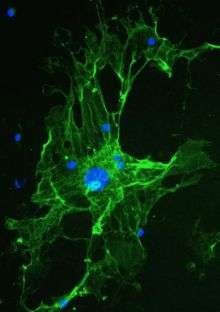
March 29, 2007 A Hepatic Stellate Cell

A hepatic stellate cell activated by the p75 Neurotrophin Receptor promotes repair in the liver.

In studies in mouse models, researchers at the University of California, San Diego (UCSD) School of Medicine have found that a cellular receptor involved in triggering cell death is also a necessary component of tissue repair and regeneration immediately following liver injury. This discovery could have implications for early intervention or therapy in liver disease such as cirrhosis or hepatitis.

In a report to be published in the March 30 issue of the journal Science, Katerina Akassoglou, Ph.D. assistant professor in UCSD's Department of Pharmacology, and colleagues describe the mechanism by which cells associated with liver damage, called hepatic stellate cells (HSCs), are activated by a cell surface molecule called the p75 neurotrophin receptor (p75NTR) to promote repair in the liver.

"Many therapeutics for liver disease target HSCs in order to kill them, but our study in animal models found that their initial activity could actually be protective," said Akassoglou.

When chronic liver injury occurs, cells in the liver begin producing collagen and other proteins that lead to the formation of fibrous tissue and scarring. Akassoglou's team looked at the molecular-cellular interface to discover how tissues respond to deposition of the fibrous protein, fibrin. In studies of a mouse model with excessive fibrin deposition in the liver, the researchers found that p75NTR signaling promotes the initial activation of HSC, which stimulates the proliferation of new hepatic cells to replace those that have been damaged. The effects of p75NTR at late stages of HSC activation and liver disease remain to be determined.

"We were intrigued by the increase of p75NTR expression after liver injury and hypothesized that p75NTR might regulate the progression of liver disease," said Akassoglou. "By identifying p75NTR as the specific molecular link between HSCs and liver regeneration, p75NTR could provide a new therapeutic target for promoting cell regeneration and repair during chronic liver disease or injury."

This discovery suggests the importance of sustaining p75 and early HSC activation – for example, in the case of liver transplantation when regeneration of liver cells is critical.

Source: University of California - San Diego


print this article email this article download pdf blog this article bookmark this article     Stumble it Digg this share on Facebook retweet share on Reddit add to delicious
Rate this story - 4.8 /5 (4 votes)


March 29, 2007 all stories

Comments: 0

4.8 /5 (4 votes)
  • Stumble this up

  • Digg this

  • share this

  • hide
  • Related Stories


  • hide
  • Relevant PhysicsForums posts

  • Swine flu vaccination
    created Nov 10, 2009
  • Improving the brain through chemistry
    created Nov 07, 2009
  • Sleep / REM Sleep and homeostasis
    created Nov 07, 2009
  • The Biceps Reflex
    created Nov 05, 2009
  • More from Physics Forums - Medical Sciences

Other News

New mechanism explains how the body prevents formation of blood vessels

Medicine & Health / Cancer

created 31 minutes ago | popularity not rated yet | comments 0

Researchers at Uppsala University, in collaboration with colleagues in Sweden and abroad, have identified an entirely new mechanism by which a specific protein in the body inhibits formation of new blood vessels. Inhibiting ...


GSK swine flu drug approved in US: company

Medicine & Health / Medications

created 51 minutes ago | popularity not rated yet | comments 0

British drug maker GlaxoSmithKline has announced that US regulators have approved its swine flu vaccine for adults in the United States.


Researchers mobilizing global resources to test new treatments for severe H1N1 infection

Medicine & Health / Diseases

created 31 minutes ago | popularity not rated yet | comments 0

An important, ground-breaking initiative is unfolding in the global critical care community in response to the H1N1 pandemic.


When seconds count: Interventional radiology treatment for pulmonary embolism saves lives

Medicine & Health / Research

created 41 minutes ago | popularity not rated yet | comments 0

Catheter-directed therapy or catheter-directed thrombolysis -- an interventional radiology treatment that uses targeted image-guided drug delivery with specially designed catheters to dissolve dangerous blood clots in the ...


Researchers find a weak link in cancer cell armor

Medicine & Health / Cancer

created 1hour ago | popularity 5 / 5 (2) | comments 0

(PhysOrg.com) -- Professor Robert Weiss has found that when two particular genes are inhibited, cancer cells are destroyed at a greater rate. The study is published in the Nov. 9 issue of PNAS.