Chandra Sheds Light on Galaxy Collision
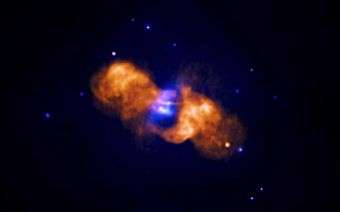
March 29, 2007 Chandra Sheds Light on Galaxy Collision

Image credit: X-ray: NASA/CXC/Univ. of Bristol/Worral et al.; Radio: NRAO/AUI/NSF

Astronomers think that there are enormous black holes at the centers of most, if not all, galaxies. These black holes, which can be millions or even billions of times more massive than the Sun, can greatly affect the galaxy and the environments around them.

One way such black holes shape their surroundings is by generating powerful jets of high-energy particles. The jets, which are bright in radio waves, have been seen to push around the hot gas that envelopes the galaxy. When this happens, astronomers can detect huge cavities and powerful shock fronts in the hot, X-ray emitting gas.

However, the opposite scenario is apparently unfolding in the galaxy known as 3C442A. X-ray data from NASA's Chandra X-ray Observatory and radio observations from the NSF's Very Large Array show that the hot gas (blue) in the middle of 3C442A is pushing apart the radio-bright gas (orange). The inner sections of the radio structure are sharp and concave, which is consistent with the idea that the X-ray bright gas is sweeping the radio-emitting gas aside. This is the first convincing evidence for such a role reversal.

A team of scientists, led by Diana Worrall of University of Bristol, UK, has studied this system and determined why the dynamics in 3C442A seem to be topsy-turvy. First, there are two galaxies near the middle of 3C442A which are in the process of merging. These two galaxies are on their second pass toward a collision, having already experienced a close encounter. The energy generated from this impending merger is heating the combined atmospheres from these two galaxies, causing them to shine brightly in X-rays and expand.

The researchers determined that the jets that had produced the lobes of radio-emitting gas are no longer active. The jets may have ceased at the time of, and possibly as a result of, the galaxy collision. Since the radio-emitting gas no longer has a power source, it is then at the mercy of the expanding hot gas and has been pushed aside.

Source: NASA


print this article email this article download pdf blog this article bookmark this article     Stumble it Digg this share on Facebook retweet share on Reddit add to delicious
Rate this story - 4.1 /5 (19 votes)


March 29, 2007 all stories

Comments: 0

4.1 /5 (19 votes)
  • Stumble this up

  • Digg this

  • share this

  • hide
  • Related Stories

  • Fermi Telescope Detects Gamma-Ray From 'Star Factories' in Other Galaxies
    created Nov 02, 2009 | popularity not rated yet | comments 0
  • X-Ray Jets from Galaxies
    created Oct 19, 2009 | popularity not rated yet | comments 0
  • Black Hole Pumps Iron
    created Sep 14, 2009 | popularity not rated yet | comments 0
  • Chandra X-Ray Observatory Turns Ten
    created Aug 20, 2009 | popularity not rated yet | comments 0
  • Seeing the Cosmos Through 'Warm' Infrared Eyes
    created Aug 05, 2009 | popularity not rated yet | comments 0


  • hide
  • Relevant PhysicsForums posts

Other News

2 Earth-sized bodies with oxygen rich atmospheres found -- but they're stars not planets

Two Earth-sized bodies with oxygen rich atmospheres found -- but they're stars not planets

Space & Earth / Astronomy

created 5 hours ago | popularity 4.8 / 5 (6) | comments 1

(PhysOrg.com) -- Astrophysicists at the University of Warwick and Kiel University have discovered two earth sized bodies with oxygen rich atmospheres - however there is a bit of a disappointing snag for anyone ...


Research gives new insights into 4 billion year-old meteorites

Research gives new insights into 4 billion year-old meteorites

Space & Earth / Astronomy

created 3 hours ago | popularity not rated yet | comments 0

(PhysOrg.com) -- Scientists have gained new insight into the makeup of ancient meteorites called Carbonaceous Chondrites, in research published in the October edition of the journal Earth Science and Planetary Le ...


Discoveries in the Deep

Discoveries in the Deep

Space & Earth / Earth Sciences

created 1hour ago | popularity not rated yet | comments 0

Scientists from NASA and the Canadian Space Agency have been using Pavilion Lake as a testing ground for the future human exploration of other worlds.


NASA to Begin Attempts to Free Sand-Trapped Mars Rover

NASA to Begin Attempts to Free Sand-Trapped Mars Rover

Space & Earth / Space Exploration

created 3 hours ago | popularity not rated yet | comments 0

(PhysOrg.com) -- NASA will begin transmitting commands to its Mars exploration rover Spirit on Monday as part of an escape plan to free the venerable robot from its Martian sand trap.


Brazil: Deforestation sees biggest drop in 20 yrs (AP)

Brazil: Deforestation sees biggest drop in 20 yrs

Space & Earth / Environment

created 1hour ago | popularity not rated yet | comments 0

(AP) -- Deforestation in the Brazilian Amazon dropped nearly 46 percent from August 2008 to July 2009 - the biggest annual decline in two decades, the government said Thursday.