Scientists Derive First Bottom-Up Determination of Air-Sea Momentum Transfer Under a Major Hurricane
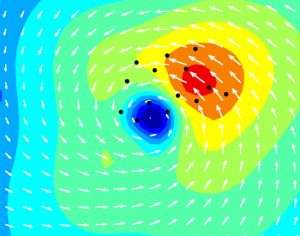
Scientists at the Naval Research Laboratory - Stennis Space Center (NRL-SSC) have directly derived the air-sea momentum exchange at the ocean interface using observed ocean currents under Hurricane Ivan and determined that it decreases when winds exceed 32 meters per second.
This is the first time that momentum exchange at the air-sea interface has been directly calculated from ocean current observations under extreme winds generated by a major tropical cyclone. The complete findings of this study titled "Bottom-up Determination of Air-Sea Momentum Exchange Under a Major Tropical Cyclone," are published in the March 23, 2007 issue of Science.
Proper evaluation of the air-sea exchange under extreme winds is of great importance for modeling and forecasting used in hurricane studies, such as in forecasting of storm track and intensity, surges, waves, and currents, particularly since our coasts have become so heavily populated. These results should be of widespread interest to the public, oceanographers, atmospheric scientists, numerical modelers, oil and gas concerns, commerce, and government agencies, explains William Teague of NRL. This research has a direct impact on storm surge modeling. Many models have been estimating the air-sea momentum exchange by assuming that it increases as the wind speed increases. But the NRL research definitely shows that this is not the case. This research will lead to a better estimation of the air-sea momentum exchange which will improve both ocean circulation and storm surge models.
During NRL's Slope to Shelf Energetics and Exchange Dynamics (SEED) field experiment, six current profiler moorings were deployed on the continental shelf at water depths ranging between 60 and 90 meters just west of the DeSoto Canyon, about 100 miles south of Mobile Bay, Alabama. Eight moorings were also deployed down the slope, but not used in this study. Fortuitously, early on September 16, the eye of Hurricane Ivan passed directly over the array of moorings. Historically, instruments moored in the ocean do not even survive such powerful storms, much less direct hits. Fortunately, all of the SEED moorings survived this powerful storm, and provided the best ocean measurements of currents and waves ever obtained directly under a major hurricane.
Past studies have attempted to determine the air-sea momentum exchange from the atmospheric side of the air-sea interface ("top-down determination") using limited, difficult to interpret meteorological observations and/or models developed for the atmospheric boundary layer. For instance, drop sondes launched from airplanes during hurricanes have been used to measure wind profiles and to estimate air-sea momentum transfer. These wind analyses suggest that the air-sea momentum transfer decreases at high wind speeds, not increases as previously thought.
No attempt has been made to determine this momentum transfer independently based on ocean observations until now. The initial forced oceanic response to Hurricane Ivan on the continental shelf consisted of a strong barotropic flow and a much weaker baroclinic component. This response was governed to the first order by the linear time-dependent depth-integrated momentum balance. Such behavior of the currents allowed a direct estimation of air-sea momentum exchange for winds greater than 20 meters per second.
NRL's direct derivation of the air-sea momentum exchange using unique ocean current profiles measured directly under Hurricane Ivan confirms the trend suggested by studies based on meteorological measurements and models developed for the atmospheric boundary layer. NRL researchers found that the exchange decreases when hurricane winds exceed 32 meters per second. These findings are compared with the atmospheric-based work using the drag coefficient. The wind stress at the sea surface, which was directly calculated from current measurements, is related to the square of the wind speed times the drag coefficient. NRL researchers were able to determine good estimates of the drag coefficient with error bounds for high winds up to 48 meters per second.
Source: Naval Research Laboratory


