Tesla Roadster: Test Driving Your Electric Dream Car
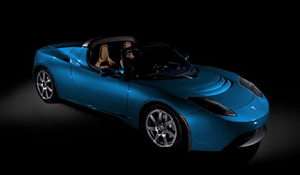
We take a ride in the Tesla Roadster, a 100-percent electric car inspired by PC technology. Due on the market this fall for under $100K, the Roadster does zero to 60 in 4 seconds.
Dear PC Magazine reader: I just took a ride in your dream car. If there was ever a vehicle whose design was inspired by PC technology, it's the Tesla Roadster, a 100-percent electric car under development at a 170-person startup just south of San Francisco.
Due on the market this fall, at a price of $92,000, the Tesla is powered by the same lithium-ion battery cells that drive the average laptop or smartphone, and you can charge it from an ordinary wall socket. There's even a grate under the rear fender where the car expels hot air, just like the typical desktop PC.
Several prototypes are already assembled, and last night, I was invited down to the company's Silicon Valley offices for a spin down the freeway. No, I didn't get to drive. Each prototype was built at a cost of over a million dollars, and only the lucky few covered by the company insurance policy are permitted behind the wheel. But I did get the rush of sitting in the passenger seat of this Lotus-like two-door convertible. And what a rush it is!
Equipped with an AC induction motor that's no larger than a watermelon, it does zero to 60 in about 4 seconds. But it's not just the acceleration that amazes. It's the way this car accelerates. Unlike a gasoline-powered car, which has very little torque at low RPMs, the Tesla reaches 100 percent torque from the instant it starts forward. You don't wait even a moment for that acceleration to kick in. It kicks in immediately. The effect is like nothing you've ever experienced.
And that's not the half of it. Even as it reaches the performance of leading sports cars, emissions are non-existent - when I say 100 percent electric, I mean 100 percent electric - and according to the company, the car gets the equivalent of 135 miles to the gallon. Translation: If you charge your car at night, during off-peak hours, when it makes the most sense to charge it, you're paying as little as one cent per mile.
The Tesla has yet to be independently tested - the final version doesn't roll off the assembly line until the fall - and what you may save powering the car is certainly offset by the initial $92,000 price tag. But it's hard not to admire the Tesla simply as a feat of engineering.
The car's 900-pound battery, or Energy Storage System, includes 6,831 lithium-ion cells, each about the size of a double-A alkaline. Plugged into an ordinary wall socket, it charges in about 7 hours. But if you use a specially designed in-home charging unit, which the company plans to include with the car at no extra cost, you can charge up in under four hours. A full-charge gets you 250 miles of driving on the open road (the company has yet to test stop-and-go performance).
We get hands-on with V2V, GM's new car-to-car safety network.
According to Phil Luk, the Tesla engineer who hand-built each prototype, the battery is equipped with 13 separate processors that monitor everything from voltage and temperature to smoke levels. To maintain appropriate temperatures inside the battery, the car includes both radiator heating and a liquid-cooling system. And that wasn't a joke: The cooling vents in the rear of the car work much like the cooling vents on an ordinary desktop PC.
The AC motor weighs a mere 70 pounds, and there are no more than two moving parts. It sits in the rear of the car, along with the battery and the cooling system. Under the hood, you'll find only the radiator and an air conditioning unit (the one used to cool the passengers).
The entire package is monitored and controlled by an onboard computer known as the PEM (Power Electronics Module), also situated in the rear of the car. The Linux-based PEM controls and monitors everything from the speed and rotation of the motor to braking and battery charging. From a digital display just under the steering wheel, you can monitor performance stats on your own. You can even see if someone has recently opened the trunk. Like I said: This is your dream car.
Copyright 2007 by Ziff Davis Media, Distributed by United Press International


