Neuroscientists find different brain regions fuel attention
March 30, 2007
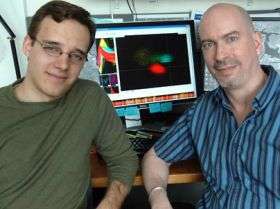
MIT graduate student Timothy J. Buschman, left, and Professor Earl Miller of the Department of Brain and Cognitive Sciences have found concrete evidence that two radically different brain regions play different roles in the different modes of attention. Credit: Donna Coveney
If you spotted an anaconda poised to strike, the signal to pay attention would originate in a different part of your brain than if you gazed at an anaconda in the zoo, neuroscientists at MIT's Picower Institute for Learning and Memory report in the March 30 issue of Science.
The work, which could have implications for treating attention deficit disorder (ADD), is the first concrete evidence that two radically different brain regions--the prefrontal cortex and the parietal cortex--play different roles in these different modes of attention.
What's more, when you focus your attention, the electrical activity in these two brain areas synchronizes and oscillates at different frequencies. "It's as if the brain is using two different stops on the FM radio dial for different types of attention," said study co-author Earl K. Miller, Picower Professor of Neuroscience.
Top to bottom
Brain signals related to the knowledge we have acquired about the world are called top-down. Signals related to incoming sensory information are called bottom-up.
"Loud, flashy things like fire alarms automatically grab our attention," Miller said. "By contrast, we choose to pay attention to certain things we think are important. We found two different modes of brain operation related to each, and they seem to originate in different parts of the brain. Further, the automatic (or bottom-up) versus willful (top-down) modes of attention seem to rely on two different frequency channels in the brain, suggesting that the brain might communicate in different frequency bands for different types of signals."
ADD involves being overly sensitive to the automatic attention-grabbers and less able to willfully sustain attention. "Our work suggests that we should target different parts of the brain to try to fix different types of attention deficits," Miller said.
"The downside of most psychiatic drugs is they are too broad," he continued. "It's like hitting the problem with a sledgehammer; you get the benefits but also many unintended consequences. Our work suggests that we may one day be able to figure out what is the exact problem with each individual and specifically target those shortcomings. And that is the ultimate goal in psychiatric intervention."
To address the fact that neural activity from the prefrontal and parietal cortices had never been directly compared, Miller and co-author Timothy J. Buschman, an MIT graduate student in the Department of Brain and Cognitive Sciences, conducted a series of experiments in which monkeys were engaged in different kinds of tasks. The researchers looked at activity in two areas of their brains simultaneously--the prefrontal cortex, also called the brain's executive because it is in charge of voluntary behavior, and the parietal cortex, which integrates sensory information coming from various parts of the body.
The monkeys had to pick out rectangles of certain colors and orientations on a video screen. Some of the rectangles popped out at them like the anaconda in the forest; others they had to search for.
The results support the idea that when something pops out at us, sensory cortical areas like the parietal cortex directs our eyes toward the stimulus. When we purposefully look for something, the prefrontal cortex is doing the driving.
"Taken together, these data suggest two modes of operation: When a stimulus pops out, a bottom-up, fast target selection occurs first in the posterior visual cortex; while in search mode, a top-down, longer latency target selection is reflected first in the prefrontal cortex," Miller said. "To our knowledge, these are the first direct demonstrations that these areas may have different contributions to these different modes of attention."
Source: MIT
-
A new study shows how to boost the power of pain relief, without drugs
Feb 03, 2012 |
4 / 5 (2) |
0
-
Gene mutation in autism found to cause hyperconnectivity in brain's hearing center
Jan 31, 2012 |
5 / 5 (2) |
0
-
Mouse brains keyed to speed
Jan 25, 2012 |
5 / 5 (3) |
0
-
A family history of alcoholism may make adolescent brains respond differently
Jan 16, 2012 |
not rated yet |
0
-
A decade of research proves PET effectively detects dementia
Jan 06, 2012 |
5 / 5 (1) |
0
-
Engineers build first sub-10-nm carbon nanotube transistor
Feb 01, 2012 |
4.9 / 5 (31) |
30
-
Something old, something new: Evolution and the structural divergence of duplicate genes
Jan 31, 2012 |
4.6 / 5 (7) |
1
-
The hidden nanoworld of ice crystals: Revealing the dynamic behavior of quasi-liquid layers
Jan 30, 2012 |
5 / 5 (3) |
1
-
Stock market network reveals investor clustering
Jan 27, 2012 |
3.9 / 5 (23) |
8
-
Of microchemistry and molecules: Electronic microfluidic device synthesizes biocompatible probes
Jan 26, 2012 |
5 / 5 (1) |
0
-
Is Everyday Technology Killing Us?
Feb 08, 2012
-
Exercise and weight loss
Feb 08, 2012
-
Why do we have head aches? Our brains can't feel anything.
Feb 07, 2012
-
"The end of diseases" by David Agus, interview from Daily Show with Jon Stewart
Feb 04, 2012
-
Oncolytic adenovirus
Feb 04, 2012
-
Nutrition label stuffs and diets
Feb 02, 2012
- More from Physics Forums - Medical Sciences
More news stories
Study finds that anti-diabetic medication can prevent the long-term effects of maternal obesity
In a study to be presented today at the Society for Maternal-Fetal Medicine's annual meeting, The Pregnancy Meeting, in Dallas, Texas, researchers will report findings that show that short therapy with the anti-diabetic medication ...
9 hours ago |
5 / 5 (1) |
1
Steroid injections prove effective in treatment of lumbar disc herniations
The use of epidural steroid injections may be a more efficient treatment option for lumbar disc herniations, according to research presented today at the American Orthopaedic Society for Sports Medicine's Specialty Day in ...
9 hours ago |
not rated yet |
0
Amateur football players not always keen on returning to play after ACL injuries
Despite the known success rates of reconstructive Anterior Cruciate Ligament (ACL) surgery, the number of high school and collegiate football players returning to play may not be as high as anticipated, say researchers presenting ...
9 hours ago |
not rated yet |
0
Study finds elevated levels of cell-free DNA in first trimester do not predict preeclampsia
In a study to be presented today at the Society for Maternal-Fetal Medicine's annual meeting, The Pregnancy Meeting, in Dallas, Texas, researchers will report findings that indicate that elevated levels of cell-free DNA in ...
9 hours ago |
not rated yet |
0
PRP treatment aids healing of elbow injuries say researchers
As elbow injuries continue to rise, especially in pitchers, procedures to help treat and get players back in the game quickly have been difficult to come by. However, a newer treatment called platelet rich plasma (PRP) may ...
9 hours ago |
5 / 5 (1) |
0
Walney offshore wind farm is world's biggest (for now)
(PhysOrg.com) -- The Walney wind farm on the Irish Sea--characterized by high tides, waves and windy weather--officially opened this week. The farm is treated in the press as a very big deal as the Walney ...
Europeans protest controversial Internet pact
Tens of thousands of people marched in protests in more than a dozen European cities Saturday against a controversial anti-online piracy pact that critics say could curtail Internet freedom.
GPS court ruling leaves US phone tracking unclear
A US Supreme Court decision requiring a warrant to place a GPS device on the car of a criminal suspect leaves unresolved the bigger issue of police tracking using mobile phones, legal experts say.
Europe stakes billion-dollar bet on new rocket
A pencil-slim rocket is scheduled to lift into space from South America on Monday, carrying a billion-dollar bet that Europe can grab a juicy slice of the market to place satellites in low orbit.
Netflix settlement trims 14 pct off 4Q earnings
(AP) -- Netflix pressed the rewind button on its fourth-quarter earnings after settling allegations that the video subscription service violated a consumer-privacy law.
Elbow position not a predictor of injury
Elbow position alone appeared to not affect injury rates and performance in college-level, male pitchers say researchers presenting at the American Orthopaedic Society for Sports Medicine's Specialty Day in San Francisco, ...