Titanium dioxide -- It slices, it dices ...
March 30, 2007 Titanium dioxide -- It slices, it dices ...

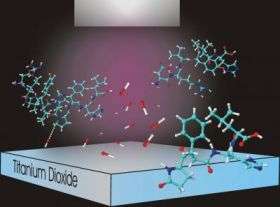
Illustration of the cleavage of proteins near a titanium dioxide surface: when illuminated with ultraviolet light, hydroxyl radicals are formed in water near the semiconductor's surface and cut proteins at the location of the amino acid proline. Credit: NIST

Chemists from the National Institute of Standards and Technology and Arizona State University have proposed an elegantly simple technique for cleaving proteins into convenient pieces for analysis. The prototype sample preparation method, detailed recently in Analytical Chemistry, uses ultraviolet light and titanium dioxide and could be ideal for new microfluidic “lab-on-a-chip” devices designed to rapidly analyze minute amount of biological samples.

Because most proteins are very large, complex molecules made up of hundreds or thousands of amino acids, they usually must be cut up into more manageable pieces for analysis. Today, this most commonly is done by using special enzymes called “proteases” that sever the chains at well-known locations. The protease trypsin, for example, cuts proteins at the locations of the amino acids lysine and arginine.

Analyzing the residual fragments can identify the original protein. But enzymes are notoriously fussy, demanding fairly tight control of temperature and acidity, and the enzymatic cutting process can be time-consuming, from a matter of hours to days.

For a “radically” different approach, the NIST group turned to a semiconductor material, titanium dioxide. Titanium dioxide is a photocatalyst—when exposed to ultraviolet light its surface becomes highly oxidizing, converting nearby water molecules into hydroxyl radicals, a short-lived, highly reactive chemical species. In the NIST experiments, titanium dioxide coatings were applied to a variety of typical microanalysis devices, including microfluidic channels and silica beads in a microflow reactor. Shining a strong UV light on the area, in the presence of a protein solution, creates a small “cleavage zone” of hydroxyl radicals that rapidly cut nearby proteins at the locations of the amino acid proline.

Although development work remains to be done, according to the researchers, the NIST photocatalysis technique offers several advantages over conventional enzyme cleavage of proteins. It’s not particularly sensitive to temperature or acidity, and needs no additional reagents other than dissolved oxygen in the solution. It’s a simple arrangement, easy to incorporate into a wide range of instruments and devices, and titanium dioxide, an inorganic material, will last virtually forever in a broad range of conditions—enzymes have to be treated carefully and stored in temperature-controlled environments. The target amino acid, proline, is relatively sparse in most proteins, but it’s found at key locations, such as sharp turns in the molecule, that aid analysis. And it’s fast—in trials with the protein angiotensin I, the team obtained detectable cleavage patterns in as little as 10 seconds.

Citation: B.J. Jones, M.J. Vergne, D.M. Bunk, L.E. Locascio and M.A. Hayes. Cleavage of peptides and proteins using light-generated radicals from titanium dioxide. Anal. Chem. 2007, 79, 1327-1332.

Source: National Institute of Standards and Technology


print this article email this article download pdf blog this article bookmark this article     Stumble it Digg this share on Facebook retweet share on Reddit add to delicious
Rate this story - 4.3 /5 (10 votes)


March 30, 2007 all stories

Comments: 0

4.3 /5 (10 votes)
  • Stumble this up

  • Digg this

  • share this

  • hide
  • Related Stories

  • When particles are so small that they seep right through skin
    created Sep 30, 2008 | popularity not rated yet | comments 0
  • Researchers 'hammer' proteins
    created Apr 17, 2007 | popularity not rated yet | comments 0
  • Electrons 'in limbo' seen for first time
    created Mar 15, 2006 | popularity not rated yet | comments 0
  • Nano-interfaces with cells
    created Jan 04, 2006 | popularity not rated yet | comments 0
  • Nanotechnology's miniature answers to developing world's biggest problems
    created Apr 12, 2005 | popularity not rated yet | comments 0


Other News

H1N1 Virus Can Be Killed by Acidic Ozone Water

H1N1 Virus Can Be Killed by Acidic Ozone Water

Chemistry / Biochemistry

created 5 hours ago | popularity 5 / 5 (9) | comments 5

(PhysOrg.com) -- Scientists have found that acidic ozone water can deactivate H1N1 viruses very effectively, offering a promising disinfectant for the millions of people trying to avoid the disease. Acidic ...


Wet ethanol production process yields more ethanol and more co-products

Chemistry / Biochemistry

created 3 hours ago | popularity not rated yet | comments 1

Using a wet ethanol production method that begins by soaking corn kernels rather than grinding them, results in more gallons of ethanol and more usable co-products, giving ethanol producers a bigger bang for their buck - ...


Look ma, no mercury in fillings!

Chemistry / Materials Science

created 4 hours ago | popularity 5 / 5 (1) | comments 0

Tooth enamel is hardest material in the human body because it's made almost entirely of minerals. As tough as it may be, however, enamel can be broken down by bacteria, forming cavities and eventually destroying the tooth. ...


Toward home-brewed electricity with 'personalized solar energy'

Toward home-brewed electricity with 'personalized solar energy'

Chemistry / Materials Science

created Nov 04, 2009 | popularity 3.4 / 5 (9) | comments 4

New scientific discoveries are moving society toward the era of "personalized solar energy," in which the focus of electricity production shifts from huge central generating stations to individuals in their ...


Scientists Reproduce a Building Block of Life in Laboratory

Scientists Reproduce a Building Block of Life in Laboratory

Chemistry / Biochemistry

created Nov 06, 2009 | popularity 4.8 / 5 (25) | comments 1

(PhysOrg.com) -- NASA scientists studying the origin of life have reproduced uracil, a key component of our hereditary material, in the laboratory.