Traces of nanobubbles determine nano-boiling
March 30, 2007 Traces of nanobubbles determine nano-boiling

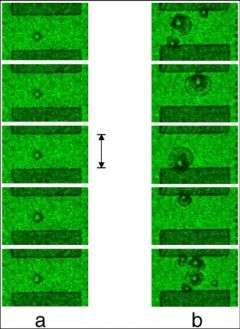
Ultra-highspeed photographs of microbubbles forming on a microheater show the effect of residual nanobubbles between heating pulses. The first pulse of a two-pulse sequence (a) produces nearly identical microbubbles time after time, but the second pulse (b) produces a random assortment of bubbles of varying sizes. Vertical bar shows a distance of 15 micrometers. Credit: NIST

Using a microscope and some extreme “snapshot” photography with shutter speeds only a few nanoseconds long, researchers from the National Institute of Standards and Technology and Cornell University have uncovered the traces of ephemeral “nanobubbles” formed in boiling water on a microheater. Their observations suggest an added complexity to the everyday phenomenon of boiling, and may affect technologies as diverse as inkjet printers and some proposed cancer therapies.

You might think that the science of boiling had been worked out some time ago, but it still has some mysteries, particularly at the nanometer scale. As water and other fluids change from their liquid state to a vapor, bubbles of the vapor form. The bubbles usually form at “nucleation sites,” which can be small surface irregularities on the container or tiny suspended particles in the fluid. The exact onset of boiling depends on the presence and nature of these sites.

To observe the process, the NIST/Cornell team used a unique ultrafast laser strobe microscopy technique with an effective shutter speed of eight nanoseconds to photograph bubbles growing on a microheater surface about 15 micrometers wide. At this scale, a voltage pulse of only five microseconds superheats the water to nearly 300 °C, creating a microbubble tens of microns in diameter. When the pulse ends, the microbubble collapses as the water cools.

What the team found was that if a second voltage pulse follows closely enough, the second microbubble forms earlier during the pulse and at a lower temperature apparently, as conjectured by the team, because nanobubbles formed by the collapse of the first bubble become new nucleation sites for the growth of later bubbles. The nanobubbles themselves are too small to observe, but by changing the timing between voltage pulses and observing how long it takes the second microbubble to form, the researchers were able to estimate the lifetime of the nanobubbles—roughly 100 microseconds.

These experiments are believed to be the first evidence that nanoscale bubbles can form on hydrophilic surfaces (previous evidence of nanobubbles was found only for hydrophobic surfaces like oilcloth) and the method for measuring nanobubble lifetimes may improve models for optimal heat transfer design in nanostructures. The work has immediate implications for inkjet printing, in which a metal film is heated with a voltage pulse to create a bubble that is used to eject a droplet of ink through a nozzle. If inkjet printing is pushed to higher speeds (repetition rates above about 10 kilohertz), the work suggests, nanobubbles on the heater surface between pulses will make it difficult or impossible to control bubble formation properly.

The findings also may impact proposed thermal cancer therapies in which nanoscale objects are designed to accumulate in tumors and are subsequently heated remotely by infrared radiation or alternating magnetic fields. Each particle acts as a nanoscale heater, with nanobubbles being created if the applied radiation is sufficient. The bubbles may have a therapeutic effect through additional heat delivered and mechanical stresses they may impart to the surrounding tissue.

Citation: R. E. Cavicchi and C.T. Avedisian. Bubble nucleation and growth anomaly for a hydrophilic microheater attributed to metastable nanobubbles. Phys. Rev. Lett. 98, 124501 (2007).

Source: National Institute of Standards and Technology


print this article email this article download pdf blog this article bookmark this article     Stumble it Digg this share on Facebook retweet share on Reddit add to delicious
Rate this story - 4.8 /5 (13 votes)


March 30, 2007 all stories

Comments: 0

4.8 /5 (13 votes)
  • Stumble this up

  • Digg this

  • share this

  • hide
  • Related Stories

  • Mysterious nanobubble burst?
    created Dec 02, 2008 | popularity not rated yet | comments 0
  • Blowing bubbles on a nanoscale
    created Oct 14, 2008 | popularity not rated yet | comments 0
  • New nano technique significantly boosts boiling efficiency
    created Jun 26, 2008 | popularity not rated yet | comments 0
  • Nanobubbles Deliver Targeted Cancer Drugs Using Ultrasound
    created Jul 11, 2007 | popularity not rated yet | comments 0
  • Nanobubbles exist, and are more stable than previously thought
    created Apr 02, 2007 | popularity not rated yet | comments 0


  • hide
  • Relevant PhysicsForums posts

  • Work done on femur
    created 3 hours ago
  • Magnet and Motors?
    created 3 hours ago
  • Effect of Volume on Revolution
    created 4 hours ago
  • Hydrostatic pressure
    created 6 hours ago
  • More from Physics Forums - General Physics

Other News

Findings show nanomedicine promising for treating spinal cord injuries

Findings show nanomedicine promising for treating spinal cord injuries

Nanotechnology / Bio & Medicine

created 6 hours ago | popularity 5 / 5 (1) | comments 0

(PhysOrg.com) -- Researchers at Purdue University have discovered a new approach for repairing damaged nerve fibers in spinal cord injuries using nano-spheres that could be injected into the blood shortly ...


New Digital 'Electronics' Concept May Continue Moore's Law

New Digital 'Electronics' Concept May Continue Moore's Law

Nanotechnology / Nanophysics

created Nov 05, 2009 | popularity 4.6 / 5 (53) | comments 9

(PhysOrg.com) -- Computers of the future could be operating not on electrons, but on tiny waves traveling through an electron "fluid," if a new proposal is successful. The new circuit design, recently introduced ...


Nanoparticles for gene therapy improve

Nanoparticles for gene therapy improve

Nanotechnology / Bio & Medicine

created Nov 06, 2009 | popularity 5 / 5 (4) | comments 3

(PhysOrg.com) -- About five years ago, Professor Janet Sawicki at the Lankenau Institute in Pennsylvania read an article about nanoparticles developed by MIT's Robert Langer for gene therapy, the insertion ...


Breakthrough in industrial-scale nanotube processing

Breakthrough in industrial-scale nanotube processing

Nanotechnology / Nanomaterials

created Nov 02, 2009 | popularity 4.9 / 5 (20) | comments 3

(PhysOrg.com) -- Rice University scientists today unveiled a method for the industrial-scale processing of pure carbon-nanotube fibers that could lead to revolutionary advances in materials science, power ...


Scientists witness nature's complexity unfold in self-assembling quasicrystals

Scientists witness nature's complexity unfold in self-assembling quasicrystals

Nanotechnology / Nanomaterials

created Oct 31, 2009 | popularity 4.9 / 5 (16) | comments 3

(PhysOrg.com) -- Just a few decades ago, scientists believed that all ordered matter consists of self-repeating building blocks -- atoms, ions or molecules. In this view, the ordinary solids of everyday life ...