Cells selectively absorb short nanotubes
March 30, 2007 Cells selectively absorb short nanotubes

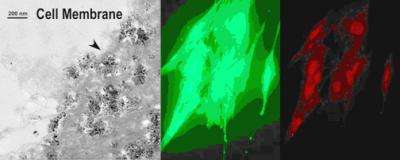
Nanotube length threshold: NIST experiments using human lung cells demonstrate that DNA-wrapped single-walled carbon nanotubes longer than about 200 nanometers are excluded from cells, while shorter lengths are able to penetrate the cell interior (dark lines in the fluorescence image above). Credit: NIST

DNA-wrapped single-walled carbon nanotubes (SWCNTs) shorter than about 200 nanometers readily enter into human lung cells and so may pose an increased risk to health, according to scientists at the National Institute of Standards and Technology. The results of their laboratory studies appear in an upcoming issue of Advanced Materials.

Eyed for uses ranging from electronic displays to fuel cells to water filtration, SWCNTs are tiny cylinders—essentially single-sheet rolls of carbon atoms. They are many times stronger than steel and possess superlative thermal, optical and electronic properties, but safety and biocompatibility remain an open question.

"Published data citing in vitro (outside the body) toxicity are particularly inconsistent and widely disputed," writes biomaterials scientist Matthew Becker and his NIST colleagues. Public concerns surrounding the environmental, health and safety impacts of SWCNTs could derail efforts to fast track the development of nanotubes for advanced technology applications. A significant hurdle in outlining the parameters contributing to nanotube toxicity is to prepare well-defined and characterized nanotube samples, as they typically contain a distribution of lengths, diameters, twists and impurities.

The team chose to isolate the effects of nanotube length. They first adsorbed short DNA molecules onto the nanotubes because this renders them soluble in water and allows them to be sorted and separated by length. The researchers then exposed human lung fibroblasts to solutions containing unsorted nanotubes. Regardless of the concentration levels, the cells did not absorb between about one-fourth and one-third of the SWCNTs in the solutions. Further examination of the results revealed that only short nanotubes made it into the cellular interior.

In the next phase of the research, the team exposed the cells to sorted nanotubes of controlled length. They found that tubes longer than about 200 nanometers were excluded from the cells and remained in solution. Cells exposed to the longer nanotube solutions did not undergo a decrease in metabolic activity, but cells exposed to nanotubes below that threshold absorbed them and, depending on the concentration level, died or showed other signs of toxicity. "Our results demonstrate that cellular uptake in these lung cells depends significantly on the length of the nanotubes," Becker explains. "This is the first of many steps in the critical goal of reducing health risk by de novo engineering of the nanotubes themselves."

Citation: M.L. Becker, J.A. Fagan, N.D. Gallant, B.J. Bauer, V. Bajpai, E.K. Hobbie, S.H. Lacerda, K. B. Migler and J.P. Jakupciak. Length-dependent uptake of DNA-wrapped single-walled carbon nanotubes. Advanced Materials, published on-line : 20 March 2007.

Source: National Institute of Standards and Technology


print this article email this article download pdf blog this article bookmark this article     Stumble it Digg this share on Facebook retweet share on Reddit add to delicious
Rate this story - 4.2 /5 (9 votes)


March 30, 2007 all stories

Comments: 0

4.2 /5 (9 votes)
  • Stumble this up

  • Digg this

  • share this

  • hide
  • Related Stories

  • Carbon nanotubes may cheaply harvest sunlight
    created Oct 19, 2009 | popularity not rated yet | comments 0
  • Chemistry Team Seeks to Use Artificial Photosynthesis and Nanotubes to Generate Hydrogen Fuel with Sunlight
    created Oct 14, 2009 | popularity not rated yet | comments 0
  • A recipe for controlling carbon nanotubes
    created Sep 20, 2009 | popularity not rated yet | comments 0
  • Nanotube risk assessment
    created Sep 18, 2009 | popularity not rated yet | comments 0
  • Carbon nanotubes could make efficient solar cells
    created Sep 10, 2009 | popularity not rated yet | comments 0


  • hide
  • Relevant PhysicsForums posts

Other News

Peptides control crystal growth with 'switches, throttles and brakes'

Peptides control crystal growth with 'switches, throttles and brakes'

Nanotechnology / Bio & Medicine

created 18 hours ago | popularity 5 / 5 (3) | comments 0

(PhysOrg.com) -- By producing some of the highest resolution images of peptides attaching to mineral surfaces, scientists have a deeper understanding how biomolecules manipulate the growth crystals. This research ...


Water droplets direct self-assembly process in thin-film materials

Nanotechnology / Nanomaterials

created 18 hours ago | popularity 5 / 5 (4) | comments 2

You can think of it as origami - very high-tech origami. Researchers at the University of Illinois have developed a technique for fabricating three-dimensional, single-crystalline silicon structures from thin films by coupling ...


Nanoparticles used in common household items caused genetic damage in mice

Nanotechnology / Bio & Medicine

created Nov 16, 2009 | popularity 4.8 / 5 (24) | comments 11

Titanium dioxide (TiO2) nanoparticles, found in everything from cosmetics to sunscreen to paint to vitamins, caused systemic genetic damage in mice, according to a comprehensive study conducted by researchers at UCLA's Jonsson ...


Nanotube defects equal better energy and storage systems

Nanotube defects equal better energy and storage systems

Nanotechnology / Nanomaterials

created Nov 19, 2009 | popularity 4.4 / 5 (10) | comments 2

(PhysOrg.com) -- Most people would like to be able to charge their cell phones and other personal electronics quickly and not too often. A recent discovery made by UC San Diego engineers could lead to carbon ...


Using superconducting probes to get a picture of what it's like inside CNTs

Nanotechnology / Nanophysics

created Nov 20, 2009 | popularity 4.4 / 5 (9) | comments 0

(PhysOrg.com) -- "Carbon nanotubes are exciting for fundamental physics, and for potential technological applications," Nadya Mason tells PhysOrg.com. "However, we are generally limited in the way that we can study them. ...