Right angles are all wrong for tree frog adhesion
April 2nd, 2007 Tree Frog

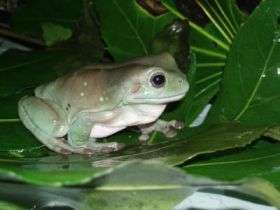
Tree frog. Credit: Julia Platter

Tree frogs have the unique ability to stick to smooth surfaces even when they are tilted well beyond the vertical - some small tree frogs can even adhere when completely upside down. Conversely when walking or jumping they can detach their toe pads easily. Researchers from the University of Glasgow will present insights into how this fascinating ability is controlled at the Society for Experimental Biology’s Annual Meeting in Glasgow, UK.

“The toe pads of tree frogs are coated with a thin mucus which adhere to surfaces by wet adhesion, like wet tissue paper sticking to glass. The process by which they detach their toe pads is called peeling and is akin to us removing a sticking plaster from ourselves,” explains Dr Jon Barnes, head of the research group, “We were keen to understand why a tree frog on an overhanging surface didn’t simply peel off rather than adhere.”

To investigate this, scientists measured adhesive and frictional forces simultaneously on individual toe pads of White’s tree frogs (Family Hylidae), while varying the surface angle. It was found that the change from adhesion to peeling is a gradual process, with adhesive forces weakening at angles above 90°. Thus frogs maintain a grip by keeping the angle of their toes with respect to a surface at a low value, and detach when this angle increases beyond 90°. By examining the behaviour of the frogs researchers were able to correlate this observation with how the animals positioned their legs - they spread their legs out sideways to minimise the angle between their feet and the surface.

The researchers also visited Trinidad to address the problem faced by larger tree frogs, who do not adhere to surfaces very well. To partially compensate for this, larger frogs have adapted to grasp objects, and can climb in a similar manner to humans. Thus the largest species of tree frog are often found higher up in trees, while smaller species are commonly found in shrubs only a metre or so above the ground.

Source: Society for Experimental Biology


print this article email this article download pdf blog this article bookmark this article     Digg this Stumble it share on Facebook share on Reddit add to delicious save to Yahoo! bookmarks
4/5 after 8 votes


April 2nd, 2007 all stories
Biology /

Comments: 0
Rank: 4/5 after 8 votes

  • Stumble this up

  • Digg this

  • Share it:
  • share on Facebook
  • share on MySpace
  • share on Slashdot
  • rss-newsfeed
  • share on Google
  • share on Reddit
  • add to delicious
  • save to Yahoo! bookmarks
  • share on Windows Live
  • Add to Mixx!
Rating: 4/5 after 8 votes

  • Related Stories

  • Sticky questions tackled in gecko research
    created Dec 20, 2007 | popularity not rated yet | comments 0
  • Beating the bullies -- changing real-world behaviour through virtual experience (w/Video)
    created Jun 22, 2009 | popularity not rated yet | comments 0
  • Scientists find 56 new species in Papua New Guinea
    created Mar 25, 2009 | popularity not rated yet | comments 0
  • The secret life of frogs
    created Mar 24, 2009 | popularity not rated yet | comments 0
  • Amazonian amphibian diversity traced to Andes
    created Mar 10, 2009 | popularity not rated yet | comments 0

Tags


  • Physicists Demonstrate Quantum Memory with Matter Qubits
    Physicists Demonstrate Quantum Memory with Matter Qubits
    Physics / General Physics
    created Jul 03, 2009 | popularity 4.4 / 5 (17) | comments 1
  • 'Holey' Nanosheets for Wastewater Dye Removal
    Nanotechnology / Nanomaterials
    created Jul 01, 2009 | popularity 5 / 5 (5) | comments 1
  • Jellyfish Robot Swims Like its Biological Counterpart
    Jellyfish Robot Swims Like its Biological Counterpart
    Electronics / Robotics
    created Jun 26, 2009 | popularity 4.4 / 5 (8) | comments 1
  • Could Maxwell's Demon Exist in Nanoscale Systems?
    Could Maxwell's Demon Exist in Nanoscale Systems?
    Physics / General Physics
    created Jun 24, 2009 | popularity 4.4 / 5 (18) | comments 29
  • Living Safely with Robots, Beyond Asimov's Laws
    Living Safely with Robots, Beyond Asimov's Laws
    Electronics / Robotics
    created Jun 22, 2009 | popularity 4.6 / 5 (52) | comments 40
  • Other News

    California water plan aims to save Puget Sound orcas

    Biology / Ecology

    created 9 hours ago | popularity not rated yet | comments 0

    A plan to restore salmon runs on California's Sacramento River also could help revive killer whale populations 700 miles to the north in Puget Sound, as federal scientists struggle to protect endangered species in a complex ...


    Scientists 'rebuild' giant moa using ancient DNA

    Biology / Plants & Animals

    created Jul 01, 2009 | popularity 5 / 5 (10) | comments 12

    (PhysOrg.com) -- Scientists have performed the first DNA-based reconstruction of the giant extinct moa bird, using prehistoric feathers recovered from caves and rock shelters in New Zealand.


    Pacific Giant Salamander (Dicamptodon tenebrosus)

    Salamanders, regenerative wonders, heal like mammals, people

    Biology / Microbiology

    created Jul 01, 2009 | popularity 5 / 5 (20) | comments 11

    The salamander is a superhero of regeneration, able to replace lost limbs, damaged lungs, sliced spinal cord -- even bits of lopped-off brain. But it turns out that remarkable ability isn't so mysterious after ...


    Genetically modified trees

    Anti-biotech groups obstruct forest biotechnology

    Biology / Biotechnology

    created Jun 30, 2009 | popularity 3.7 / 5 (7) | comments 5

    The potential of forest biotechnology to help address significant social and environmental issues is being "strangled at birth" by the rigid opposition of some groups and regulations that effectively preclude ...


    Super-sleepers could help super-sizers!

    Super-sleepers could help super-sizers!

    Biology / Plants & Animals

    created Jun 29, 2009 | popularity 5 / 5 (2) | comments 4

    Burrowing frogs can survive buried for several years without food or water. Scientists have discovered that the metabolism of their cells changes radically during the dormancy period allowing the frogs to ...