Are all males liars and cheaters? Yes -- if they're crayfish!
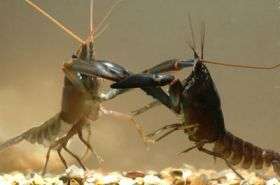
April 2, 2007 Crayfish Do Battle

Fighting crayfish. Credit: Anthony O'Toole

Intimidation and threats are common throughout society, whether it’s in the school playground, sporting arena or boardroom. Threatening behaviour is equally widespread among non-human animals. Individuals signal their superior strength to competitors to obtain food, resolve territorial disputes and acquire mates.

Current theory insists that signals of strength should be honest. Surprisingly researchers have found that dishonest signals are used routinely during dominance disputes by male Australian crayfish. This work will be presented by Dr Robbie Wilson (University of Queensland) on Monday 2nd April at the Society for Experimental Biology’s Annual Meeting in Glasgow.

Crayfish are a naturally aggressive species and will squabble over almost anything! Male crayfish possess enlarged front claws that they use to intimidate and fight with their competitors. An international team of researchers, led by Robbie Wilson from the University of Queensland, wanted to understand determinants of social dominance in these aggressive animals.

The scientists measured the size and strength of claws of both male and female crayfish, and then monitored how they performed in competitive bouts. They found crayfish use claw size to determine the winners of the most aggressive disputes. For female crayfish the size of the claw was an honest indication of how strong they were. However, claw size of males was not a good indicator of their strength. Males were routinely bluffing their opponents with weak claws to achieve dominance. They used claws more for intimidation than actual strength.

“Male crayfish lie and cheat their way to the top, whilst females appear to be honest displayers of their own strength”, Robbie Wilson said. “This is important work showing that dishonesty is commonly used by animals during fights”, said Wilson. “We already knew humans often use dishonesty during disputes, but our results suggest cheating may play a more important role in animal communication than previously imagined.”

Source: Society for Experimental Biology


print this article email this article download pdf blog this article bookmark this article     Stumble it Digg this share on Facebook retweet share on Reddit add to delicious
Rate this story - 4 /5 (11 votes)


April 2, 2007 all stories

Comments: 0

4 /5 (11 votes)
  • Stumble this up

  • Digg this

  • share this

  • hide
  • Related Stories

  • Crayfish win by cheating
    created Mar 25, 2009 | popularity not rated yet | comments 0
  • Crafty Australian crayfish cheat
    created Feb 27, 2009 | popularity not rated yet | comments 0
  • Climate Change Triggered Dwarfism in Soil-Dwelling Creatures of the Past
    created Oct 06, 2009 | popularity not rated yet | comments 0
  • Biologists discover 'death stench' is a universal ancient warning signal
    created Sep 11, 2009 | popularity not rated yet | comments 0
  • Down Under dinosaur burrow discovery provides climate change clues (w/ Video)
    created Jul 10, 2009 | popularity not rated yet | comments 0


Other News

Variable Temperatures Leave Insects wtih a Frosty Reception

Biology / Plants & Animals

created 4 hours ago | popularity not rated yet | comments 0

(PhysOrg.com) -- For the first time, scientists at The University of Western Ontario have shown that insects exposed to repeated periods of cold will trade reproduction for immediate survival.


When camouflage is a plant's best protection

Rare woodland plant uses 'cryptic coloration' to hide from predators

Biology / Plants & Animals

created 6 hours ago | popularity 4.3 / 5 (3) | comments 0

It is well known that some animal species use camouflage to hide from predators. Individuals that are able to blend in to their surroundings and avoid being eaten are able to survive longer, reproduce, and ...


Cells defend themselves from viruses, bacteria with armor of protein errors

Biology / Cell & Microbiology

created 8 hours ago | popularity 5 / 5 (5) | comments 0

When cells are confronted with an invading virus or bacteria or exposed to an irritating chemical, they protect themselves by going off their DNA recipe and inserting the wrong amino acid into new proteins to defend them ...


'Safety valve' protects photosynthesis from too much light

Biology / Cell & Microbiology

created 8 hours ago | popularity 5 / 5 (2) | comments 0

Photosynthetic organisms need to cope with a wide range of light intensities, which can change over timescales of seconds to minutes. Too much light can damage the photosynthetic machinery and cause cell death. Scientists ...


Researchers discover biological basis of 'bacterial immune system'

Biology / Cell & Microbiology

created 8 hours ago | popularity 4.5 / 5 (2) | comments 0

Bacteria don't have easy lives. In addition to mammalian immune systems that besiege the bugs, they have natural enemies called bacteriophages, viruses that kill half the bacteria on Earth every two days.