April 2, 2007 feature
Nanobubbles exist, and are more stable than previously thought
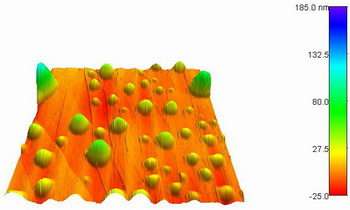
When William Ducker, a professor at the University of Melbourne in Australia started experiments on so-called nanobubbles that form as a gas state on the boundary between liquid and gas, he fully expected to discover two things: 1) that the nanobubbles didn’t exist, and 2) that if they did, they would be unstable, existing for no more than a second. So it came as a surprise when the results of an experiment he performed along with Xuehua Zhang, required Ducker to admit that he was wrong. “Not only do these nanobubbles exist, but they are relatively stable, lasting for days,” he tells PhysOrg.com.
Ducker and Zhang’s discovery provides the first direct evidence for a new nanoscale gas state that manifests as small, thin bubbles called “nanobubbles.” Their experiment is outlined in a recent Letter titled “A Nanoscale Gas State,” published in Physical Review Letters.
“For years quite a few people speculated that such a gas state might exist,” Ducker explains. “This was based on indirect evidence, and there was a significant amount of theoretical evidence to suggest that this finely divided gas state did not exist. It was also contended that even if such a nanoscale gas state did exist, the bubbles wouldn’t last long enough to be of any use.”
So Ducker set out to prove with direct evidence that this nanoscale gas state did not exist. “It’s funny that I should be on the team to discover this,” he says with a laugh. “I set out to prove that they didn’t exist.” But, he says, he has changed his tune. “We found such compelling evidence in favor of these nanobubbles, that I’ve had no choice but to change my mind.”
The experiment that provides such compelling evidence for the existence of this new nanoscale gas state uses infrared spectroscopy. “We know how a gas behaves,” explains Ducker. “If the material is in the gas state, the molecules rotate around more quickly than they collide with each other, so it is possible to monitor distinct rotational states. We used infrared light to find evidence of those rotational states.”
After determining that the nanobubbles were, indeed, a bone fide gas state, the team also used infrared spectroscopy to measure the pressure inside the nanobubbles. “The theory was that the pressure inside the nanobubbles would be high enough that it would force the nanobubbles to break up and disappear almost immediately,” Ducker says. “But we found that the pressure inside is not that high: it is about the same as in the atmosphere.” He continues: “This is why the gas state is relatively stable, lasting for days. The pressure inside the nanobubble is about the same as on the outside.”
What’s next for the nanobubbles?
“It’s intellectually interesting to find this new state of matter,” Ducker enthuses. “And it is exciting in terms of applications.” One of the industrial applications Ducker thinks could benefit from nanobubbles is pumping liquid through pipes. “It takes a significant amount of energy to pump liquid through pipes. If we could generate these nanobubbles uniformly along the walls of the pipes, we should reduce wall friction and lower the cost of pumping, since it would take less energy.”
But Ducker sees uses for nanobubbles in the everyday as well. “If we can understand how this works, it could have many uses.” He explains that many manmade products and natural resources are made from mixtures; in some cases we want to keep the substances mixed, and in other cases we want to separate them. “We should be able to manipulate this nanoscale gas state so that we can do things like make the oil and water in salad dressings stay together longer. Salad dressing stability is very important.”
Ducker points out a more economically significant use for the nanobubbles: “We may also be able to enhance separation processes. For example, removing the oil in the oil sands in Canada. Right now it’s difficult to separate the oil from the sand. But if we can figure out how to manipulate this gas state, it may become easier.”
Now that Ducker knows that the nanobubbles exist, he is excited to move forward. “The next step is to generate more uniform, dense, and longer-lasting coatings of bubbles, and then we will be able to see if they find useful applications. That would be a major prize for us, and I think we will get there.”
Copyright 2007 PhysOrg.com.
All rights reserved. This material may not be published, broadcast, rewritten or redistributed in whole or part without the express written permission of PhysOrg.com.


