Engineers create 'optical cloaking' design for invisibility
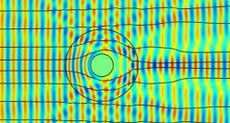
Researchers using nanotechnology have taken a step toward creating an "optical cloaking" device that could render objects invisible by guiding light around anything placed inside this "cloak."
The Purdue University engineers, following mathematical guidelines devised in 2006 by physicists in the United Kingdom, have created a theoretical design that uses an array of tiny needles radiating outward from a central spoke. The design, which resembles a round hairbrush, would bend light around the object being cloaked. Background objects would be visible but not the object surrounded by the cylindrical array of nano-needles, said Vladimir Shalaev, Purdue's Robert and Anne Burnett Professor of Electrical and Computer Engineering.
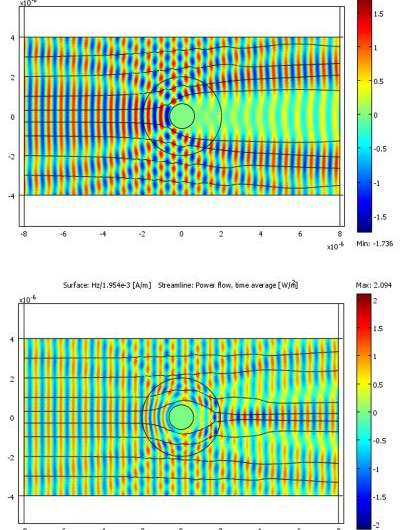
The design does, however, have a major limitation: It works only for any single wavelength, and not for the entire frequency range of the visible spectrum, Shalaev said.
"But this is a first design step toward creating an optical cloaking device that might work for all wavelengths of visible light," he said.
Research findings are detailed in a paper appearing this month in the journal Nature Photonics. The paper, which is appearing online this week, was co-authored by doctoral students Wenshan Cai and Uday K. Chettiar, research scientist Alexander V. Kildishev and Shalaev, all in Purdue's School of Electrical and Computer Engineering.
Calculations indicate the device would make an object invisible in a wavelength of 632.8 nanometers, which corresponds to the color red. The same design, however, could be used to create a cloak for any other single wavelength in the visible spectrum, Shalaev said.
"How to create a design that works for all colors of visible light at the same time will be a big technical challenge, but we believe it's possible," he said. "It is clearly doable. In principle, this cloak could be arbitrarily large, as large as a person or an aircraft."
The research is based at the Birck Nanotechnology Center at Purdue's Discovery Park.
Other researchers published findings in 2006 describing the mathematics generally required for the optical cloaking device. Those researchers include: John Pendry at the Imperial College in London, along with David Schurig and David R. Smith at Duke University, and simultaneously, Ulf Leonhardt at the University of St. Andrews in Scotland.
"These mathematical requirements were very general, and then we determined how to fulfill the requirements with a specific design," Shalaev said.
Leonhardt, a professor of theoretical physics, wrote a commentary piece about the Purdue paper appearing in the same issue of Nature Photonics. In the commentary, he compares the Purdue design to the Roman creation of "the first optical metamaterial," a type of glass containing nanometer-scale particles of gold. In ordinary daylight, a cup made of the glass appeared green, but then it glowed ruby when illuminated from the inside.
The Purdue research, Leonhardt writes, represents " ... theoretical simulations that show that a modified Roman cup based on modern nanofabrication technology will act as an invisibility device ... Any object you put inside will disappear as if dissolved in air, provided it is viewed through polarizing tinted glasses of precisely that colour."
Other researchers have developed concepts for cloaking objects smaller than the wavelengths of visible light and for objects detected in the microwave range of the spectrum, which are much larger than the wavelengths of visible light. But the new design is the first for cloaking an arbitrary object in the range of light visible to humans.
"What we propose is the cloaking of objects of any shape and size," Shalaev said.
Two requirements are needed to render an object invisible: Light must not reflect off of the object, and the light must bend around the object so that people would see only the background and not the cloaked object itself.
"If you satisfied only the first requirement of preventing light from reflecting off of the object, you would still see the dark shadowlike shape of the object, so you would know something was there," Shalaev said. "The most difficult requirement is to bend light around the cloaked object so that the background is visible but not the object being cloaked. The viewer would, in effect, be seeing around, or through, the object."
The device would be made of so-called "non-magnetic metamaterials." Meta in Greek means beyond, so the term metamaterial means to create something that doesn't exist in nature. Unlike designs for invisibility in the microwave range, the new design has no magnetic properties. Having no magnetic properties makes it much easier to cloak objects in the visible range but also causes a small amount of light to reflect off of the cloaked object.
"But this could, in principle, be offset by other means, for example, with antireflective coatings," Shalaev said. "The big challenge is how to make rays bend around the object, which we have described how to do in this paper."
A key factor in the design is the ability to reduce the "index of refraction" to less than 1. Refraction occurs as electromagnetic waves, including light, bend when passing from one material into another. Refraction causes the bent-stick-in-water effect, which occurs when a stick placed in a glass of water appears bent when viewed from the outside. Each material has its own refraction index, which describes how much light will bend in that particular material and defines how much the speed of light slows down while passing through a material.
Natural materials typically have refractive indices greater than 1.The new design reduces a refractive index to values gradually varying from zero at the inner surface of the cloak, to 1 at the outer surface of the cloak, which is required to guide light around the cloaked object.
Creating the tiny needles would require the same sort of equipment already used to fabricate nanotech devices. The needles in the theoretical design are about as wide as 10 nanometers, or billionths of a meter, and as long as hundreds of nanometers. They would be arranged in layers emanating from a central spoke in a cylindrical shape. A single nanometer is roughly the size of 20 hydrogen atoms strung together.
Although the design would work only for one frequency, it still might have applications, such as producing a cloaking system to make soldiers invisible to night-vision goggles.
"Because night-imaging systems detect only a specific wavelength, you could, in theory, design something that cloaks in that narrow band of light," Shalaev said.
Another possible application is to cloak objects from "laser designators" used by the military to illuminate a target, he said.
Leonhardt says in his commentary that creating a cloak for rendering total invisibility in the entire visible spectrum would require "further advances in optical metamaterials, new combinations of nanotechnology with highly abstract ideas ..."
Source: Purdue University


