April 3, 2007 feature
Future of war demands futuristic flying machines
While no one can predict where, when or why countries will fight future wars, experts are already creating war technology that may play a deciding factor in the outcome. Perhaps it’s a bit bold to say scientists can write history before it occurs, but only future historians can decide that. In any case, scientists, militarists, and governments are currently investing large amounts of resources in an intriguing, futuristic technology—fleets of small unmanned aerial vehicles (UAVs).
Actually, as scientists Tariq Samad, John Bay and Datta Godbole write in Proceedings of the IEEE, UAVs are not all that new, although interest in these small fliers has spiked recently due to current world circumstances. The scientists’ invited paper analyzes current UAV technology and suggests untapped research areas. Also, the group presents a concept of operations for a coordinated fleet of different types of UAVs, which are defined as powered aerial vehicles that use aerodynamic forces for lift, and which can either fly autonomously or be piloted remotely.
“A particularly exciting development in UAVs over the last few years has been the emergence of (by now several) small, often portable, relatively low-cost vehicles,” Samad told PhysOrg.com. “These new UAVs, unlike their traditional counterparts, are especially well suited for urban operations and they promise to allow safer, easier, and more comprehensive surveillance and reconnaissance in urban areas.”
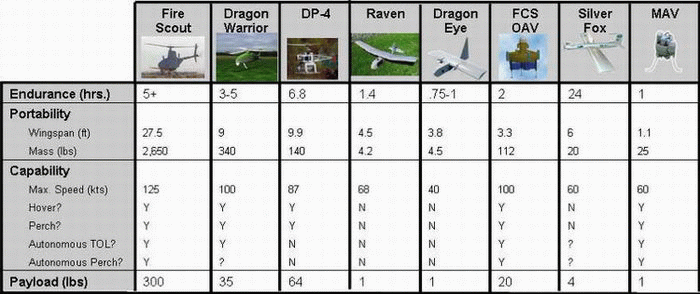
The major impetus for investing in UAV technology lies in the replacement of the traditional, open battleground with the urban theater of war. Urban environments—with their mazes of tall buildings, parked cars, residences, alleys and tunnels—create a three-dimensional challenge for invading troops unfamiliar with the city. UAVs, however, armed with imaging technology, signals and sensors, could provide surveillance and reconnaissance operations for soldiers. Live video coverage, close-up views, and tracking moving objects are well within the reach of UAVs, based on recent demonstrations.
Another role that UAVs could serve might involve filling in the gaps in GPS or cellular infrastructure in the limited line-of-sight regions common in urban areas. A fleet of UAVs equipped with radio or cell technology could sense and follow a unit moving through a city, providing uninterrupted communication service.
This intelligence aspect of the UAVs represents an area that the authors suggest has yet to be investigated, but has great potential for advanced applications. For example, truly autonomous UAVs would have to communicate with each other, and therefore possess a certain knowledge of their surroundings and reasoning to make decisions. Samad, Bay and Godbole describe the complexity of UAV intercommunication, and the complexities of mutual and reciprocal knowledge, beliefs and actions.
Current UAVs are quite far from possessing full autonomy; however, a question that scientists debate on is the nature of the coordination system: centralized, decentralized, or a hybrid. Many experts, according to the researchers, believe that decentralized coordination could be more robust due to the lack of a single failure point. Others argue that ground control would be more realistic for military applications, which have a command-and-control basis.
“One aspect of UAV technology of particular interest to us is autonomy: how can UAVs successfully operate with minimal human oversight,” Samad said. “Limitations include the fact that obstacle and collision avoidance require the human operator's engagement. Advances in control algorithms, sensing, and communications are being pursued that should address these and other outstanding challenges. We should remember that our warfighters in the midst of urban operations cannot be expected to devote their attention to low-level aspects of controlling and managing UAVs. Minimizing the associated cognitive and physical workload of urban warfighters through increasingly autonomous UAVs and UAV-based systems is essential for the potential benefits of UAV technology to be realized.”
The concept of operations introduced by Samad, Bay and Godbole of an integrated and diverse multi-UAV system uses local control stations that communicate with a single centralized station. While this centralized structure has advantages in coordination, it also faces increased complexity in assigning tasks. In this example, the scientists emphasize the need for a network service architecture that can accommodate both existing and future UAVs.
“The current research in this area typically assumes individual UAV capabilities that are well beyond those of today's craft—the implication is that useful multi-UAV missions are a future, often-distant prospect,” explained Samad. “We believe our concept of operations is unique in that it shows that the benefits of multi-UAV missions—such as coordinated, area-wide reconnaissance and surveillance—can be realized with today's UAV systems with little or no modifications to the vehicles. (Of course, as UAV capabilities improve additional benefits will be possible.)”
Recently, a few types of UAVs have proven effective in Iraq and Afghanistan, providing troops with timely surveillance and reconnaissance. Due to their relatively inexpensive fabrication and testing, along with a variety of applications, UAVs seem poised to play a significant role in the future of war.
“Our conops illustrates that coordinated operation of multiple UAVs is feasible with current technology,” said Samad. “We hope that it provides an impetus to research in new multi-UAV system architectures and coordination schemes.”
Citation: Samad, Tariq, Bay, John S., and Godbole, Datta. “Network-Centric Systems for Military Operations in Urban Terrain: The Role of UAVs.” Proceedings of the IEEE. Vol. 95, No. 1, January 2007.
Copyright 2007 PhysOrg.com.
All rights reserved. This material may not be published, broadcast, rewritten or redistributed in whole or part without the express written permission of PhysOrg.com.


