How did life on Earth originate?
April 3rd, 2007 How did life on Earth originate?

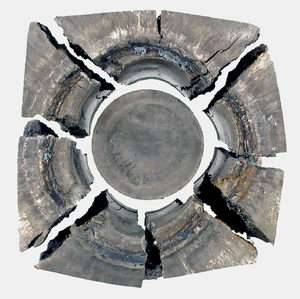
After the detonation test, the steel container has been destroyed by the massive shock waves. However, the canister in the center which contains the microorganisms between the two stone plates is still intact. © Fraunhofer EMI

Did life arrive from space? Rather than developing here, could the first life forms have been catapulted to Earth on a chunk of rock from outer space? Investigations show that microbes are capable of surviving just such a journey.

At the mention of life forms from other planets, images of green Martians, ET-like creatures or Klingons immediately spring to mind, largely influenced by the film industry. They travel through space in UFOs in order to conquer the Earth. Something similar may well have happened a long time ago: The ‘UFOs’ could have been lumps of rock that broke off from a planet when it was hit by a meteorite, and their ‘crews’ could have been microbes.

This is the assumption on which the panspermia hypothesis is based. However, assuming that there are microbes on other planets, Mars for example, would they be able to withstand the pressure that arises when a meteorite crashes into their planet and catapults their rocky UFO into space – a pressure that is 400,000 times higher than that of the Earth’s atmosphere?

Researchers at the Fraunhofer Institute for High-Speed Dynamics, Ernst-Mach-Institut, EMI have systematically investigated this question for the first time: “We simulate the shock wave that occurs when a meteorite crashes into Mars,” says Dr. Ulrich Hornemann, who is in charge of the experiments at the EMI. “To do that, we detonate an explosive cylinder that accelerates a metal plate. This metal plate then hits a steel canister containing two thin stone plates between which there is a thin layer of microbes.”

When the metal plate crashes into the container, a shock wave is generated that passes through the stone plates and the layer of microbes. The astonishing thing is that even at 400,000 times atmospheric pressure, one ten thousandth of the microbes survive the impact of the metal plate; the main reason for this being that the inhospitably high pressure only lasts for a fraction of a second just like the impact of a meteorite.

Because the rocks that are broken off by meteorites usually have small cracks and crevices in them, the experts have also investigated the feasibility of porous rocks as ‘UFOs’. The result: Microorganisms can also survive here. And the small fissures are also advantageous to the tiny organisms in other ways, providing them with protection on their journey through space against UV radiation, solar wind and the icy cold and thus increasing their chances of survival, as the EMI’s project partners at the German Aerospace Center (DLR) found out. “It is therefore possible,” says Hornemann, “that life on Earth came here from other planets.”

Source: Fraunhofer-Gesellschaft


print this article email this article download pdf blog this article bookmark this article     Digg this Stumble it share on Facebook share on Reddit add to delicious save to Yahoo! bookmarks
3.8/5 after 25 votes


April 3rd, 2007 all stories
Other Sciences / Other

Comments: 0
Rank: 3.8/5 after 25 votes

  • Stumble this up

  • Digg this

  • Share it:
  • share on Facebook
  • share on MySpace
  • share on Slashdot
  • rss-newsfeed
  • share on Google
  • share on Reddit
  • add to delicious
  • save to Yahoo! bookmarks
  • share on Windows Live
  • Add to Mixx!
Rating: 3.8/5 after 25 votes

  • Related Stories

  • Research team finds definitive evidence for ancient lake on Mars
    created Jun 18, 2009 | popularity not rated yet | comments 0
  • A serious search for extraterrestrial life
    created May 26, 2009 | popularity not rated yet | comments 0
  • New book suggests Earth perhaps not such a benevolent mother after all
    created May 20, 2009 | popularity not rated yet | comments 0
  • Life in the universe? Almost certainly. Intelligence? Maybe not
    created May 12, 2009 | popularity not rated yet | comments 0
  • NASA mission sends germs into space
    created May 05, 2009 | popularity not rated yet | comments 0

Tags


  • Physicists Demonstrate Quantum Memory with Matter Qubits
    Physicists Demonstrate Quantum Memory with Matter Qubits
    Physics / General Physics
    created Jul 03, 2009 | popularity 4.4 / 5 (17) | comments 1
  • 'Holey' Nanosheets for Wastewater Dye Removal
    Nanotechnology / Nanomaterials
    created Jul 01, 2009 | popularity 5 / 5 (5) | comments 1
  • Jellyfish Robot Swims Like its Biological Counterpart
    Jellyfish Robot Swims Like its Biological Counterpart
    Electronics / Robotics
    created Jun 26, 2009 | popularity 4.4 / 5 (8) | comments 1
  • Could Maxwell's Demon Exist in Nanoscale Systems?
    Could Maxwell's Demon Exist in Nanoscale Systems?
    Physics / General Physics
    created Jun 24, 2009 | popularity 4.4 / 5 (18) | comments 29
  • Living Safely with Robots, Beyond Asimov's Laws
    Living Safely with Robots, Beyond Asimov's Laws
    Electronics / Robotics
    created Jun 22, 2009 | popularity 4.6 / 5 (52) | comments 40
  • Other News

    Creation Museum president Ken A. Ham

    Paleontologists brought to tears, laughter by Creation Museum

    Other Sciences / Other

    created Jun 30, 2009 | popularity 4.3 / 5 (44) | comments 124

    For a group of paleontologists, a tour of the Creation Museum seemed like a great tongue-in-cheek way to cap off a serious conference.


    Mummified dinosaur skin yields up new secrets

    Mummified dinosaur skin yields up new secrets

    Other Sciences / Archaeology & Fossils

    created Jul 01, 2009 | popularity 4.7 / 5 (15) | comments 10

    (PhysOrg.com) -- Scientists from The University of Manchester have identified preserved organic molecules in the skin of a dinosaur that died around 66-million years ago.


    Liberal? Conservative? Stanford study says mental nudge can make voters flip-flop

    Liberal? Conservative? Stanford study says mental nudge can make voters flip-flop

    Other Sciences / Social Sciences

    created Jul 02, 2009 | popularity 3.8 / 5 (6) | comments 4

    (PhysOrg.com) -- No doubt you’ve worked hard for your success. But chances are you’ve also had some help and lucky breaks along the way.


    Probing Question: How do Ponzi Schemes work?

    Other Sciences / Economics

    created Jul 02, 2009 | popularity 5 / 5 (2) | comments 2

    Imagine the shock, the horror, and the sheer panic that would come with learning that the financial plan you’d sunk your life savings into was a sham, the financial experts you trusted were crooks, and all your money was ...


    Tourists enjoy a "Pineapple Tour" in Costa Rica

    Costa Rica tops happiness, 'green living' poll

    Other Sciences / Social Sciences

    created Jul 04, 2009 | popularity 3.5 / 5 (4) | comments 0

    Costa Rica is the happiest place on earth, and one of the most environmentally friendly, according to a new survey by a British non-governmental group.