Stop signs: Study identifies 'braking' mechanism in the brain
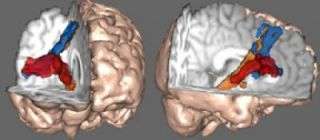
As wise as the counsel to "finish what you've started" may be, it is also sometimes critically important to do just the opposite -- stop. And the ability to stop quickly, to either keep from gunning the gas when a pedestrian steps into your path or to bite your tongue mid-sentence when the subject of gossip suddenly comes into view, may depend on a few "cables" in the brain.
Researchers led by cognitive neuroscientist Adam Aron, an assistant professor of psychology at the University of California, San Diego, have found white matter tracts -- bundles of neurons, or "cables," forming direct, high-speed connections, between distant regions of the brain -- that appear to play a significant role in the rapid control of behavior.
Published in the April 4 issue of the Journal of Neuroscience, the study is the first to identify these white matter tracts in humans, confirming similar findings in monkeys, and the first to relate them to the brain's activity while people voluntarily control their movements.
"Our results provide important information about the correspondence between the anatomy and the activity of control circuits in the brain," Aron said. "We've known for some time about key brain areas involved in controlling behavior and now we're learning how they're connected and how it is that the information can get from one place to the other really fast."
"The findings could be useful not only for understanding movement control," Aron said, "but also 'self-control' and how control functions are affected in a range of neuropsychiatric conditions such as addiction, Tourette's syndrome, stuttering and Attention Deficit Hyperactivity Disorder."
To reveal the network, Aron and researchers from UCLA, Oxford University and the University of Arizona performed two types of neuroimaging scan on healthy volunteers.
They used diffusion-weighted MRI, in 10 subjects, to demonstrate the "cables" between distant regions of the brain known to be important for control, and they used functional MRI, in 15 other subjects, to show that these same regions were activated when participants stopped their responses on a simple computerized "go-stop" task.
One of the connected regions was the subthalamic nucleus, within the deep-seated midbrain, which is an interface with the motor system and can be considered a "stop button" or the brake itself. A second region was in the right inferior frontal cortex, a region near the temple, where the control signal to put on the brakes probably comes from.
"This begs the profound question," Aron said, "of where and how the decision to execute control arises."
While this remains a mystery, Aron noted that an additional, intriguing finding of the study was that the third connected node in the network was the presupplementary motor area, which is at the top of the head, near the front. Prior research has implicated this area in sequencing and imagining movements, as well as monitoring for changes in the environment that might conflict with intended actions.
The braking network for movements may also be important for the control of our thoughts and emotions.
There is some evidence for this, Aron said, in the example of Parkinson's patients. In the advanced stages of disease, people can be completely frozen in their movements, because, it seems, their subthalamic nucleus, or stop button, is always "on." While electrode treatment of the area unfreezes the patients' motor system, it can also have the curious effect of disinhibiting them in other ways. In one case, an upstanding family man became manic and hypersexual, and suddenly began stealing money from his wife to pay for prostitutes.
Examples like these motivate Aron to investigate the generality of the braking mechanism.
"The study gives us new targets for studying how the brain relates to behavior, personality and genetics," Aron said. "Variability in the density and thickness of the 'cable' connections is probably influenced by genes, and it would be intriguing if these differences explained people's differing abilities not only to control the swing of a bat but also to control their temper."
Source: University of California - San Diego


