Want to monitor climate change? P-p-p-pick up a penguin!
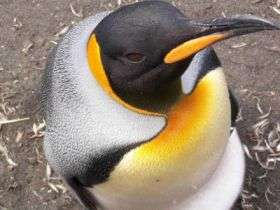
April 4, 2007 King Penguin

King penguin. Credit: Lewis Halsey

We are used to hearing about the effects of climate change in terms of unusual animal behaviour, such as altering patterns of fish and bird migration. However, scientists at the University of Birmingham are trying out an alternative bio-indicator – the king penguin – to investigate whether they can be used to monitor the effects of climate change.

“If penguins are travelling further or diving deeper for food, that tells us something about the availability of particular fish in regions of the Antarctic. We may be able to assess the pressure exerted by king penguins on this ecosystem, and look at the effects of both climate change and overfishing in this region of the world”, says Dr Lewis Halsey who will present his results on Wednesday 4th April at the Society for Experimental Biology’s Annual Meeting in Glasgow.

A new way of using animals as bio-indicators is to ascertain their energy requirements. Dr Halsey and co-workers measured the heart rate and energy expenditure of king penguins whilst walking on a treadmill and whilst swimming in a long water channel, and obtained relationships between these two variables. They then implanted heart rate loggers in penguins going to sea such that they could infer the energy expended by these birds from the recorded heart rate. Researchers were then able to find out if there was a correlation between the energetic costs of foraging at sea and the levels of fish available to the penguins i.e. did penguins have to work harder when food was scarce.

King penguins are good candidates as bio-indicators for several reasons. Firstly, while at sea foraging, they cover hundreds of kilometres and are able to dive to depths of several hundred metres, so they explore a relatively large portion of the expansive Southern Oceans. Secondly, the diets of several populations of king penguins are well known. Thirdly, while foraging for food is done at sea the penguins also come ashore to breed and moult, making them accessible to researchers.

Source: Society for Experimental Biology


print this article email this article download pdf blog this article bookmark this article     Stumble it Digg this share on Facebook retweet share on Reddit add to delicious
Rate this story - 5 /5 (3 votes)


April 4, 2007 all stories

Comments: 0

5 /5 (3 votes)
  • Stumble this up

  • Digg this

  • share this

  • hide
  • Related Stories

  • Prehistoric equatorial penguins reached 5 feet in height
    created Jun 25, 2007 | popularity not rated yet | comments 0
  • Human preference for other species could determine whether they survive
    created Jan 29, 2007 | popularity not rated yet | comments 0
  • The secret life of penguins revealed
    created May 13, 2009 | popularity not rated yet | comments 0
  • Blubbery 'researchers' lend fin to climate science
    created Apr 06, 2009 | popularity not rated yet | comments 0
  • Climate-related changes on the Antarctic peninsula
    created Mar 16, 2009 | popularity not rated yet | comments 0


Other News

New study describes connections between Circadian and metabolic systems

Biology / Other

created 2 hours ago | popularity not rated yet | comments 0

A paper by University of Notre Dame biologist Giles Duffield and a team of researchers offers new insights into a gene that plays a key role in modulating the body's Circadian system and may also simultaneously modulate its ...


A biology whodunnit: are rodents helping protect trees from fire?

A biology whodunnit: are rodents helping protect trees from fire?

Biology / Ecology

created 1hour ago | popularity not rated yet | comments 0

Tom Parker has made an unusual find. In California forests and shrubland that burned in 2008, he has spotted Manzanita seedlings sprouting in tight clusters, suggesting that the young shrubs emerged from underground ...


With Help from a Bacterium, Cockroaches Develop Way to Store Excess Uric Acid

With Help from a Bacterium, Cockroaches Develop Way to Store Excess Uric Acid

Biology / Plants & Animals

created 3 hours ago | popularity 5 / 5 (1) | comments 0

(PhysOrg.com) -- What life form can use materials as nutrients that we, and most other animals, would consider waste products?


Longer toes eyed as sprinters' edge

Biology / Other

created 4 hours ago | popularity not rated yet | comments 0

(PhysOrg.com) -- Longer toes may give sprinters a leg up on other runners, according to a new study.


neuron

To make memories, new neurons must erase older ones

Biology / Cell & Microbiology

created 6 hours ago | popularity 5 / 5 (3) | comments 0

Short-term memory may depend in a surprising way on the ability of newly formed neurons to erase older connections. That's the conclusion of a report in the November 13th issue of the journal Cell that provid ...