In young mice, gregariousness seems to reside in the genes
Beyond the lineage of primates, according to scientific gospel, social behavior is dictated primarily by competition for resources such as food, territory and reproduction.
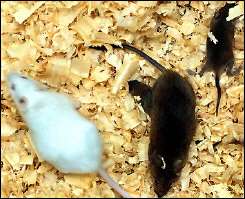
That may well be true for many adult animals, but in a groundbreaking study researchers from the University of Wisconsin-Madison have found evidence that social interactions among young mice result from basic motivations to be with one another. What's more, the researchers say, the extent of a young mouse's gregariousness is influenced by its genetic background.
The work, reported today in the journal Public Library of Science (PLoS) One, is important because it provides the first scientific insight that genes contribute to a novel form of natural reward - the pleasure of interacting with other juveniles. At a practical level, the new findings provide a foundation for understanding the motivations that underlie acts of altruism. Moreover, the work may also help influence the development of new, more effective drugs to treat depression, addiction and autism.
"We are quite confident it is genetic," says Jules B. Panksepp, a UW-Madison neuroscience graduate student and the lead author of the new study, which was conducted using two different strains of young mice, one gregarious in nature, the other much less so. "Their motivation to engage others varies with their genetic background; it appears to affect how young mice approach social situations."
The inbred strains of mice used in the study, once weaned, display markedly different social aptitudes. Young mice from one strain are amicable, spending much more time seeking out and interacting with other mice introduced into their environment. By controlling for a host of behavioral variables during the course of adolescent development, the researchers demonstrated specific differences in social motivations among juveniles of the two mouse strains - behavioral variations that could only be explained by genetic differences.
Intriguingly, the Wisconsin researchers also found that young mice from the gregarious strain seek environments that predict the possibility of a social encounter and avoid places where they have experienced social isolation.
"They like company. That's the point," says Garet Lahvis, of the gregarious strain of mouse. Lahvis is a professor of surgery in the UW School of Medicine and Public Health and the senior author of the new study.
Performing under the dim glow of red lights to simulate the nocturnal environment when mice are most active, the sociability of test mice was assessed when they were reunited with their former cage mates. At the same time, the researchers tuned in to the ultrasonic chattering that mice use to communicate with each other.
For the more socially predisposed animal, gregariousness was the order of the day, says Lahvis: "A young mouse will seek social interaction and avoid isolation. The social life of these animals is a rich integration of behavior, vocalizations and positive emotional experience."
The level of social interplay of the two strains of mice, Panksepp and Lahvis note, is mirrored in their vocalizations, and the differences in vocalization between the two types of mouse also segregated with genetic background.
"We identified associations between types of mouse vocalizations and the extent of their social interactions," says Lahvis. "There is an association between high-pitched calls in mice and positive experience. The quality and quantity of the call are tightly associated with the nature of the interaction itself."
As the mice neared sexual maturity, the genetic influence on social behavior ebbed and the animals became much more responsive to social cues such as gender, according to Lahvis.
"As they get older, they take on the [behavioral] characteristics associated with gender," Lahvis explains. "The initial genetic predisposition gets masked by reproductive maturity."
This result is crucial, argue Lahvis and Panksepp, because it suggests that the genetic influences on juvenile social behavior may be quite distinct from genetic factors that affect adult social behavior, a finding the researchers suggest has great importance for understanding social evolution, as well as developing more realistic animal models of pervasive developmental disorders, such as autism.
In past research, the social capacities of rodents have been studied primarily in the context of behaviors associated with sexual reproduction, territorial defense and parental care. Those studies, say Lahvis and Panksepp, do not account for the many forms of social interaction that occur prior to sexual maturity, nor do they account for the many kinds of social groupings that occur throughout the animal kingdom and provide much more subtle benefits to an individual.
Results of the new work suggest that juvenile animals may experience different emotional states, depending upon whether they are alone or with others, and that specific genes may influence how they feel within different social contexts.
Identifying the gene or genes at play, says Lahvis, is the next step. "We now know that social motivation can be responsive to genetic factors, but we don't know what these factors are."
Source: University of Wisconsin-Madison


