Dust clouds in cosmic cycle
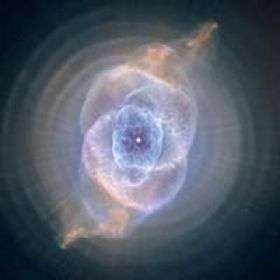
It has been a mystery for astronomers how certain dying stars have their colossal quantities of material blown out into the universe and shrink into objects called "white dwarves". This is the basis of a ground-breaking new theory by astrophysicists Anja C. Andersen from the Dark Cosmology Centre at the University of Copenhagen and Susanne Höfner of the University of Uppsala.
Earth and the other planets in our solar system are built up of elements which have been produced in earlier generations of stars. Deep in the stars' very hot core, the elements are created out of hydrogen, and when the stars explode and die, the elements are shot out into the universe as huge clouds of gas and dust. Gradually, all that dust aggregates, eventually forming new stars and planets.
Stars smaller than our sun and up to eight times as large die by first swelling up to being a red giant, and then shrinking to a white dwarf. There are two types of red giants, one contains lots of carbon and the the other a lot of oxygen. When the carbon-rich stars die, large clouds of carbon particles such as soot and graphite are produced. Soot and graphite are pitch-black, so when the rays from the dying star hit the soot particles they stop the light and are pushed out into space, where they are seen as gigantic dust clouds. This is a 20 year old theory which fits both the observations and the model calculations.
But for the other type of red giant stars, which are oxygen-rich, it has been a mystery how their material is blown out into space. The oxygen-rich stars produce large quantities of water and silicates, like quartz or grains of sand. Water and silicates are transparent, which means that when rays from the star hit the particles, they go straight through—just like when the sun's rays go through glass. The star's radiation therefore, can't push on the particles and be the motor which drives the dust clouds out into space.
So how does it happen? The astrophysicists, Anja C. Andersen and Susanne Höfner have pondered the problem for many years and weighed possible solutions. First they considered whether there could be iron in the silicates, so that it wasn't transparent. But then calculations showed that with iron, the dust grains would have melted and were therefore unstable.
Next they thought that perhaps many molecules had been produced, which could block out the light and thereby create a wind which blew the star's outermost layer into space. But the model calculations showed that the molecules could not block enough light to drive the process alone.
When the star becomes a red giant it pulses in it's death-throes, and perhaps this could "spark" the process into motion and force the star's material out. But this theory didn't tally with real observations of these stars.
It was back to the start, and suddenly it hit them. "What if the oxygen-rich stars also make some carbon that works with the transparent dust, and altogether can give a push to the process by forcing the star's outer layer into space"? They looked at each other and hardly dared to think that it could be so simple, that in reality it was the same process that was happening in both types of stars.
"It is so wonderful, that it can be so simple, and the theory fits with all our subsequent model calculations", says Anja C. Andersen. The theory also fits with the observations one has from dying red giants. The carbon may be the explanation for how both types of star blow their material into space, where they are ultimately reused in the cosmic cycle in new stars and planets.
Link: Astronomy & Astrophysics -- www.aanda.org/index.php?option … orthcoming&Itemid=18
Source: University of Copenhagen


