Aurora Space Exploration Program's proposal mulls take off in May
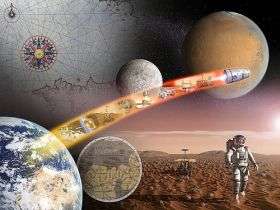
Scientists working with the European Science Foundation (ESF) are putting the finishing touches to an ambitious programme of research for the exploration of the Moon and Mars. They expect to publish their proposals in May.
The Aurora Programme was set up by the European Space Agency (ESA) in 2001 as Europe's contribution to an international endeavour to explore the solar system. A flotilla of robotic probes will pave the way towards the ultimate goal of landing humans on Mars in the 2030s.
"Aurora is not science-driven in the same way as the mandatory science programme of ESA," says Dr Jean-Claude Worms, of ESF. "It's a technology-driven programme though it does of course have an important science component."
The first Aurora mission will be ExoMars, a robotic spacecraft scheduled to depart in 2013-2014 to land on the red planet. It will release a rover carrying a fully equipped laboratory able to analyse rock and soil samples for signs of life. Even though few scientists expect to find living organisms on Mars, there remains a chance that traces of extinct life may be detectable from an earlier era when the planet was more hospitable than it is today.
Europe was then expecting to play a major part in a US-led mission to send a probe to pick up and return a sample of Martian soil. That is regarded as an essential forerunner to a later human expedition. NASA has now put the project on hold and it is uncertain when, if ever, it will fly.
ESA now is considering whether to go ahead with its own sample-return mission. It would be an ambitious undertaking, with five spacecraft modules and several new procedures such as precision landing, take-off from Mars, orbital rendezvous and a return to Earth. "Of course, the US and maybe other stakeholders such as Japan, China or India could participate," says Dr Worms, "but the current discussion in the community is whether a sample-return mission could be a European-led effort."
In the light of this more ambitious challenge ESA has asked ESF to come up with a revised scientific strategy for the whole of the Aurora programme. ESF's European Space Sciences Committee is developing priorities under five headings: robotic probes to the Moon, Mars and asteroids, and human expeditions to the Moon and Mars. Their recommendations will be announced at a workshop in Athens in May.
Human spaceflight has always been controversial – many space scientists think that robotic probes are much more cost effective – however without humans on Mars at an appropriate stage the scientific and technological return will be incomplete and the confirmation of the hypothesis that life exists or has existed in some form there will probably remain open.
"Humans are adaptable, more dexterous and much better at dealing with the unpredictable," says Dr Worms. "Whenever you're faced with a decision to be taken quickly, it's certainly better to have humans there on Mars than down here on Earth." Radio signals can take up to 20 minutes to make the journey from Earth to Mars so it is not practicable to control a robotic explorer in real time. Extensive geological fieldwork (e.g. deep drilling or in situ microfossils search) is one area where a human geologist can work more efficiently and creatively than even the most advanced automated rover.
But with the Americans already planning their own programme of exploration, why does Europe need to get involved at all? "Aurora is going to be the European contribution to an international endeavour," Dr Worms stresses. "The idea is that Europe should develop its own roadmap, define its own capabilities and its own unique expertise so that it could contribute to an international programme. We want to find those niches in which Europe is best and prepare a programme that makes use of them. That's why we're designing our own programme, not because we want to go it alone but because we want to be a major part of an international venture."
European industry, too, will benefit from the exacting technological challenges that Aurora will demand of it. "If the goals were purely scientific, then scientists probably would not care very much about who takes the lead as long as good science is done. But in this specific context the competitiveness of European industry is important as well and for this you need to develop unique capabilities or at least mirror some capabilities you currently don't have."
Source: European Science Foundation


