Arctic sea ice narrowly missed record low in winter 2007, says University of Colorado team
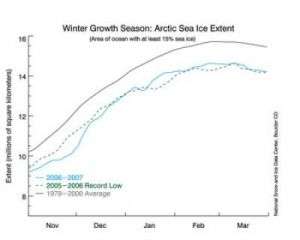
April 4, 2007 Arctic Sea Ice Extent

Arctic Sea Ice Extent. Credit: CU-Boulder

The maximum extent of Arctic sea ice in winter 2007 was the second lowest on satellite record, narrowly missing the 2006 record, according to a team of University of Colorado at Boulder researchers.

The Arctic sea-ice extent, which is the area of ocean covered by at least 15 percent ice, was 5.7 million square miles in March 2007, slightly higher than the record low of 5.6 million square miles measured in March 2006. The declining sea ice has been blamed on higher winter temperatures in the Arctic, a result of rising greenhouse gases in the atmosphere and strong natural variability in the ice, said researcher Walt Meier of CU-Boulder's National Snow and Ice Data Center.

"This year's wintertime low extent is another milestone in a strong downward trend," said Meier. "We're still seeing near-record lows (in sea ice) and higher-than-normal temperatures, and we expect this downward trend to continue in future years."

While researchers monitor Arctic sea ice year round, they pay special attention to the months of March and September because they generally mark the annual maximum and minimum sea-ice extents respectively for the year, Meier said. Sea ice usually stops growing, or recovering, from the summer melt each March.

A review study led by CU-Boulder research scientist Mark Serreze of NSIDC and published in Science last month indicated Arctic sea-ice extent trends have been negative for every month since 1979, when reliable satellite record-keeping efforts began. The September minimum measurements indicate the Arctic has been losing about 38,000 square miles of ice annually.

Source: University of Colorado at Boulder


print this article email this article download pdf blog this article bookmark this article     Stumble it Digg this share on Facebook retweet share on Reddit add to delicious
Rate this story - 3.8 /5 (4 votes)


April 4, 2007 all stories

Comments: 0

3.8 /5 (4 votes)
  • Stumble this up

  • Digg this

  • share this

  • hide
  • Related Stories

  • Cave study links climate change to California droughts
    created Nov 10, 2009 | popularity not rated yet | comments 0
  • Antarctica glacier retreat creates new carbon dioxide store
    created Nov 09, 2009 | popularity not rated yet | comments 0
  • Tackling new Arctic challenges from space
    created Nov 05, 2009 | popularity not rated yet | comments 0
  • Life's Ancient Island in the Ice
    created Oct 29, 2009 | popularity not rated yet | comments 0
  • Feds designate polar bear habitat in Alaska
    created Oct 22, 2009 | popularity not rated yet | comments 0


  • hide
  • Relevant PhysicsForums posts

  • Rocks
    created 8 hours ago
  • Himalayan glaciers
    created 18 hours ago
  • upcoming GRL paper shows CO2 fraction is constant
    created 23 hours ago
  • Is there a point to buying organic?
    created Nov 11, 2009
  • More from Physics Forums - Earth

Other News

A faraway planet intrigues: Exoplanet with extremely tilted orbit raises new interest in stellar astronomy

A faraway planet intrigues: Exoplanet with extremely tilted orbit raises new interest in stellar astronomy

Space & Earth / Astronomy

created 20 minutes ago | popularity 5 / 5 (1) | comments 0

(PhysOrg.com) -- Two teams of astronomers have found a planet outside the solar system that might be orbiting backwards compared to its star's rotation, a discovery that could shed light on how unique the ...


iceberg

Giant Antarctic iceberg heads towards N.Zealand: experts

Space & Earth / Earth Sciences

created 1hour ago | popularity not rated yet | comments 0

A giant iceberg twice the length of Beijing's "Bird's Nest" Stadium has been spotted floating off Australia and could be headed for New Zealand, scientists said on Thursday.


Exoplanets Clue to Sun's Curious Chemistry

Exoplanets Clue to Sun's Curious Chemistry

Space & Earth / Astronomy

created 18 hours ago | popularity 4.7 / 5 (15) | comments 12

(PhysOrg.com) -- A ground-breaking census of 500 stars, 70 of which are known to host planets, has successfully linked the long-standing "lithium mystery" observed in the Sun to the presence of planetary systems. ...


A bubbling ball of gas

A bubbling ball of gas (w/ Video)

Space & Earth / Space Exploration

created 19 hours ago | popularity 4.9 / 5 (15) | comments 5

The Sun is a bubbling mass. Packages of gas rise and sink, lending the sun its grainy surface structure, its granulation. Dark spots appear and disappear, clouds of matter dart up - and behind the whole thing ...


Earth's early ocean cooled more than a billion years earlier than thought: Stanford study

Earth's early ocean cooled more than a billion years earlier than thought (w/ Video)

Space & Earth / Earth Sciences

created 17 hours ago | popularity 4.6 / 5 (9) | comments 1

(PhysOrg.com) -- The scalding-hot sea that supposedly covered the early Earth may in fact never have existed, according to a new study by Stanford University researchers who analyzed isotope ratios in 3.4 ...