X-ray satellites catch magnetar in gigantic stellar 'hiccup'
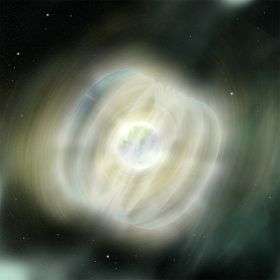
April 4th, 2007 Artist’s impression of a magnetar

Magnetars are neutron stars with extremely powerful magnetic fields. They are extremely dense objects (the size of mountains but weighing as much as the sun), with magnetic fields hundreds of trillions of times more powerful than the Earth’s. The decay of these powerful magnetic fields powers the emission of very energetic radiation, usually in the form of X-rays or Gamma Rays. A seismic event accompanied by a powerful burst was observed on one such magnetar, Westerlund 1 in September 2005. Located in a star cluster about 15 000 light-years away in the Ara constellation in the southern hemisphere, the magnetar goes by the unwieldy official name CXOU J164710.2-455216. Credits: NASA/Swift/Sonoma State University/A. Simonnet

Astronomers using data from several X-ray satellites have caught a magnetar – the remnant of a massive star with an incredibly strong magnetic field – in a sort of giant cosmic blench.

When it comes to eerie astrophysical effects, the neutron stars commonly known as magnetars are hard to beat. The massive remnants of exploded stars, magnetars are the size of mountains but weigh as much as the sun, and have magnetic fields hundreds of trillions of times more powerful than the Earth’s, which pushes our compass needles north.

Now astrophysicists have managed to catch a recently discovered magnetar in a sort of giant cosmic hiccup that still has them puzzled. In multiple reports in the Astrophysical Journal and Monthly Notices of the Royal Astronomical Society, the researchers describe the behaviour of this body, located in a star cluster about 15 000 light-years away in the Ara constellation in the southern hemisphere. The magnetar goes by the unwieldy official name CXOU J164710.2-455216, or more informally, the ‘Westerlund 1 magnetar.’
X-ray satellites catch magnetar in gigantic stellar 'hiccup'

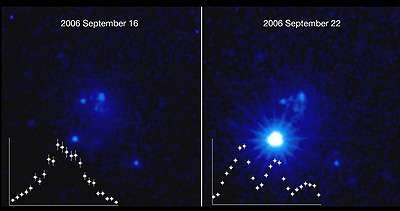
Located in a star cluster about 15 000 light-years away in the Ara constellation in the southern hemisphere, the magnetar goes by the unwieldy official name CXOU J164710.2-455216. These images were taken by the European Photon Imaging Camera (EPIC), on board ESA’s XMM-Newton satellite, using 0.3-12.0 keV photons. The left panel shows the image of the field before the burst. The magnetar is brighter in the right panel, taken after the burst. A seismic event was observed on this object on September 2005 while it was being heavily observed with several satellites, including ESA’s X-ray satellite, XMM-Newton, and NASA's Swift X-ray and gamma-ray observatory. The event caused the surface of the dense star to crack and shine brightly from multiple sources. The light ‘pulses’ from the neutron star as detected by the camera are superimposed. Credits: ESA/XMM-Newton/ California Institute of Technology, M.Muno/G.Israel

"We only know of about a dozen magnetars," says Michael Muno, a scientist at the California Institute of Technology's Space Radiation Laboratory, and the original discoverer of the magnetar in 2005. "In brief, what we observed was a seismic event on the magnetar, which tells us a lot about the stresses these objects endure."
In September 2005, about a year after Muno found the magnetar, the object produced a burst that luckily came at a time when it was being heavily observed with several satellites, including the European Space Agency's X-ray satellite, XMM-Newton, and NASA's Swift X-ray and gamma-ray observatory. Just five days before the burst, Muno and his collaborators had been looking at the magnetar with XMM-Newton and saw it in the relatively calm state in which he had originally found it.

As most magnetars do, it produced a beam of X-ray light that, like the beam from a lighthouse, swept across Earth once every ten seconds. This allowed its rotational rate to be determined very precisely. The event that produced the burst also caused the magnetar to shine 100 times more brightly, created three separate beams that sweep past Earth where previously only one had existed, and sped up its rotation rate by about a thousandth of a second.

Muno says more work is required to understand what happened with the magnetar, because it is built of matter far denser than anything on Earth, and its composition is still a mystery.

However, it is possible to make educated guesses by extending theories developed to explain other neutron stars. The magnetic fields inside the neutron star are probably wound up, like a twisted spring. In a manner somewhat similar to plate tectonics here on Earth, as the magnetic fields unwind, they put stress on the outer crust. The crust would resist these stresses for a while, but would eventually fracture, producing a seismic event. The fractures would cause the magnetar's surface to shine brightly from multiple sources.
Also, there is reason to think that part of the interior of the neutron star is liquid and may be rotating faster than the crust. The seismic event could cause this fluid to become attached to the crust, so that the outer crust would speed up slightly.

"So we think the crust cracked," Muno says, adding that the observations are important for two reasons. "First, we have now seen another way in which these exotic objects dissipate their internal fields as they age.”

"Second, this event was only spotted because a team of us were concentrating hard on this newly discovered object," he adds. "The fact that we saw the event only a year after we discovered the magnetar implies that dozens more could be lurking in our Galaxy."

"If we find many more of these magnetars, we will have to re-evaluate our understanding of what happens when stars die," says Gianluca Israel, an Italian astronomer who is publishing a separate paper on the magnetar with his collaborators in the Astrophysical Journal.

Muno is lead author of a paper appearing this week in Monthly Notices of the Royal Astronomical Society.

Source: ESA


print this article email this article download pdf blog this article bookmark this article     Digg this Stumble it share on Facebook share on Reddit add to delicious save to Yahoo! bookmarks
4.5/5 after 27 votes

Rank Filter

Move the slider to adjust rank threshold, so that you can hide some of the comments.


Display comments: newest first

  • Xray - Jul 21, 2008
    • Rank: not rated yet
    If no one minds some questions from a non-scientist, I have a few. How intense are these gamma rays? Is there a health threat, or is most of the harmful radiation deflected by the earth's magnetosphere?

April 4th, 2007 all stories
Space & Earth / Astronomy

Comments: 1
Rank: 4.5/5 after 27 votes

  • Stumble this up

  • Digg this

  • Share it:
  • share on Facebook
  • share on MySpace
  • share on Slashdot
  • rss-newsfeed
  • share on Google
  • share on Reddit
  • add to delicious
  • save to Yahoo! bookmarks
  • share on Windows Live
  • Add to Mixx!
Rating: 4.5/5 after 27 votes

  • Related Stories

  • Giant eruption reveals 'dead' star
    created Jun 16, 2009 | popularity not rated yet | comments 0
  • Studying the 'mountains' and 'starquakes' that develop on neutron stars
    created May 26, 2009 | popularity not rated yet | comments 0
  • Star crust 10 billion times stronger than steel, physicists find
    created May 06, 2009 | popularity not rated yet | comments 0
  • A Star That Bursts, Blinks and Disappears
    created Sep 30, 2008 | popularity not rated yet | comments 0
  • Powerful explosions suggest neutron star missing link
    created Feb 21, 2008 | popularity not rated yet | comments 0

Tags


  • Physicists Demonstrate Quantum Memory with Matter Qubits
    Physicists Demonstrate Quantum Memory with Matter Qubits
    Physics / General Physics
    created Jul 03, 2009 | popularity 4.4 / 5 (17) | comments 1
  • 'Holey' Nanosheets for Wastewater Dye Removal
    Nanotechnology / Nanomaterials
    created Jul 01, 2009 | popularity 5 / 5 (5) | comments 1
  • Jellyfish Robot Swims Like its Biological Counterpart
    Jellyfish Robot Swims Like its Biological Counterpart
    Electronics / Robotics
    created Jun 26, 2009 | popularity 4.4 / 5 (8) | comments 1
  • Could Maxwell's Demon Exist in Nanoscale Systems?
    Could Maxwell's Demon Exist in Nanoscale Systems?
    Physics / General Physics
    created Jun 24, 2009 | popularity 4.4 / 5 (18) | comments 29
  • Living Safely with Robots, Beyond Asimov's Laws
    Living Safely with Robots, Beyond Asimov's Laws
    Electronics / Robotics
    created Jun 22, 2009 | popularity 4.6 / 5 (52) | comments 40
  • Other News

    Forty years ago man first walked on the moon

    Space & Earth / Space Exploration

    created 12 hours ago | popularity 5 / 5 (2) | comments 1

    Forty years ago on July 20, 1969, American astronaut Neil Armstrong realized the oldest dream of human civilizations when he became the first man to walk on the moon.


    The least sea ice in 800 years

    The least sea ice in 800 years

    Space & Earth / Earth Sciences

    created Jul 01, 2009 | popularity 4.3 / 5 (59) | comments 52

    New research, which reconstructs the extent of ice in the sea between Greenland and Svalbard from the 13th century to the present indicates that there has never been so little sea ice as there is now. The ...


    Gas around young galaxy

    Intense heat killed the Universe's would-be galaxies, researchers say

    Space & Earth / Astronomy

    created Jul 01, 2009 | popularity 3.2 / 5 (19) | comments 27

    (PhysOrg.com) -- Our Milky Way galaxy only survived because it was already immersed in a large clump of dark matter which trapped gases inside it, scientists led by Durham University's Institute for Computational ...


    Scientists' Drill Hits Magma: Only Third Time on Record

    Scientists' Drill Hits Magma: Only Third Time on Record

    Space & Earth / Earth Sciences

    created Jun 29, 2009 | popularity 4.7 / 5 (22) | comments 19

    (PhysOrg.com) -- Scientists drilling a borehole deep into Iceland’s rocky crust to explore new methods of using geothermal energy hit a major roadblock on Thursday: Their drill ran into molten rock at a depth ...


    NASA manager pitches a cheaper return-to-moon plan

    Space & Earth / Space Exploration

    created Jun 30, 2009 | popularity 4 / 5 (7) | comments 18

    (AP) -- Like a car salesman pushing a luxury vehicle that the customer no longer can afford, NASA has pulled out of its back pocket a deal for a cheaper ride to the moon.