Taking nature’s cue for cheaper solar power
April 4, 2007 Taking nature’s cue for cheaper solar power

Solar cell technology developed by the University’s Nanomaterials Research Centre will enable New Zealanders to generate electricity from sunlight at a 10th of the cost of current silicon-based photo-electric solar cells.

Dr Wayne Campbell and researchers in the centre have developed a range of coloured dyes for use in dye-sensitised solar cells.

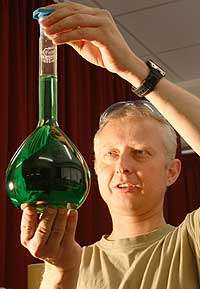
The synthetic dyes are made from simple organic compounds closely related to those found in nature. The green dye Dr Campbell (pictured) is synthetic chlorophyll derived from the light-harvesting pigment plants use for photosynthesis.

Other dyes being tested in the cells are based on haemoglobin, the compound that give blood its colour.

Dr Campbell says that unlike the silicon-based solar cells currently on the market, the 10x10cm green demonstration cells generate enough electricity to run a small fan in low-light conditions – making them ideal for cloudy climates. The dyes can also be incorporated into tinted windows that trap to generate electricity.

He says the green solar cells are more environmentally friendly than silicon-based cells as they are made from titanium dioxide – a plentiful, renewable and non-toxic white mineral obtained from New Zealand’s black sand. Titanium dioxide is already used in consumer products such as toothpaste, white paints and cosmetics.

“The refining of pure silicon, although a very abundant mineral, is energy-hungry and very expensive. And whereas silicon cells need direct sunlight to operate efficiently, these cells will work efficiently in low diffuse light conditions,” Dr Campbell says.

“The expected cost is one 10th of the price of a silicon-based solar panel, making them more attractive and accessible to home-owners.”

The Centre’s new director, Professor Ashton Partridge, says they now have the most efficient porphyrin dye in the world and aim to optimise and improve the cell construction and performance before developing the cells commercially.

“The next step is to take these dyes and incorporate them into roofing materials or wall panels. We have had many expressions of interest from New Zealand companies,” Professor Partridge says.

He says the ultimate aim of using nanotechnology to develop a better solar cell is to convert as much sunlight to electricity as possible.

“The energy that reaches earth from sunlight in one hour is more than that used by all human activities in one year”.

The solar cells are the product of more than 10 years research funded by the Foundation for Research, Science and Technology.

Source: Massey University


print this article email this article download pdf blog this article bookmark this article     Stumble it Digg this share on Facebook retweet share on Reddit add to delicious
Rate this story - 4.7 /5 (52 votes)


April 4, 2007 all stories

Comments: 0

4.7 /5 (52 votes)
  • Stumble this up

  • Digg this

  • share this

  • hide
  • Related Stories

  • Vibrations key to efficiency of green fluorescent protein
    created Nov 11, 2009 | popularity not rated yet | comments 0
  • Porphyrin Dimers Increase Efficiency of Dye-Sensitized Solar Cells
    created Oct 30, 2009 | popularity not rated yet | comments 0
  • How a Solar-Hydrogen Economy Could Supply the World's Energy Needs
    created Aug 24, 2009 | popularity not rated yet | comments 0
  • Bringing solar power to the masses
    created Aug 05, 2009 | popularity not rated yet | comments 0
  • Project Sage: Bringing Solar Power to the Masses (w/ Video)
    created Jul 23, 2009 | popularity not rated yet | comments 0


  • hide
  • Relevant PhysicsForums posts

  • Thin Film Laboratory resources
    created 9 hours ago
  • Theoretical air URGENT
    created 20 hours ago
  • photoconductivity of polymers
    created Nov 25, 2009
  • Heat pipe for high temperature
    created Nov 24, 2009
  • More from Physics Forums - Materials & Chemical Engineering

Other News

Nanowire Formation

Nanowires key to future transistors, electronics

Nanotechnology / Nanophysics

created 21 hours ago | popularity 4.8 / 5 (8) | comments 1

(PhysOrg.com) -- A new generation of ultrasmall transistors and more powerful computer chips using tiny structures called semiconducting nanowires are closer to reality after a key discovery by researchers ...


Water droplets direct self-assembly process in thin-film materials

Nanotechnology / Nanomaterials

created Nov 23, 2009 | popularity 5 / 5 (4) | comments 2

You can think of it as origami - very high-tech origami. Researchers at the University of Illinois have developed a technique for fabricating three-dimensional, single-crystalline silicon structures from thin films by coupling ...


Using superconducting probes to get a picture of what it's like inside CNTs

Nanotechnology / Nanophysics

created Nov 20, 2009 | popularity 4.4 / 5 (9) | comments 0

(PhysOrg.com) -- "Carbon nanotubes are exciting for fundamental physics, and for potential technological applications," Nadya Mason tells PhysOrg.com. "However, we are generally limited in the way that we can study them. ...


Peptides control crystal growth with 'switches, throttles and brakes'

Peptides control crystal growth with 'switches, throttles and brakes'

Nanotechnology / Bio & Medicine

created Nov 23, 2009 | popularity 4.8 / 5 (5) | comments 0

(PhysOrg.com) -- By producing some of the highest resolution images of peptides attaching to mineral surfaces, scientists have a deeper understanding how biomolecules manipulate the growth crystals. This research ...


Fast, easy, and highly sensitive arsenic detection with gold nanoparticles

Nanotechnology / Nanomaterials

created Nov 25, 2009 | popularity 5 / 5 (1) | comments 0

(PhysOrg.com) -- Mention of arsenic poisoning usually brings to mind underhanded murder. However, the danger of arsenic poisoning from contaminated drinking water is far greater. Low concentrations of arsenic are found in ...