Fish evolve a longer lifespan by evolving a longer period during which they reproduce
January 2nd, 2006 Fish evolve a longer lifespan by evolving a longer period during which they reproduce

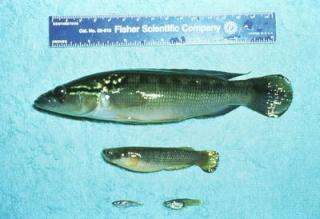
Image: The fish at the top is the pike cichlid, Crenicichla alta. It is one of the key predators in high-predation localities. The middle fish is the killifish Rivulus hartii. It is the only predator that co-occurs with guppies in low-predation sites. The fish on the bottom left is an adult male guppy while the one on the bottom right is an adult female guppy. Photo credit. D. Reznick.

A UC Riverside-led research team has found that as some populations of an organism evolve a longer lifespan, they do so by increasing only that segment of the lifespan that contributes to “fitness” – the relative ability of an individual to contribute offspring to the next generation.

Focusing on guppies, small fresh-water fish biologists have studied for long, the researchers found that guppies living in environments with a large number of predators have adapted to reproduce earlier in life than guppies from low-predation localities. Moreover, when reproduction ceases, guppies from high-predation localities are far older, on average, than guppies from low-predation localities, indicating that high-predation guppies enjoy a long “reproductive period” – the time between first and last reproduction.

“In earlier work, we showed that guppies from high predation environments have longer lifespans,” said David Reznick, professor of biology. “Our new study explores how and why this happens. We found that fish from populations enjoying longer lifespans live longer because there is a selective increase in their reproductive lifespan. Indeed, theory predicts this result because only reproductive lifespan determines fitness.”
Fish evolve a longer lifespan by evolving a longer period during which they reproduce

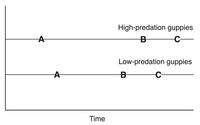
Image: Guppies in environments with a high number of predators live longer than low-predation guppies because the former have evolved a long reproductive period, a study led by David Reznick reports. In the above chart, "A" marks the time reproduction begins, "B" marks the time reproduction ceases, and "C" marks the time of death for guppies. The reproductive period is therefore AB.

Study results appear Dec. 27 in the online edition of the Public Library of Science – Biology.

The study supports the controversial hypothesis that natural selection – the process in nature by which only organisms best adapted to their environment tend to survive and pass on their genetic characters in increasing numbers to succeeding generations – introduces changes in only a specific segment of an organism’s lifespan.

The researchers conducted their experiments by comparing life-history traits in 240 guppies they retrieved from high- and low-predation streams in mountains in Trinidad. In their analysis, they divided the life history into three non-overlapping segments: the age at maturity (birth to first reproduction), the reproductive lifespan (first to last reproduction) and the post-reproductive lifespan (last reproduction to death). They also devised a statistical criterion for evaluating whether or not guppies had a post-reproductive lifespan, that is, did guppies live significantly past the end of their capacity to reproduce?

“We were exploring whether or not fish have the equivalent of mammalian menopause,” Reznick said. “We found that 60 percent of the fish had a significant post-reproductive lifespan, indicating that, yes, fish do have menopause. Indeed, their patterns of growing old are similar to those of mammals.”

The researchers’ statistical analysis also showed that regardless of which environments the guppies lived in, there were no differences among their populations in the probability of having a post-reproductive lifespan or in its duration.

“This is just what one might predict because these fish provide no care for their young,” explained Reznick. “The older fish, after they stop reproducing, do not contribute to the fitness of young fish. As a result, the post-reproductive period is not influenced by natural selection. This result could be of interest to those who study menopause in humans and who have argued that post-reproductive humans can increase their own fitness by contributing to the fitness of their grandchildren and that the prolonged post-reproductive lifespan of humans is, therefore, the product of natural selection.

“But such arguments are difficult to prove by working on a single population or species. Nevertheless, our results show how it would be possible to evaluate whether or not menopause in humans has been shaped by natural selection. Appropriate comparisons, such as those between humans and apes, would help.”

Reznick was assisted in the study by Michael Bryant of the California Institute of the Arts and Donna Holmes of the University of Idaho. The Population Biology Division of the National Research Foundation provided support.

Source: University of California, Riverside


print this article email this article download pdf blog this article bookmark this article     Digg this Stumble it share on Facebook share on Reddit add to delicious save to Yahoo! bookmarks
2.6/5 after 5 votes


January 2nd, 2006 all stories
Other Sciences /

Comments: 0
Rank: 2.6/5 after 5 votes

  • Stumble this up

  • Digg this

  • Share it:
  • share on Facebook
  • share on MySpace
  • share on Slashdot
  • rss-newsfeed
  • share on Google
  • share on Reddit
  • add to delicious
  • save to Yahoo! bookmarks
  • share on Windows Live
  • Add to Mixx!
Rating: 2.6/5 after 5 votes


Tags


  • Physicists Demonstrate Quantum Memory with Matter Qubits
    Physicists Demonstrate Quantum Memory with Matter Qubits
    Physics / General Physics
    created Jul 03, 2009 | popularity 4.4 / 5 (17) | comments 1
  • 'Holey' Nanosheets for Wastewater Dye Removal
    Nanotechnology / Nanomaterials
    created Jul 01, 2009 | popularity 5 / 5 (5) | comments 1
  • Jellyfish Robot Swims Like its Biological Counterpart
    Jellyfish Robot Swims Like its Biological Counterpart
    Electronics / Robotics
    created Jun 26, 2009 | popularity 4.4 / 5 (8) | comments 1
  • Could Maxwell's Demon Exist in Nanoscale Systems?
    Could Maxwell's Demon Exist in Nanoscale Systems?
    Physics / General Physics
    created Jun 24, 2009 | popularity 4.4 / 5 (18) | comments 29
  • Living Safely with Robots, Beyond Asimov's Laws
    Living Safely with Robots, Beyond Asimov's Laws
    Electronics / Robotics
    created Jun 22, 2009 | popularity 4.6 / 5 (52) | comments 40
  • Other News

    Creation Museum president Ken A. Ham

    Paleontologists brought to tears, laughter by Creation Museum

    Other Sciences / Other

    created Jun 30, 2009 | popularity 4.3 / 5 (41) | comments 120

    For a group of paleontologists, a tour of the Creation Museum seemed like a great tongue-in-cheek way to cap off a serious conference.


    Mummified dinosaur skin yields up new secrets

    Mummified dinosaur skin yields up new secrets

    Other Sciences / Archaeology & Fossils

    created Jul 01, 2009 | popularity 4.7 / 5 (14) | comments 10

    (PhysOrg.com) -- Scientists from The University of Manchester have identified preserved organic molecules in the skin of a dinosaur that died around 66-million years ago.


    Liberal? Conservative? Stanford study says mental nudge can make voters flip-flop

    Liberal? Conservative? Stanford study says mental nudge can make voters flip-flop

    Other Sciences / Social Sciences

    created Jul 02, 2009 | popularity 3.8 / 5 (5) | comments 4

    (PhysOrg.com) -- No doubt you’ve worked hard for your success. But chances are you’ve also had some help and lucky breaks along the way.


    Probing Question: How do Ponzi Schemes work?

    Other Sciences / Economics

    created Jul 02, 2009 | popularity 5 / 5 (1) | comments 2

    Imagine the shock, the horror, and the sheer panic that would come with learning that the financial plan you’d sunk your life savings into was a sham, the financial experts you trusted were crooks, and all your money was ...


    Tourists enjoy a "Pineapple Tour" in Costa Rica

    Costa Rica tops happiness, 'green living' poll

    Other Sciences / Social Sciences

    created Jul 04, 2009 | popularity 2 / 5 (2) | comments 0

    Costa Rica is the happiest place on earth, and one of the most environmentally friendly, according to a new survey by a British non-governmental group.