Females do best if they wait a while
April 5, 2007 Females do best if they wait a while

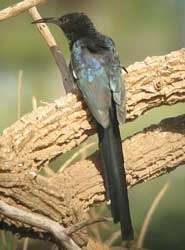
A green woodhoopoe.

Starting to breed late in life is a bad idea if you want to maximise the number of offspring that you produce - or so the theory goes. But doubt has now been cast on this hypothesis - one of the biggest assumptions in behavioural ecology - by researchers from the universities of Bristol and Cape Town and published today in Current Biology.

Green woodhoopoes are a cooperative bird species that live in year-round, residential groups of 2-12 individuals in which only one pair breeds per season. The remaining individuals help to raise the offspring of the dominant pair, while waiting to breed themselves. Consequently, although both males and females reach reproductive maturity at one year of age, individuals may not start breeding for several years.

Using data gathered over 24 years, Dr Andy Radford and colleagues demonstrate that the females that started breeding later in life actually had more offspring than those that started earlier. Males, on the other hand, met the traditional expectation that a delayed start to breeding results in fewer offspring.

The researchers hypothesise that this surprising and apparently paradoxical situation is because females that attempt to start breeding early in life have a very high mortality rate. In contrast, females who start breeding later tend to live longer, have longer breeding careers, and thus produce more fledglings.

Dr Radford, from Bristol University's School of Biological Sciences, who is funded by the BBSRC, said: "It has been generally assumed that males and females suffer similarly from a delayed start to breeding, and many studies have investigated how non-breeding birds might mitigate this assumed cost. However, as in many facets of life, the sexes differ dramatically: although male woodhoopoes do indeed suffer if they don't start breeding as soon as possible, females do best to wait a while."

The authors postulate that the reason why young females have such a high mortality rate when attempting to breed is that they are not in as good condition as older females. Because breeding female woodhoopoes lay all the eggs and conduct all the incubation, they pay a potentially high cost.

This is exacerbated because in incubating the eggs overnight, the breeding female sleeps alone, while the rest of the group roost communally; she therefore suffers a potential thermoregulatory cost in addition to the costs associated with laying and incubation. If young females are in poorer condition than older females, they will be more likely to die as a consequence of these costs.

Source: University of Bristol


print this article email this article download pdf blog this article bookmark this article     Stumble it Digg this share on Facebook retweet share on Reddit add to delicious
Rate this story - 3.5 /5 (6 votes)


April 5, 2007 all stories

Comments: 0

3.5 /5 (6 votes)
  • Stumble this up

  • Digg this

  • share this

  • hide
  • Related Stories

  • Should females trust showy males?
    created Aug 21, 2009 | popularity not rated yet | comments 0
  • San Diego Zoo panda gives birth to 5th cub
    created Aug 05, 2009 | popularity not rated yet | comments 0
  • China announces first panda from frozen sperm
    created Jul 24, 2009 | popularity not rated yet | comments 0
  • Spread your sperm the smart way
    created Jul 09, 2009 | popularity not rated yet | comments 0
  • Most endangered feline brought back from the brink
    created Jun 21, 2009 | popularity not rated yet | comments 0


Other News

Hammerhead shark

Wide heads give hammerheads exceptional stereo view

Biology / Plants & Animals

created 8 hours ago | popularity 4.3 / 5 (4) | comments 4

Hammerhead sharks are some of the Ocean's most distinctive residents. 'Everyone wants to understand why they have this strange head shape,' says Michelle McComb from Florida Atlantic University. One possible ...


Tough yet stiff deer antler is materials scientist's dream

Biology / Plants & Animals

created 8 hours ago | popularity not rated yet | comments 2

Prized for their impressive antlers, red deer have been caught in the hunters' sights for generations. But a deer's antlers are much more than decorative. They are lethal weapons that stags crash together when duelling. John ...


Indonesia rejects Bali plan for turtle sacrifices (AP)

Indonesia rejects Bali plan for turtle sacrifices

Biology / Ecology

created 6 hours ago | popularity not rated yet | comments 0

(AP) -- Indonesia has rejected a push by the resort island of Bali for rare turtles to be legally slain in Hindu ceremonies, siding with conservationists of the protected reptiles against religious advocates, ...


Ecologists sound out new solution for monitoring cryptic species

Biology / Ecology

created 8 hours ago | popularity not rated yet | comments 0

Ecologists have at last worked out a way of using recordings of birdsong to accurately measure the size of bird populations. This is the first time sound recordings from a microphone array have been translated into accurate ...


The six elephants in Sierra Leone were shot and "crudely butchered"

S.Leone elephants 'wiped out' by poachers: official

Biology / Ecology

created Nov 26, 2009 | popularity 5 / 5 (5) | comments 6

Poachers "wiped out" the entire elephant herd in Sierra Leone's only wildlife park, wildlife managers said Thursday after police said they had arrested a gang of 10 poachers.