Ancient Genetic Material Keeps Pups Pint-Sized
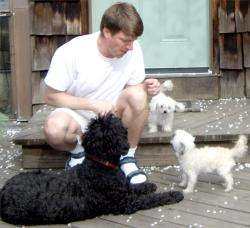
Soon after humans began domesticating dogs 12,000 to 15,000 years ago, they started breeding small canines. Now, scientists from the University of Utah and seven other institutions have identified a piece of doggy DNA that reduces the activity of a growth gene, ensuring that small breeds stay small.
The small piece of DNA is not a gene, but is known as a regulatory sequence. It is located on dog chromosome 15 next to a previously known gene named IGF1, for insulin-like growth factor 1. The gene and regulatory sequence together are known as a haplotype or variant, and that haplotype was found in all breeds of small dogs, showing it "is a major contributor to body size in all small dogs," the research team reports in the Friday, April 6 issue of the journal Science. The study is featured on Science's cover.
The scientists have not yet pinpointed the exact mutation in the regulatory DNA that reduces the IGF1 gene's output of a growth-inducing protein hormone. But finding the short stretch of DNA that keeps small dogs small serves as a model for how to track down genetic causes of complex, multigene traits, including human diseases such as heart disease, diabetes, arthritis and cancer, say study co-authors K. Gordon Lark and Kevin Chase, biologists at the University of Utah.
The IGF1 gene's hormone helps humans and other mammals grow from birth to adolescence. But in small dogs, one or more mutations in the DNA next to the IGF1 gene suppress the gene's activity, keeping small dogs from growing larger, says Lark, a distinguished professor emeritus of biology.
Medium and large dogs also have the IGF1 gene, but they do not have the same piece of DNA next to it, so their size is not restricted by that DNA, says Chase, a biology research specialist. Other yet-unidentified genes likely play a role in controlling the size of medium and large dogs, he adds.
Lark and Chase are among 21 authors of the new study, which was led by geneticists Elaine Ostrander and Nathan B. Sutter at the National Human Genome Research Institute, which is one of the National Institutes of Health in Bethesda, Md.
Other coauthors of the study are from Cornell University in Ithaca, N.Y.; the University of California, Los Angeles; the University of Southern California; the Waltham Centre for Pet Nutrition in Leicestershire, England; the University of Missouri, Columbia; and the Nestle Research Center in St. Louis.
Hot on the Trail of Little Dogs
The Utah researchers played a key role in the new study, which began with their research on Portuguese water dogs, a breed with sizes ranging from small to large.
"Lark and Chase were instrumental in the success of this study," says Ostrander, the study's senior author and chief of cancer genetics at the National Human Genome Research Institute. "Their approach was very clever. They enlisted the help of hundreds of pet dog owners across America to provide DNA samples and body-size measurements in the form of X-rays from over 500 Portuguese water dogs. That allowed a careful analysis of all the dog's chromosomes and the eventual identification of a region on canine chromosome 15 where a gene critical for controlling body size was likely to lie."
"Dogs have the biggest range of sizes of any mammal in existence," says Lark. "One of the big questions has always been, where does this range of sizes come from? By studying the Portuguese water dog, which has three-fold range of sizes – from 25 pounds to 75 pounds – we realized that IGF1 was a big player."
A scan of the dog genome at the University of Utah found a long stretch of DNA (called a quantitative trait locus) on chromosome 15 that strongly correlated with size in Portuguese water dogs. IGF1 was within that stretch of DNA, but so were about 100 other genes.
Chase and Lark suspected IGF1 was involved in keeping small dogs small for several reasons: It produces a growth factor. Another study showed poodles are larger if they have more of the growth factor in their blood. And a disabled version of the gene was known to produce small mice and was linked to an unusual case of a tiny person.
But to turn suspicion into fact, many more breeds had to be examined. So the study eventually expanded the genetic analysis to 3,241 dogs from 143 breeds, ranging from small ones like bichon frise, Chihuahua, Maltese, Pomeranian, toy poodle, pug and Pekingese to large breeds such as Saint Bernard, Newfoundland, mastiff, Great Dane, Irish wolfhound, and standard poodle.
Ostrander, Sutter and colleagues traveled to dog shows across the country to collect blood or cells. Their analyses confirmed that the location of genetic instructions for keeping dogs small was near the IGF1 gene.
"All dogs under 20 pounds have this – all of them," Lark says. "That's extraordinary."
Oddly, so do Rottweilers, which are large. But even though they have the small-dog haplotype, other yet-unidentified genetic factors make them big, Chase says.
Researchers plan to breed mice with the small-dog haplotype – the IGF1 gene and nearby DNA – to see how mouse size is affected and pinpoint the exact mutation responsible for small size. Chase says one or more of six mutations in the short DNA regulatory sequence are suspected of reducing activity of the growth factor gene.
From Wolves to Chihuahuas: The Baby-ization of Dogs
Dogs evolved from wolves sometime before 12,000 to 15,000 years ago, when they were domesticated by humans. Because the small-dog genetic material is found in small breeds that are distantly related and found in distant regions, the researchers concluded the genetic instructions to make dogs small must be at least 12,000 years old.
"It's as ancient as all small dogs," Lark says. "Dogs are derived from wolves. Since this is found in all small dogs, it either got into dogs when they were first domesticated, or it was a small wolf that dogs descended from. The small dog haplotype is not found in wolves today."
The genetic instructions to make dogs small arose either because "a small wolf couldn't survive in nature, but it could survive in company with humans" or because an early human "wanted to domesticate a wolf and they didn't want to adopt a big sucker" due to confined quarters in early cities, he adds.
Lark says this "unnatural selection" led to global proliferation of small dogs.
"Everybody treats their dogs like their babies, so it's not surprising they would select for tiny dogs," says Chase, who owns a pair of 4-pound, toy poodle-Maltese mixes. "Tiny dogs are not particularly functional. They don't hunt with you. They don't protect your house. They don't pull carts. They're just small and sweet."
Some also are yappy, but Chase says: "Yappy we didn't study."
The researchers wrote that the genetic code to make small dogs "was readily spread over a large geographic area by trade and human migration."
Or, as Lark puts it: "A local sailor came in with a small dog and everyone said, 'Ooh, I want a dog like that! Can I use him to father my next dog?'"
Meanwhile, other people bred dogs to be large for use as guard dogs, hunting dogs, and war dogs (like mastiffs) and even to pull carts, Lark says.
How it Started: A Dog Named Georgie
The study has its roots in the death of Lark's beloved dog Georgie. Lark, whose earlier work focused on soybean genetics, adopted Georgie, a stray, in 1986, not knowing until a few years later that she was a Portuguese water dog. In 1996, Georgie died from an autoimmune anemia that destroyed her blood cells.
Lark looked for a replacement, and contacted Karen Miller, a breeder in New York state. He mentioned he studied soybean genetics. Miller heard only genetics, and began pestering Lark to study dog genetics. She sent him an expensive Portuguese water dog – Mopsa, who is now 10 years old – free of charge. Within three months, she also sent him 5,000 pedigrees.
To their surprise, Chase and Lark realized Portuguese water dogs were ideal for genetic studies because they all descended from a small number of "founders" – a characteristic that also makes Utah's Mormon population ideal for human genetic research. So they began recruiting Portuguese water dog owners to provide samples of their pooches' DNA.
Lark, Chase and others thus began "The Georgie Project," looking for long stretches of the dog genome with genes and other DNA that made Portuguese water dogs vary in size and shape, and in their tendency to develop osteoarthritis and Addison’s disease, a hormone disorder suffered by assassinated U.S. President John F. Kennedy.
"There are at least 1,000 Portuguese water dog owners throughout the country who are very proud of the fact their breed has led the way," Lark says.
Chase adds: "Portuguese water dogs put dogs on the map in terms of a model system for looking for genes responsible for complex traits."
Ostrander praised Lark and Chase, saying, "Their creativity, vision and hard work are evident in every step of the study. The University of Utah has been extremely visionary in their support of this work."
Source: University of Utah


