An X-ray Time Machine?
April 5th, 2007 By Brad Plummer An X-ray Time Machine?

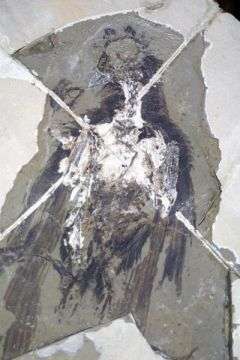
Fossilized bird, 122 million years old. Credit: Stanford Linear Accelerator Center

There's nothing new about using x-rays to look at bones. But using them on bones a hundred million years old is another story. This week, a team of researchers visiting SSRL is finding that when it comes to ancient fossils and bones locked in stone, x-rays may be revolutionizing the science of paleontology.

Fossilized remains of birds, sharks, squid and other ancient creatures contain far more than the flat, skeletal traces visible to the eye, according to materials scientist Bob Morton. Almost 20 years ago, Morton came up with the idea of using x-rays to map the invisible chemistry hidden within fossils, elements left behind as a living creature decays.

Now, using the x-ray fluorescence microprobe at SSRL's Beamline 6-2, Morton and his team are finding details long thought by fossil experts to be irretrievable. From ancient samples of shale and limestone are emerging the first ever images of the ghostly remnants of soft tissues—the organs and skin of a shark, the tentacles of an extinct squid, and possibly a heart of a bird that died 122 million years ago.

"This is a story about chemical fossils," said Morton. "In the past people have focused on physical fossils. But now we can take a detailed look at life going back billions of years in a way never before possible. Knowing the chemistry of ancient creatures and how they are preserved elementally can yield clues about genetics, and help scientists fill in gaps on the tree of life going back to the first evidence of life on earth."

The process of fossilization is still mostly a mystery. When an animal dies in mud or silt, it is primarily the hard parts such as bones or shells that persist as fossils. At least that's how it looks to our eyes. Depending on how the animal decays, the soft tissues dissolve, but their chemical traces remain. Squid, for example, utilize copper instead of iron as part of the oxygen carrying component in their blood; mapping out the copper in a fossilized squid could reveal clues about its ancient circulatory system.

Mapping the chemistry of fossils is giving researchers a revolutionary glimpse into the biodiversity of the ancient world, said paleontologist Peter Larson of the Black Hills Institute in South Dakota. Larson has studied fossils for more than 30 years and his team from Black Hills Institute excavated the celebrated T. rex skeleton "Sue."

"Here we have a new way of looking at fossils and the fossilization process," said Larson. "This really is a first. Sort of like the moment the apple fell on Newton's head. Maybe this will open up a new field of dinosaur CSI."

Among the samples Morton, Larson and colleagues examined so far are the skin of a Tyrannosaurus rex and Triceratops, an 80-million-year-old shark from Lebanon, and 530-million-year-old samples of Burgess Shale from Canada which represent some of the earliest well-fossilized creatures on earth.

Source: Stanford Linear Accelerator Center


print this article email this article download pdf blog this article bookmark this article     Digg this Stumble it share on Facebook share on Reddit add to delicious save to Yahoo! bookmarks
4.4/5 after 32 votes


April 5th, 2007 all stories
Other Sciences / Archaeology & Fossils

Comments: 0
Rank: 4.4/5 after 32 votes

  • Stumble this up

  • Digg this

  • Share it:
  • share on Facebook
  • share on MySpace
  • share on Slashdot
  • rss-newsfeed
  • share on Google
  • share on Reddit
  • add to delicious
  • save to Yahoo! bookmarks
  • share on Windows Live
  • Add to Mixx!
Rating: 4.4/5 after 32 votes


Tags


  • Physicists Demonstrate Quantum Memory with Matter Qubits
    Physicists Demonstrate Quantum Memory with Matter Qubits
    Physics / General Physics
    created Jul 03, 2009 | popularity 4.4 / 5 (17) | comments 1
  • 'Holey' Nanosheets for Wastewater Dye Removal
    Nanotechnology / Nanomaterials
    created Jul 01, 2009 | popularity 5 / 5 (5) | comments 1
  • Jellyfish Robot Swims Like its Biological Counterpart
    Jellyfish Robot Swims Like its Biological Counterpart
    Electronics / Robotics
    created Jun 26, 2009 | popularity 4.4 / 5 (8) | comments 1
  • Could Maxwell's Demon Exist in Nanoscale Systems?
    Could Maxwell's Demon Exist in Nanoscale Systems?
    Physics / General Physics
    created Jun 24, 2009 | popularity 4.4 / 5 (18) | comments 29
  • Living Safely with Robots, Beyond Asimov's Laws
    Living Safely with Robots, Beyond Asimov's Laws
    Electronics / Robotics
    created Jun 22, 2009 | popularity 4.6 / 5 (53) | comments 40
  • Other News

    Creation Museum president Ken A. Ham

    Paleontologists brought to tears, laughter by Creation Museum

    Other Sciences / Other

    created Jun 30, 2009 | popularity 4.3 / 5 (44) | comments 126

    For a group of paleontologists, a tour of the Creation Museum seemed like a great tongue-in-cheek way to cap off a serious conference.


    Mummified dinosaur skin yields up new secrets

    Mummified dinosaur skin yields up new secrets

    Other Sciences / Archaeology & Fossils

    created Jul 01, 2009 | popularity 4.7 / 5 (15) | comments 10

    (PhysOrg.com) -- Scientists from The University of Manchester have identified preserved organic molecules in the skin of a dinosaur that died around 66-million years ago.


    Liberal? Conservative? Stanford study says mental nudge can make voters flip-flop

    Liberal? Conservative? Stanford study says mental nudge can make voters flip-flop

    Other Sciences / Social Sciences

    created Jul 02, 2009 | popularity 3.8 / 5 (6) | comments 4

    (PhysOrg.com) -- No doubt you’ve worked hard for your success. But chances are you’ve also had some help and lucky breaks along the way.


    Probing Question: How do Ponzi Schemes work?

    Other Sciences / Economics

    created Jul 02, 2009 | popularity 5 / 5 (2) | comments 2

    Imagine the shock, the horror, and the sheer panic that would come with learning that the financial plan you’d sunk your life savings into was a sham, the financial experts you trusted were crooks, and all your money was ...


    New fossil primate suggests common Asian ancestor, challenges primates such as 'Ida'

    New fossil primate suggests common Asian ancestor, challenges primates such as 'Ida'

    Other Sciences / Archaeology & Fossils

    created Jul 01, 2009 | popularity 4.4 / 5 (11) | comments 0

    According to new research published online in the Proceedings of the Royal Society B (Biological Sciences) on July 1, 2009, a new fossil primate from Myanmar (previously known as Burma) suggests that the co ...