No Foolin' -- 'Lab on a Chip' Works!
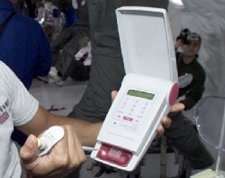
"What a huge relief," says Norman Wainwright of the Charles River Laboratories in Charleston, SC. "The whole technical team was delighted that it worked so well."
He's talking about a miniature biological laboratory just tested for the first time onboard the International Space Station. Called LOCAD-PTS (short for Lab-On-a-Chip Application Development–Portable Test System), the mini-lab detects the presence of bacteria or fungi on the surfaces of a spacecraft far more rapidly than standard methods of culturing.
"The ability to monitor microorganisms would be especially important on long space voyages, not only to check the health of astronauts but also to monitor electronics and structural materials, which can be corroded or otherwise damaged by certain fungi and bacteria," says Wainwright, the experiment's principal investigator. LOCAD-PTS is designed so that "astronauts can do the analysis onboard with no need to return samples to laboratories on Earth."
The device was launched last December 9th on board the space shuttle Discovery, and then stowed aboard ISS until its scheduled experiment time—which happened to be Saturday night, March 31, Marshall Space Flight Center time. (Remember that time!)
Astronaut Sunita "Suni" Williams opened the instrument kit bag, assembled LOCAD-PTS, and then took six readings. "The first two readings were controls to show that the instrument was operating correctly," explains Jake Maule, LOCAD-PTS project scientist at the Carnegie Institution of Washington. "First she swabbed her palm, which she had first pressed to handrails and other often-handled surfaces that should have had lots of bacteria—and indeed, we got a strong positive reading," he continues. "Then she sampled some ultraclean water in the instrument that is used to moisten samples, to check that the water was truly clean—and indeed, we got a great negative reading."
Next, Williams chose a wall panel in ISS Node 1 to test using both LOCAD-PTS and, for comparison, a standard culturing method.
For the standard method, she pressed a layer of solid gel growth medium (rather like agar) to the panel for a few seconds, replaced it securely in its packaging, and then set it aside to incubate for a few days.
Then she took a dry swab, rather like a high-tech Q-tip, from LOCAD-PTS and rubbed it on the panel next to the same area. Flushing ultraclean water through the swab converted the sample to liquid form, and a few drops were dispensed into the hand-held LOCAD-PTS instrument.
"The cleaner the sample, the longer the analysis takes," Wainwright says. "Because this site was pretty clean, it took about 12 minutes, but dirty samples can take as little as a couple of minutes."
It was during the wait that Williams must have noted the time. Although it was 10:20 PM Central Daylight Time at Marshall in Huntsville, Alabama, where all the LOCAD-PTS scientists were anxiously watching television monitors, it was actually past midnight on April 1, Greenwich Mean Time, the time zone used by ISS.
"Suni said, 'Ah, this last set of readings for LOCAD-PTS looks a bit strange,'" Maule recalls. "After a pause of about five seconds, she exclaimed, 'Happy April Fools' Day! The numbers are just fine!'"
"She definitely got me!" he laughs.
Over the next few months, LOCAD-PTS and standard culture methods will be used to investigate different parts of ISS. "A second-generation of LOCAD-PTS cartridges for the specific detection of fungi are scheduled to launch to ISS on Space Shuttle STS-123," says Anthony T. Lyons, LOCAD-PTS project manager at Marshall, the NASA center that has overseen the project since its inception and supervised getting the equipment spaceflight-ready. "With each generation of cartridges, we are getting more and more specific in what we detect. Our ultimate aim is to provide the crew with a selection of cartridges for the detection of a wide variety of target compounds, biological and chemical both inside and outside the spacecraft—something that would be especially important for long-duration missions to the Moon or to Mars."
"Right now, we're very happy with the first tests."
Source: By Trudy E. Bell, Science@NASA


