Behavioural tests probe ray and shark colour vision
April 10, 2007 Behavioural tests probe ray and shark colour vision

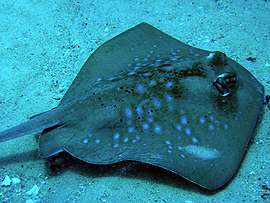
Blue spotted stingray in Moreton Bay. Photo: Susan Theiss

University of Queensland researchers have shown stingrays, once thought to be colour-blind, may be capable of seeing in colour.

They have shown the blue-spotted maskray, a common stingray in Moreton Bay, has all the physical components necessary for colour vision.

Susan Theiss, a Californian PhD student working on the project, said seeing in colour could help rays find mates, detect prey and avoid predators.

Her UQ team of supervisors Dr Nathan Hart and Professor Shaun Collin and collaborator Professor Justin Marshall, started behavioural tests on shovelnose rays and reef sharks at UQ's Heron Island Research Station, off Gladstone in March.

Dr Hart said the animals were being trained to associate a coloured light with food and tested to see if they could discriminate between the training colour and a light of different colour.

He said he was unsure when these tests would be done because the Station had to be rebuilt after the fire on Friday, March 30.

He said he lost $20,000 of his equipment and about six months of research in the blaze. However, he was hopeful the experiments could be repeated in the future.

Although rays have the apparatus to see colour, the tests should confirm if they can use that colour information.

He said the blue spotted maskray was different to the bull ray that killed Crocodile Hunter Steve Irwin but it was likely that many rays had similar colour vision.

Dr Hart is also investigating whether sharks have the potential for colour vision for his ARC QEII Fellowship.

He said knowing more about ray and shark vision could eventually help in the design of wetsuits and surfboards to reduce attacks on divers, surfers and swimmers.

Professor Collin, a fish vision expert, said that the design of trawler nets could potentially be altered to reduce shark and ray catches.

Miss Theiss, who is currently studying the sensory biology and ecology of wobbegong sharks, will travel to London later this year to study the genetics of ray and shark eyes.

Susan's work has been published in the Journal of Comparative Physiology.

Source: University of Queensland


print this article email this article download pdf blog this article bookmark this article     Stumble it Digg this share on Facebook retweet share on Reddit add to delicious
Rate this story - 4 /5 (2 votes)


April 10, 2007 all stories

Comments: 0

4 /5 (2 votes)
  • Stumble this up

  • Digg this

  • share this

  • hide
  • Related Stories

  • Cosmic meddling with the clouds by seven-day magic
    created Aug 01, 2009 | popularity not rated yet | comments 0
  • Scientists Probe Green Comet
    created Feb 20, 2009 | popularity not rated yet | comments 0
  • New x-ray technique targets terrorists and tumours
    created Nov 29, 2007 | popularity not rated yet | comments 0
  • New guide to sharks and rays of Indonesia
    created Feb 28, 2007 | popularity not rated yet | comments 0
  • The topsy-turvy galaxy
    created Nov 27, 2006 | popularity not rated yet | comments 0


Other News

New study describes connections between Circadian and metabolic systems

Biology / Other

created 2 hours ago | popularity not rated yet | comments 0

A paper by University of Notre Dame biologist Giles Duffield and a team of researchers offers new insights into a gene that plays a key role in modulating the body's Circadian system and may also simultaneously modulate its ...


A biology whodunnit: are rodents helping protect trees from fire?

A biology whodunnit: are rodents helping protect trees from fire?

Biology / Ecology

created 1hour ago | popularity not rated yet | comments 0

Tom Parker has made an unusual find. In California forests and shrubland that burned in 2008, he has spotted Manzanita seedlings sprouting in tight clusters, suggesting that the young shrubs emerged from underground ...


neuron

To make memories, new neurons must erase older ones

Biology / Cell & Microbiology

created 7 hours ago | popularity 5 / 5 (3) | comments 0

Short-term memory may depend in a surprising way on the ability of newly formed neurons to erase older connections. That's the conclusion of a report in the November 13th issue of the journal Cell that provid ...


With Help from a Bacterium, Cockroaches Develop Way to Store Excess Uric Acid

With Help from a Bacterium, Cockroaches Develop Way to Store Excess Uric Acid

Biology / Plants & Animals

created 4 hours ago | popularity 5 / 5 (1) | comments 0

(PhysOrg.com) -- What life form can use materials as nutrients that we, and most other animals, would consider waste products?


New explanation for nature's hardiest life form

Biology / Cell & Microbiology

created 9 hours ago | popularity 4.3 / 5 (3) | comments 0

Got food poisoning? The cause might be bacterial spores, en extremely hardy survival form of bacteria, a nightmare for health care and the food industry and an enigma for scientists. Spore-forming bacteria, present almost ...