Fermilab experiment resolves long-standing neutrino question
Scientists of the MiniBooNE experiment at the Department of Energy's Fermilab today announced their first findings. The MiniBooNE results resolve questions raised by observations of the LSND experiment in the 1990s that appeared to contradict findings of other neutrino experiments worldwide. MiniBooNE researchers showed conclusively that the LSND results could not be due to simple neutrino oscillation, a phenomenon in which one type of neutrino transforms into another type and back again.
The announcement significantly clarifies the overall picture of how neutrinos behave.
Currently, three types or "flavors" of neutrinos are known to exist: electron neutrinos, muon neutrinos and tau neutrinos. In the last 10 years, several experiments have shown that neutrinos can oscillate from one flavor to another and back. The observations made by the LSND collaboration also suggested the presence of neutrino oscillation, but in a neutrino mass region vastly different from other experiments.
Reconciling the LSND observations with the oscillation results of other neutrino experiments would have required the presence of a fourth, or "sterile" type of neutrino, with properties different from the three standard neutrinos. The existence of sterile neutrinos would throw serious doubt on the current structure of particle physics, known as the Standard Model of Particles and Forces. Because of the far-reaching consequences of this interpretation, the LSND findings cried out for independent verification.
The MiniBooNE collaboration ruled out the simple LSND oscillation interpretation by looking for signs of muon neutrinos oscillating into electron neutrinos in the region indicated by the LSND observations. The collaboration found no appearance of electron neutrinos as predicted by a simple two-neutrino oscillation scenario.
"It was very important to verify or refute the surprising LSND result," said Robin Staffin, DOE Associate Director of Science for High Energy Physics. "We never know what nature has in store for us. The MiniBooNE experiment was an important one to do and is to be complimented for a job well done."
The MiniBooNE experiment, approved in 1998, took data for the current analysis from 2002 until the end of 2005 using muon neutrinos produced by the Booster accelerator at Fermilab. The MiniBooNE detector, located about 500 meters from the point at which the muon neutrinos were produced, looked for electron neutrinos created by the muon neutrinos. The experiment's goal was either to confirm or to refute the startling observations reported by the LSND collaboration, thus answering a long-standing question that has troubled the neutrino physics community for more than a decade.
"Our results are the culmination of many years of very careful and thorough analysis. This was really an extraordinary team effort," said MiniBooNE cospokesperson Janet Conrad of Columbia University. "We know that scientists everywhere have been eagerly waiting for our results."
The MiniBooNE collaboration used a blind-experiment technique to ensure the credibility of their analysis and results. While collecting their neutrino data, the MiniBooNE collaboration did not permit themselves access to data in the region, or "box," where they would expect to see the same signature of oscillations as LSND. When the MiniBooNE collaboration opened the box and "unblinded" its data less than three weeks ago, the telltale oscillation signature was absent.
"We are delighted to see that the work of the MiniBooNE team has led to the resolution of this puzzle," said Marv Goldberg, Program Director for Elementary Particle Physics at the National Science Foundation. "We're proud that our support yielded such an important breakthrough for neutrino physics and we look forward to additional results from this team of university and national laboratory scientists."
Although the MiniBooNE researchers have decisively ruled out the interpretation of the LSND results as being due to oscillation between two types of neutrinos, the collaboration has more work ahead.
"We have been studying the bulk of our data for several years," said Fermilab physicist Steve Brice, analysis coordinator for the MiniBooNE experiment, "but we have had access to these sequestered data for only a short time. There are remaining analyses that we are eager to do next. They include detailed investigation of data we observe at low energy that do not match what we expected to see, along with more exotic neutrino oscillation models and other exciting physics."
At this time, the source of the apparent low-energy discrepancy is unknown.
"It is great to get the MiniBooNE results out," said Fermilab Director Pier Oddone. "It clears one mystery but it leaves us with a puzzle that is important to understand."
The MiniBooNE collaboration will further analyze its data.
"As in many particle physics experiments, we have a result that answers some questions and raises others," said MiniBooNE co-spokesperson William Louis, Los Alamos National Laboratory, who also worked on the original LSND experiment. "We live in interesting times."
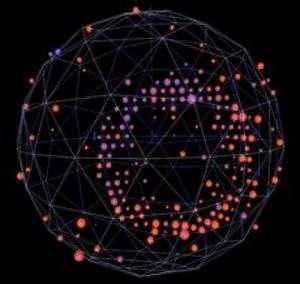
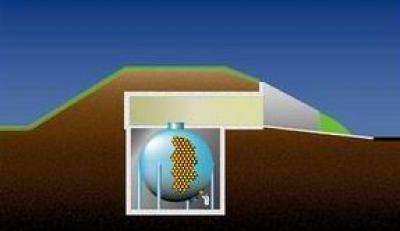
For its observations, MiniBooNE relies on a detector made of a 250,000-gallon tank filled with ultrapure mineral oil, clearer than water from a faucet. A layer of 1280 light-sensitive photomultiplier tubes, mounted inside the tank, detects collisions between neutrinos made by the Booster accelerator and carbon nuclei of oil molecules inside the detector. Since January 2006, the MiniBooNE experiment has been collecting data using beams of antineutrinos instead of neutrinos and expects further results from these new data.
Source: Fermi National Accelerator Laboratory


