Earthshaking images
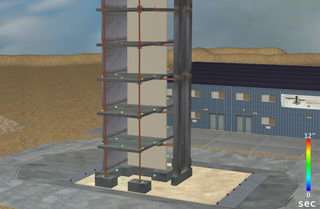
The powerful earthquake struck suddenly, shaking the seven-story building so hard it bent, cracked and swayed in response. But this was no ordinary earthquake.
In a groundbreaking series of tests, engineering researchers from UC San Diego's Jacobs School of Engineering jarred a full-size 275-ton building erected on a shake table, duplicating ground motions recorded during the January 17, 1994 Northridge earthquake in Los Angeles, California.
To record the impact on the building, the structure was fitted with some 600 sensors and filmed as the shake table simulated the earthquake, yielding a flood of data including stress, strain, and acceleration -- so much information that engineers were having a hard time making sense of it all.
That's where visualization experts from the San Diego Supercomputer Center (SDSC) at UC San Diego came in.
"By recreating the shake table experiment in movies in a virtual environment based on the observed data, this lets engineers explore all the way from viewing the 'big picture' of the entire building from a 360-degree viewpoint to zooming in close to see what happened to a specific support," said SDSC visualization scientist Amit Chourasia. "Integrating these disparate data elements into a visual model can lead to critical new insights."
Added José Restrepo, a professor of structural engineering at UCSD, "These visualizations give us an intuitive way to see how the building behaves in our shake table experiments -- this tool will be very valuable in helping us understand the tests in ways we can't from traditional approaches, and also in sharing this research with other engineers and the public."
The costliest quake in U.S. history, the magnitude 6.7 Northridge event prompted calls for more scientific evaluation of structural elements, leading the engineers to conduct the building tests on one of the world's largest shake tables at UCSD's outdoor Englekirk Structural Engineering Center.
A paper by Chourasia describing the project was published in a special graphics issue of ACM Crossroads, the student journal of the Association for Computing Machinery.
In addition to helping engineers understand the earthquake's impact on the building, the visualizations can also give researchers a tool to do "what if" virtual experiments.
"We found that the recorded motion aligns very well with the movie we created," said Steve Cutchin, director of Visualization Services at SDSC. "This is important because knowing the model is accurate means it can be used to take simulated earthquake data and predict the sensor values -- you can ask, 'What if a larger 7 point earthquake hits?' and simulate how the building will shake in response."
To make the visualizations more useful and provide a rich visual context, the researchers wanted to incorporate recognizable elements from the surroundings, which meant integrating features from the actual video footage recorded during the test. "Our goal was to have fidelity not only in rendering quality but also in visual realism," said Chourasia. In addition, the integrated video would let the researchers validate this virtual reconstruction visually.
Once Chourasia and his colleagues had developed the building model and animated the deformation caused by the shaking, they worked to align the virtual camera and lighting with the real world video camera so that the scene would match in the recorded footage and the virtual version.
"However, when we tried to composite the actual video footage, we found that the instruments had sampled the data at 50 Hz but the video was recorded at 29.97 Hz.," Chourasia explained. "And there wasn't any timing synchronization between the building sensors and camera." This posed a serious hurdle for compositing.
"After viewing the video footage, we noticed that the recording also contained audio data, because the moving building and shake table make noise, and this proved to be the key." By "listening to the building" and analyzing the audio and sensor signals, the researchers were able to synchronize the video and instrument data for the visualization.
In the future, the visualization researchers plan to develop lighting models for more realistic rendering and to find automated ways to match the real and virtual cameras. They are also distilling lessons learned from this study into requirements for a visualization workbench for analysis of the dissimilar types of data that come from structural and seismic experiments.
Source: University of California - San Diego


