Apollo Chronicles: Dark Shadows
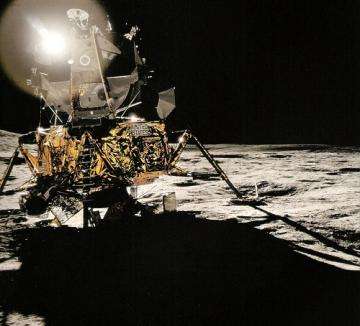
On the next sunny day, step outdoors and look inside your shadow. It's not very dark, is it? Grass, sidewalk, toes--whatever's in there, you can see quite well.
Your shadow's inner light comes from the sky. Molecules in Earth's atmosphere scatter sunlight (blue more than red) in all directions, and some of that light lands in your shadow. Look at your shadowed footprints on fresh sunlit snow: they are blue!
Without the blue sky, your shadow would be eerily dark, like a piece of night following you around. Weird. Yet that's exactly how it is on the Moon.
To visualize the experience of Apollo astronauts, imagine the sky turning completely and utterly black while the sun continues to glare. Your silhouette darkens, telling you "you're not on Earth anymore."
Shadows were one of the first things Apollo 11 astronaut Neil Armstrong mentioned when he stepped onto the surface of the moon. "It's quite dark here in the shadow [of the lunar module] and a little hard for me to see that I have good footing," he radioed to Earth.
The Eagle had touched down on the Sea of Tranquility with its external equipment locker, a stowage compartment called "MESA," in the shadow of the spacecraft. Although the sun was blazing down around them, Armstrong and Buzz Aldrin had to work in the dark to deploy their TV camera and various geology tools.
"It is very easy to see in the shadows after you adapt for a while," noted Armstrong. But, added Aldrin, "continually moving back and forth from sunlight to shadow should be avoided because it's going to cost you some time in perception ability."
Truly, moon shadows aren't absolutely black. Sunlight reflected from the moon's gently rounded terrain provides some feeble illumination, as does the Earth itself, which is a secondary source of light in lunar skies. Given plenty of time to adapt, an astronaut could see almost anywhere.
Almost. Consider the experience of Apollo 14 astronauts Al Shepard and Ed Mitchell:
They had just landed at Fra Mauro and were busily unloading the lunar module. Out came the ALSEP, a group of experiments bolted to a pallet. Items on the pallet were held down by "Boyd bolts," each bolt recessed in a sleeve used to guide the Universal Handling Tool, a sort of astronaut's wrench. Shepard would insert the tool and give it a twist to release the bolt--simple, except that the sleeves quickly filled with moondust. The tool wouldn't go all the way in.
The sleeve made its own little shadow, so "Al was looking at it, trying to see inside. And he couldn't get the tool in and couldn't get it released--and he couldn't see it," recalls Mitchell.
"Remember," adds Mitchell, "on the lunar surface there's no air to refract light--so unless you've got direct sunlight, there's no way in hell you can see anything. It was just pitch black. That's an amazing phenomenon on an airless planet."
(Eventually they solved the problem by turning the entire pallet upside down and shaking loose the moondust. Some of the Boyd bolts, loosened better than they thought, rained down as well.)
Tiny little shadows in unexpected places would vex astronauts throughout the Apollo program--a bolt here, a recessed oxygen gauge there. These were minor workaday nuisances, mostly, but astronauts were jealous of the minutes lost from their explorations.
Shadows could also be mischievous:
Apollo 12 astronauts Pete Conrad and Al Bean landed in the Ocean of Storms only about 600 yards from Surveyor 3, a robotic spacecraft sent by NASA to the moon three years earlier. A key goal of the Apollo 12 mission was to visit Surveyor 3, to retrieve its TV camera, and to see how well the craft had endured the harsh lunar environment. Surveyor 3 sat in a shallow crater where Conrad and Bean could easily get at it--or so mission planners thought.
The astronauts could see Surveyor 3 from their lunar module Intrepid. "I remember the first time I looked at it," recalls Bean. "I thought it was on a slope of 40 degrees. How are we going to get down there? I remember us talking about it in the cabin, about having to use ropes."
But "it turned out [the ground] was real flat," rejoined Conrad.
What happened? When Conrad and Bean landed, the sun was low in the sky. The top of Surveyor 3 was sunlit, while the bottom was in deep darkness. "I was fooled," says Bean, "because, on Earth, if something is sunny on one side and very dark on the other, it has to be on a tremendous slope." In the end, they walked down a gentle 10 degree incline to Surveyor 3--no ropes required.
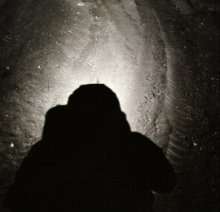
A final twist: When astronauts looked at the shadows of their own heads, they saw a strange glow. Buzz Aldrin was the first to report "…[there's] a halo around the shadow of my helmet." Armstrong had one, too.
This is the "opposition effect." Atmospheric optics expert Les Cowley explains: "Grains of moondust stick together to make fluffy tower-like structures, called 'fairy castles,' which cast deep shadows." Some researchers believe that the lunar surface is studded with these microscopic towers. "Directly opposite the sun," he continues," each dust tower hides its own shadow and so that area looks brighter by contrast with the surroundings."
Sounds simple? It's not. Other factors add to the glare. The lunar surface is sprinkled with glassy spherules (think of them as lunar dew drops) and crystalline minerals, which can reflect sunlight backwards. And then there's "coherent backscatter"--specks of moondust smaller than the wavelength of light diffract sunlight, scattering rays back toward the sun. "No one knows which factor is most important," says Cowley.
We can experience the opposition effect here on Earth, for example, looking away from the sun into a field of tall dewy grass. The halo is there, but our bright blue sky tends to diminish the contrast. For full effect, you've got to go to the Moon.
Luminous halos; mind-bending shadows; fairy-castles made of moondust. Apollo astronauts discovered a strange world indeed.
Source: Science@NASA (by Dr. Tony Phillips)


