Feather-light touch all that's needed for Darwin's frictionless optics
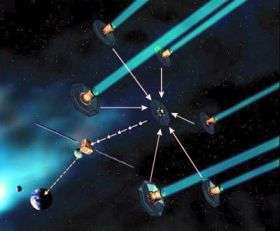
ESA's Darwin mission will look for extrasolar planets and signs of life. The Agency's Technology Research Programme has sponsored the development of critical optical components whose frictionless mechanism can respond to the touch of a feather.
ESA's Darwin mission aims to discover extrasolar planets and examine their atmospheres for signs of life, particularly for the presence of certain life-related chemicals such as oxygen and carbon dioxide. The major technical challenge lies in distinguishing, or resolving, the light from an extrasolar planet from the hugely overwhelming radiation emitted by the planet's nearby star.
The multi-satellite Darwin mission will use optical interferometry in which at least three separate orbiting telescopes jointly operate as an equivalent single telescope with a much larger effective aperture, thus achieving the required resolution. With this method, multiple smaller telescopes having actual apertures of, for example, 3 metres, can combine to provide an effective aperture of several tens to hundreds of metres, depending on the distance between the individual telescopes.
Creating delicate phase delays
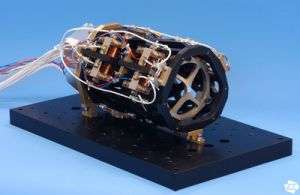
Darwin will use nulling interferometry, a specific interferometric technique used to shield the overwhelming star emissions by precisely delaying the radiation coming from some of the telescopes by a small amount. This, in combination with achromatic - or colour independent - phase shifters, will cancel out the bright star radiation while allowing the much fainter extrasolar planet light to be detected. A component known as an Optical Delay Line (ODL) is at the core of such interferometric observations. An ODL is a sophisticated opto-mechanical device that can introduce well-defined variations, or delays, in the optical path of a light beam and includes a moving mirror positioned with extremely good accuracy.
Precise movement using magnetic levitation
To demonstrate the critical technology required by Darwin, ESA's Technology Research Programme has sponsored the design and testing of an ODL that uses magnetic levitation for precise, frictionless mirror movement. The ODL's wonderfully sophisticated guidance and translation mechanism is, thanks to the magnetic levitation, completely contactless and frictionless and can be easily displaced by the faint touch of a feather (see video clip accompanying article). The optical delay introduced by the ODL must be capable of adjusting the optical path length of collected light beams with an accuracy of a few nanometers; 1 nanometre corresponds to a millionth of a millimetre.
Under ESA sponsorship, the ODL was built by an industrial consortium led by TNO Science and Industry, part of The Netherlands' Organisation for Applied Scientific Research, and including SRON and Dutch Space in the Netherlands, Belgium's Micromega-Dynamics s.a. and the Centre Spatial de Liège, and France's Alcatel Alenia Space and Sageis CSO. The ODL magnetic suspension technology was pre-developed by Micromega-Dynamics under the ESA-funded MABE (Magnetic Bearing) research study, which included quasi-zero gravity testing during parabolic flights.
Sub-nanometre resolution to be incorporated in future flight mechanism
The ODL shown here successfully demonstrated sub-nanometre resolution and stability; the design, materials and manufacturing processes for this ODL are representative of a future flight-capable mechanism. The ODL has also been thoroughly tested in Darwin's demanding cryogenic environment, at 40 Kelvin - or about -233 Celsius.
Darwin's ODLs are uniquely engineered to operate at cryogenic temperatures to avoid self-interference from the satellites' own thermal radiation. This is mandatory as Darwin will conduct observations at mid-infrared wavelengths, where the planet-to-starlight brightness ratio is relaxed compared to that in visible wavelengths, and where life-related marker chemicals such as water, ozone and carbon dioxide can be detected.
The ODLs will be used in Darwin for co-phasing the light collected by the separate telescopes within a central hub spacecraft, which is responsible for the correct recombination of the light beams and hence achieving the high-performance resolution of a single very large telescope.
Source: European Space Agency


