Chandra sees remarkable eclipse of black hole
April 12, 2007 Chandra sees remarkable eclipse of black hole

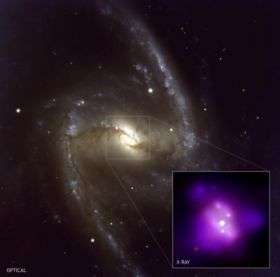
The large image shows an optical view of NGC 1365 from the ESO Very Large Telescope and the inset shows the Chandra X-ray Observatory view of the center of this galaxy. The bright source in the middle of the Chandra image shows the position of the supermassive black hole. During the eclipse the high energy X-rays from regions close to the black hole are blocked by dense gas clouds. Credit: X-ray: NASA/CXC/CfA/INAF/Risaliti Optical: ESO/VLT

A remarkable eclipse of a supermassive black hole and the hot gas disk around it has been observed with NASA's Chandra X-ray Observatory. This eclipse has allowed two key predictions about the effects of supermassive black holes to be tested.

Just as eclipses of the Sun and moon give astronomers rare opportunities to learn about those objects, an alignment in a nearby galaxy has provided a rare opportunity to investigate a supermassive black hole.

The supermassive black hole is located in NGC 1365, a galaxy 60 million light years from Earth. It contains a so called active galactic nucleus, or AGN. Scientists believe that the black hole at the center of the AGN is fed by a steady stream of material, presumably in the form of a disk. Material just about to fall into a black hole should be heated to millions of degrees before passing over the event horizon, or point of no return.

The disk of gas around the central black hole in NGC 1365 produces copious X-rays but is much too small to resolve directly with a telescope. However, the disk was eclipsed by an intervening cloud, so observation of the time taken for the disk to go in and out of eclipse allowed scientists to estimate the size of the disk.

"For years we've been struggling to confirm the size of this X-ray structure," said Guido Risaliti of the Harvard-Smithsonian Center for Astrophysics (CfA) in Cambridge, Mass, and the Italian Institute of Astronomy (INAF). "This serendipitous eclipse enabled us to make this breakthrough."

The Chandra team directly measured the size of the X-ray source as about seven times the distance between the Sun and the Earth. That means the source of X-rays is about 2 billion times smaller than the host galaxy and only about 10 times larger than the estimated size of the black hole's event horizon, consistent with theoretical predictions.

"Thanks to this eclipse, we were able to probe much closer to the edge of this black hole than anyone has been able to before," said co-author Martin Elvis from CfA. "Material this close in will likely cross the event horizon and disappear from the universe in about a hundred years, a blink of an eye in cosmic terms."

In addition to measuring the size of this disk of material, Risaliti and his colleagues were also able to estimate the location of the dense gas cloud that eclipsed the X-ray source and central black hole. The Chandra data show that this cloud is one hundredth of a light year from the black hole's event horizon, or 300 times closer than generally thought.

"AGN include the brightest objects in the Universe and are powerful probes of the early universe. So, it's vital to understand their basic structure," said Risaliti. "It turns out that we still have work to do to understand these monsters."

A series of six Chandra observations of NGC 1365 were made every two days over a period of two weeks in April 2006. During five of the observations, high energy X-rays from the central X-ray source were visible, but in the second one - corresponding to the eclipse - they were not.

Source: Chandra X-ray Center


print this article email this article download pdf blog this article bookmark this article     Stumble it Digg this share on Facebook retweet share on Reddit add to delicious
Rate this story - 4.4 /5 (74 votes)


April 12, 2007 all stories

Comments: 0

4.4 /5 (74 votes)
  • Stumble this up

  • Digg this

  • share this

  • hide
  • Related Stories

  • Longest Solar Eclipse of the 21st Century
    created Jul 21, 2009 | popularity not rated yet | comments 0
  • New Massive Black Hole Smashes Record
    created Oct 30, 2007 | popularity not rated yet | comments 0
  • Heaviest stellar black hole discovered in nearby galaxy
    created Oct 17, 2007 | popularity not rated yet | comments 0
  • Astronomers explore 'last blank space' on map of the Universe
    created Oct 28, 2009 | popularity not rated yet | comments 0
  • Blast from the Past Gives Clues About Early Universe
    created Oct 28, 2009 | popularity not rated yet | comments 0


  • hide
  • Relevant PhysicsForums posts

  • The shape of our solar system's orbits.
    created 18 hours ago
  • Above or Below the Line of Nodes
    created 23 hours ago
  • Supernova vs. Nova?
    created Nov 07, 2009
  • Supernova's Gamma Rays and Comets
    created Nov 06, 2009
  • More from Physics Forums - General Astronomy

Other News

Deep creep means milder, more frequent earthquakes along Southern California's San Jacinto fault

Deep creep means milder, more frequent earthquakes along Southern California's San Jacinto fault

Space & Earth / Earth Sciences

created 4 hours ago | popularity 4.7 / 5 (3) | comments 0

With an average of four mini-earthquakes per day, Southern California's San Jacinto fault constantly adjusts to make it a less likely candidate for a major earthquake than its quiet neighbor to the east, the ...


Success in 'space elevator' competition (AP)

Success in 'space elevator' competition (Update 3)

Space & Earth / Space Exploration

created Nov 05, 2009 | popularity 4.3 / 5 (33) | comments 50

(AP) -- A robot powered by a ground-based laser beam climbed a long cable dangling from a helicopter on Wednesday to qualify for prize money in a $2 million competition to test the potential reality of the ...


'Dropouts' pinpoint earliest galaxies

'Dropouts' pinpoint earliest galaxies

Space & Earth / Astronomy

created Nov 06, 2009 | popularity 4.2 / 5 (10) | comments 12

Astronomers, conducting the broadest survey to date of galaxies from about 800 million years after the Big Bang, have found 22 early galaxies and confirmed the age of one by its characteristic hydrogen signature ...


Space hotel taking bookings for 2012 opening

Space hotel taking bookings for 2012 opening

Space & Earth / Space Exploration

created Nov 05, 2009 | popularity 4.4 / 5 (20) | comments 11

(PhysOrg.com) -- The first orbiting space hotel is on track to open for its first customers in 2012, but hurry, as bookings are filling fast.


In a Galaxy Far, Far Away...

In a Galaxy Far, Far Away...

Space & Earth / Astronomy

created Nov 06, 2009 | popularity 4.8 / 5 (4) | comments 12

(PhysOrg.com) -- Astronomers have published the discovery of the farthest known object in the cosmos: a star that exploded when the universe was only 630 million years old -- only 4.6% of its current age. ...