Where is the proton? Yale scientists discover footprints of shared protons
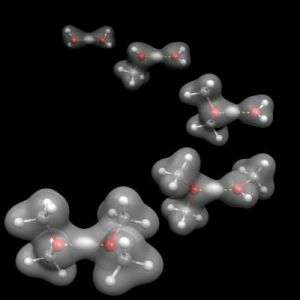
This week in Science, Yale researchers present "roadmaps" showing that shared protons, a common loose link between two biological molecules, simply vibrate between the molecules as a local oscillator, rather than intimately entangling with the molecular vibrations of the attached molecules.
Led by Professor Mark Johnson in the Department of Chemistry, the new data reveal distinct, isolated vibrational patterns, solely associated with the bridging proton, that change dramatically according to the chemical properties of the tethered molecules.
In effect, the paper reports clear "roadmaps" for the widely varying, characteristic vibrational frequencies that occur when an excess proton binds together simple nitrogen and oxygen containing molecules.
Rather than studying the proton-trapped pairs of molecular in crystals or in solution at room temperature, as has been common in the past, Johnson’s team made their measurements of proton interactions with 18 simple molecules by isolating them in the gas-phase and cooling them to about 50 Kelvin by taking advantage of recent advances in argon nanomatrix spectroscopy.
"Historically it has been very difficult to isolate the signature of an excess proton in a complex environment like a cell membrane, and say with confidence ‘Aha, I have one,’" said Johnson. "The proton is in constant motion in a warm, disordered medium, which causes its natural vibrational frequency to spread out over a huge spectral range. As a result, its ‘signature’ is often thought to comprise the continuous ‘junk’ background in the vibrational spectra of protonated samples."
"When we cool the isolated systems, the protons sing out their sharp vibrational frequencies, and therefore provide clear signatures that are characteristic of each kind of interaction," said Johnson.
The research shows that the extra proton is associated with a specific pair of atoms on the two tethered molecules, participating in partial chemical bonds to both. "In biological systems, any time you have molecules with a nitrogen or oxygen, and add in an extra proton, the proton forms a bond with one of the extra electron pairs that are available," according Johnson. "It crashes the party and changes the character of the molecule."
Extending Johnson’s analogy, if another molecule containing nitrogen or oxygen comes by, the proton crashes that party, too. Because the proton is not deciding between one molecule and the other, it is creating a bond between them — crashing both parties at the same time. "A proton is a great handshaker that works the room until it gets to where it is needed," he said.
This motif is the generic intermediate involved in passing a proton through a biological membrane. Each paired interaction forms a locally stable intermediate. In a sense, the oxygen atoms in water molecules chaperone protons between oxygen and nitrogen atoms on organic structures. For example, the primary events in trans-membrane proton pumps require passing protons through many relay steps across the cell membrane.
In earlier studies, Johnson looked only at water molecules trapping protons. This study expands the work to biologically relevant molecules that contain oxygen and nitrogen atoms. In it the researchers were able to look at how stiff the proton trap is between two molecules, and how this stiffness depends on the properties of the molecules to which the protons are attached.
"The strength with which the proton is grabbed by a nitrogen- or oxygen-containing molecule is highly affected by the environment," said Johnson. "So, we systematically changed that environment over a huge range and followed how the localization of the proton changed. We found that the way the proton is localized depends very much on the chemical properties of the atoms you are trapping it with."
Source: Yale University


