Soft tissue taken from 68 million-year-old Tyrannosaurus rex fossil yields original protein
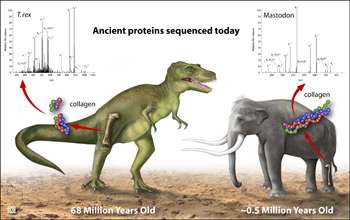
What happens when a 68 million-year-old Tyrannosaurus Rex meets 21st century medical science?
A North Carolina State University researcher and her colleagues at Harvard Medical School and Beth Israel Deaconess Medical Center found out when they confirmed the existence of protein in soft tissue recovered from the bone of a 68 million-year-old T. rex. Their results may both change the way that people think about fossil preservation and present a new method for studying diseases such as cancer.
Dr. Mary Schweitzer, assistant professor of paleontology at NC State with a joint appointment at the N.C. Museum of Natural Sciences, had previously discovered soft tissue in the leg bone of a T. rex recovered in 2003 from the Hell Creek formation in Montana.
After her own chemical and molecular analyses of the tissue indicated that original protein fragments might be preserved, she turned to colleagues Dr. John Asara, director of the mass spectrometry core facility at Beth Israel Deaconess Medical Center and instructor in pathology at Harvard Medical School and co-author Dr. Lewis Cantley, to see if they could provide the "nail in the coffin" that would confirm her suspicions. That nail would be sequence – the amino acid 'letters' used to make collagen, a fibrous protein found in bone.
Schweitzer's findings – and those of her colleagues – appear in the April 13 edition of the journal Science.
Bone is a composite material, consisting of both protein and mineral. When minerals are removed from modern bone, a collagen matrix – fibrous, resilient material that gives the bone its structure and flexibility – is left behind. When Schweitzer demineralized the T. rex bone, she was surprised to find such a matrix, because current theories of fossilization held that no original organic material could survive that long.
To see if the material had the characteristic cross-banded "stripes" that indicate collagen, Schweitzer and her colleagues examined the resultant soft tissue with both an electron microscope and atomic force microscopy. They then tested it against various antibodies that are known to react with collagen.
"We looked for collagen because it's plentiful, it's durable, and it has been recovered from other fossil materials, although none as old as this T. rex," Schweitzer says. "It's also a relatively easy molecule to identify, and it's not something that any microbes living in the immediate environment could produce. So identifying collagen in the soft tissue would indicate that it is original to the T. rex – that the tissue contains remnants of the molecules produced by the dinosaur, though highly altered."
But the evidence that Schweitzer had managed to find for the existence of collagen, while strongly suggestive, was not definitive. Fortunately, a mass spectrometry technique developed for studying low-level proteins in human diseases in Asara's mass spectrometry core facility was able to do what hadn't been possible before: provide the sequence of a 68 million-year-old protein and thus identify it.
Mass spectrometry measures the mass to charge ratio of individual molecules (peptides) that have been charged, identifying them by weight. Peptide fragmentation patterns reveal the amino acid sequence. The advantage of this method is that it extremely sensitive and can be used in cases where only very small amounts of material are available for analysis. That was definitely true of the T. rex sample, which only produced a miniscule amount of remnant protein, and the protein was in a mixture of other material that had remained after the extraction process.
Asara first applied the method to modern ostrich and then to 160,000- 600,000 year-old mastodon to demonstrate the efficiency and accuracy of their method while sequencing novel sequences unique to mastodon. Then he successfully sequenced the dinosaur protein, identifying the amino acids and confirming that the material from the T. rex was collagen. When the researchers compared the collagen sequences to a database that contains existing sequences from modern species, they found that the T. rex sequence had similarities to those of chicken, frog and newt.
"The similarity to chicken is definitely what we would expect given the relationship between modern birds and dinosaurs," Schweitzer says. "From a paleo standpoint, sequence data really is the nail in the coffin that confirms the preservation of these tissues. This data will help us learn more about dinosaurs' evolutionary relationships, about how preservation happens, and about how molecules degrade over time, which could also have some important medical implications for treating disease."
Citation: “Analyses of Soft Tissue from Tyrannosaurus rex Suggest the Presence of Protein”, Authors: Mary H. Schweitzer, North Carolina State University; John M. Asara, Beth Israel Deaconess Medical Center and Harvard Medical School; Jack Horner, Montana State University; et al, Published: April 13, 2007, Science
Source: North Carolina State University


