Mass weddings -- NIST's new efficient 2-photon source
April 12, 2007 Mass weddings -- NIST's new efficient 2-photon source

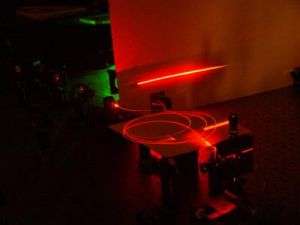
A microstructured optical fiber in NIST's new paired-photon source delivers high numbers of photon pairs over a broad bandwidth with low noise, all in a compact device for quantum communication devices. Credit: Migdall/NIST

For a variety of applications in physics and technology, ranging from quantum information theory to telecommunications, it’s handy to have access to pairs of photons created simultaneously, with a chosen energy. In a significant improvement on previous designs, physicists at the National Institute of Standards and Technology have devised a system that delivers such pairs with great efficiency over a wide range of energy, and with very little noise from extraneous photons.

Paired photons can be generated—albeit very inefficiently—in standard optical media such as glass optical fibers. Photons normally travel through glass independently, without interacting, but if monochromatic laser light is sent down even an ordinary optical fiber, very occasionally two of the input photons will interact, producing an output photon pair with one higher in energy than the original photons and the other lower by the same amount.

Because the vast majority of photons go through the fiber unchanged, the relative intensity of these pairs is very small. Worse, the fiber generates the pairs randomly with a range of possible energies, so picking out those with some specific energy reduces the number of useful photon pairs still further. Worse yet, there is noise in the system due to the phenomenon called "Raman scattering," in which individual photons bounce off the fiber’s molecular structure and change their energies. Scattering produces photons that look as if they might be one half of a pair, but aren’t.

To beat these odds, the new NIST two-photon source relies on a microstructured optical fiber. The fiber has a slender glass core at the center of an array of hollow channels, giving it a honeycomb appearance in cross-section. The geometrical structure of the fiber tightly restricts the way light can travel down it, increasing the intensity of light in the thin central core. Higher intensity means that photons are crowded more densely together, making events such as pair production more likely.

That greater efficiency allows the NIST researchers to get significant production of photon pairs by sending laser light through a mere 1.8 meters of the microstructured fiber, in contrast to the hundreds of meters of ordinary fiber that might be used in other systems. In addition, modifying the size of the channels in the microstructured fiber allows its properties to be optimized to reduce the amount of Raman scattering relative to the two-photon light of interest. The result is a source that produces significantly more pairs of photons over a wide frequency range, and with greatly reduced contamination by spurious Raman photons.

Photon pairs from the new source could be useful, for example, in exploring quantum "entanglement," in which measurements on one of a pair of quantum particles with a common origin exert a subtle influence on the properties of the other, or in quantum cryptography.

Citations: J. Fan and A. Migdall. A broadband high spectral brightness fiber-based two-photon source. Optics Express 15, 2915 (2007).
J. Fan, A. Migdall and L. Wang. A twin photon source based on optical fiber. Optics and Photonics News. March, 2007.

Source: National Institute of Standards and Technology


print this article email this article download pdf blog this article bookmark this article     Stumble it Digg this share on Facebook retweet share on Reddit add to delicious
Rate this story - 3.7 /5 (3 votes)


April 12, 2007 all stories

Comments: 0

3.7 /5 (3 votes)
  • Stumble this up

  • Digg this

  • share this

  • hide
  • Related Stories

  • Loopy photons clarify 'spookiness' of quantum physics
    created Mar 18, 2008 | popularity not rated yet | comments 0
  • 'Plug and Play' Source of Single Photons
    created Mar 15, 2007 | popularity not rated yet | comments 0
  • Miniature microscope allows biomedical researchers to observe tissue deep inside live subjects
    created Sep 13, 2005 | popularity not rated yet | comments 0
  • A Few Steps Closer to Nanoscale Photonic Technology
    created May 20, 2005 | popularity not rated yet | comments 0
  • New nano color sorters from Molecular Foundry
    created Nov 12, 2009 | popularity not rated yet | comments 0


  • hide
  • Relevant PhysicsForums posts

  • Laser spots
    created 1hour ago
  • Do you know elementary physics?
    created 3 hours ago
  • Bicycles and their mad skillz
    created 3 hours ago
  • Clarification of doubts on rolling motion
    created 7 hours ago
  • More from Physics Forums - General Physics

Other News

Aquatic creatures mix ocean water

Physics / General Physics

created 3 hours ago | popularity not rated yet | comments 0

Understanding mixing in the ocean is of fundamental importance to modeling climate change or predicting the effects of an El Niño on our weather. Modern ocean models primarily incorporate the effects of winds and tides. However, ...


Generating electricity from air flow

Physics / General Physics

created 6 hours ago | popularity 3.8 / 5 (6) | comments 1

A group of researchers at the City College of New York is developing a new way to generate power for planes and automobiles based on materials known as piezoelectrics, which convert the kinetic energy of motion into electricity. ...


Nuclear weapons: Predicting the unthinkable

Physics / General Physics

created 6 hours ago | popularity 1.5 / 5 (2) | comments 0

If a nuclear weapon were detonated in a metropolitan area, how large would the affected area be? Where should first responders first go? According to physicist Fernando Grinstein, we have some initial understanding to address ...


Butterfly proboscis to sip cells

Physics / General Physics

created 3 hours ago | popularity not rated yet | comments 0

A butterfly's proboscis looks like a straw -- long, slender, and used for sipping -- but it works more like a paper towel, according to Konstantin Kornev of Clemson University. He hopes to borrow the tricks of this piece ...


Restored machine to explore mysteries of Big Bang (AP)

Restored machine to explore mysteries of Big Bang

Physics / General Physics

created Nov 21, 2009 | popularity 4.6 / 5 (18) | comments 16

(AP) -- Scientists are preparing the world's largest atom smasher to explore the depths of matter after successfully restarting the $10 billion machine following more than a year of repairs.