Stretching exercises shed new light on nanotubes
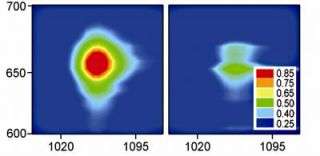
Stretching a carbon nanotube composite like taffy, researchers at the National Institute of Standards and Technology and the Rochester Institute of Technology have made some of the first measurements of how single-walled carbon nanotubes (SWNTs) both scatter and absorb polarized light, a key optical and electronic property.
SWNTs have excited materials scientists with the promise of novel materials that have exceptional mechanical, electronic, and optical properties. One fundamental issue is how light interacts with SWNTs. Is there, for example, a way to use appropriately tailored light to exert a force on SWNTs so that they can be trapped or aligned? Or can they be designed to be nanoscale tags for medical diagnostics? Semiconducting SWNTs can fluoresce in the near infrared region, an ideal characteristic for medical applications because body fluids and tissues are nearly transparent in that range.
Recent research on the optics of SWNTs has focused on the behavior of “excitons” — the pairing of a negatively charged electron with the positively charged “hole” that it leaves behind when it gets excited by a photon into a higher energy state. An important optical characteristic is how excitons in SWNTs impact the way the nanotubes absorb and scatter light.For example, how easy is it for the incident light to deform an exciton to create positive and negative poles? Theory says it should be significantly harder to do in a nearly one-dimensional nanotube than in a bulk semiconductor, where nearby electrons and holes reduce the amount of energy required.
Measuring that is difficult because the effect depends on the orientation of the nanotubes, and they’re hard to line up neatly. The NIST/RIT team solved the problem elegantly by wrapping SWNTs with DNA to keep them from clumping together, and dispersing them in a polymer. When they heated the polymer and stretched it in one direction, the nanotubes aligned like sugar crystals lining up in pulled taffy, making the optical measurements possible. The team obtained the first experimental verification of the full optical response of individual semiconducting SWNTs, finding good agreement with theory.
The stretching alignment technique is applicable to a broad range of SWNT experiments where orientation is important, particularly in optics. The work should further our current understanding of how nanotubes interact with light, with important practical applications in optical sensing and the manipulation of individual nanotubes using electromagnetic fields.
Citation: J.A. Fagan, J.R. Simpson, B.J. Landi, L.J. Richter, I.Mandelbaum, V. Bajpai, D.L. Ho, R. Raffaelle, A.R. Hight Walker, B.J. Bauer and E.K. Hobbie. Dielectric response of aligned semiconducting single-wall nanotubes. Physical Review Letters. 98, 147402 (2007).
Source: NIST


