Displays that give a clear view
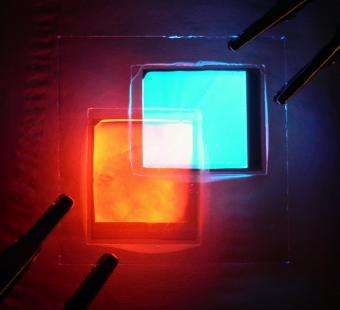
Displays made of organic LEDs are brightly lit but tend to be mostly opaque. Making them transparent opens up a whole new world of applications: OLEDs can be wedded with conventional LCDs and transform laminated glass into a display panel.
Sales of displays based on organic light-emitting diodes (OLEDs) are expected to reach 550 million euros this year. This represents an increase of almost 60 percent compared to last year. In terms of volume, the number of units sold over the same period is estimated at 67 million – or twice as many as in 2004. The main products incorporating these self-lit displays, which are still generally small in size, are cellular phones and MP3 players.
Scientists at the Fraunhofer Institute for Applied Polymer Research IAP in Potsdam have succeeded in constructing transparent OLED displays using light-emitting polymers. Their brightness, operating life time and efficiency are so high that the first commercial applications can be envisaged. “We achieved this result by using a new type of metal electrode to supply the polymer film with electric current,” reports Armin Wedel of the IAP. “The clue of the transparency lies in its physical properties.” Earlier metal oxide coatings were too thick to allow enough light to pass through. But making them thinner reduces their conductivity and hence the luminescence and operating life time of the display.
With the achieved degree of transparency, OLED displays can now be combined with the meanwhile mature technology of TFT liquid crystal displays which are commonly found in a wide variety of products. Thus, the researchers are considering to integrate additional functions directly in displays, such as highlighted areas or flashing warning symbols. By combining the two types, it becomes possible to concentrate a higher density of information content within the same surface area. Project partner Optrex Europe GmbH located near Frankfurt has already produced demonstration models of the hybrid display.
Some new ideas are being investigated in collaboration with the University of Applied Sciences in Potsdam and the University of the Arts in Bremen. Transparent OLEDs allow conventional displays to be illuminated from the back or front. Once the manufacturing process even for larger surface areas has been mastered, it will be possible to incorporate the light-emitting polymers in laminated glass. The result would be, for instance, to transform car windshields or glazing elements in buildings into display panels that hardly interfere at all with their main function of letting in daylight or allowing a clear view out. Another novel idea are two-color transparent displays: The ability to mix colors permits the creation of entirely new effects and applications.
Source: Fraunhofer-Gesellschaft


