Diffraction and scattering -- the solution to what's in solution
April 13, 2007 Diffraction and scattering -- the solution to what's in solution

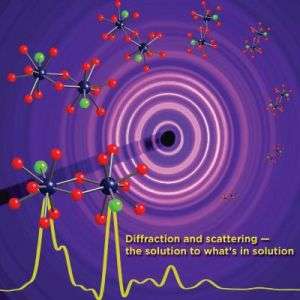
Researchers at the Department of Energy's Argonne National Laboratory and the University of Notre Dame have successfully applied X-ray scattering techniques to determine how dissolved metal ions interact in solution. Credit: Argonne National Laboratory

Researchers at the Department of Energy’s Argonne National Laboratory and the University of Notre Dame have successfully applied X-ray scattering techniques to determine how dissolved metal ions interact in solution.

These findings will help researchers better understand how metal ions, such as those found in nuclear waste and other industrial processes, behave in the environment.

The results show that the ion structures are visible in solution and reveals their interactions with other ions.

"The scientific community has long asked the question, 'What happens to a metal ion in solution?'” said Suntharalingam “Skantha” Skanthakumar, Argonne senior scientific associate. "Direct measurement of metal correlations in solutions show long-range interactions and a strong correspondence to the structures in solution and solid state environment."

"We have been provided with additional structural and chemical insight into tetravalent actinide hydrolysis," said Lynda Soderholm, senior scientist at Argonne. "We discovered that the way atoms interact is transferable with a lot more detail than what was previously thought. Hydrolysis of dissolved metal ions is one of the most fundamental and important reactions in aqueous chemistry.”

Experiments for this work were conducted at Argonne’s Advanced Photon Source (APS). The 1,104-meter circumference APS accelerator complex, large enough to encircle a baseball stadium, houses a complex of machines and devices that produce, accelerate and store a beam of electrons that is the source of the APS X-rays. For this research, thin beams of high-energy X-rays were used to bombard the dissolved ions. When the X-rays scattered off the solutions, special CCD cameras equipped to detect them mapped out their two-dimensional pattern.

The detailed results of these findings were published in the paper, "Structures of Dimeric Hydrolysis Products of Thorium" and in the journal Inorganic Chemistry.

"Going forward, additional research is planned with thorium and other dissolvable materials across the periodic table," said Argonne postdoctoral researcher Richard E. Wilson. "The goal is to be able to predict reactions to metal contaminants and determine the chemistry that influences their transport in the environment"

This research involved collaborations from various scientific disciplines including input from physicists, chemists and geologists.

Source: Argonne National Laboratory


print this article email this article download pdf blog this article bookmark this article     Stumble it Digg this share on Facebook retweet share on Reddit add to delicious
Rate this story - 3.8 /5 (10 votes)


April 13, 2007 all stories

Comments: 0

3.8 /5 (10 votes)
  • Stumble this up

  • Digg this

  • share this

  • hide
  • Related Stories

  • A Pocketful of Uranium: Construction of a Selective Uranium-Binding Protein
    created Feb 12, 2009 | popularity not rated yet | comments 0
  • New research could lead to practical uses for metal-organic frameworks
    created Sep 25, 2008 | popularity not rated yet | comments 0
  • Cancer cells forming blood vessels send their copper to the edge
    created Feb 27, 2007 | popularity not rated yet | comments 0
  • A Boost for Hydrogen Fuel Cell Research
    created Jan 25, 2007 | popularity not rated yet | comments 0
  • Scientists Working Toward Better Batteries
    created Mar 09, 2006 | popularity not rated yet | comments 0


Other News

Toward home-brewed electricity with 'personalized solar energy'

Toward home-brewed electricity with 'personalized solar energy'

Chemistry / Materials Science

created Nov 04, 2009 | popularity 3.4 / 5 (9) | comments 4

New scientific discoveries are moving society toward the era of "personalized solar energy," in which the focus of electricity production shifts from huge central generating stations to individuals in their ...


Scientists Reproduce a Building Block of Life in Laboratory

Scientists Reproduce a Building Block of Life in Laboratory

Chemistry / Biochemistry

created Nov 06, 2009 | popularity 4.8 / 5 (23) | comments 0

(PhysOrg.com) -- NASA scientists studying the origin of life have reproduced uracil, a key component of our hereditary material, in the laboratory.


Newly Discovered Fat Molecule: An Undersea Killer with an Upside

Newly Discovered Fat Molecule: An Undersea Killer with an Upside

Chemistry / Biochemistry

created Nov 05, 2009 | popularity 4.8 / 5 (9) | comments 0

(PhysOrg.com) -- A chemical culprit responsible for the rapid, mysterious death of phytoplankton in the North Atlantic Ocean has been found by collaborating scientists at Rutgers University and the Woods Hole ...


CU-Boulder map of human bacterial diversity shows wide interpersonal differences

Map of Human Bacterial Diversity Shows Wide Interpersonal Differences

Chemistry / Biochemistry

created Nov 05, 2009 | popularity 4.7 / 5 (11) | comments 0

(PhysOrg.com) -- A University of Colorado at Boulder team has developed the first atlas of bacterial diversity across the human body, charting wide variations in microbe populations that live in different ...


Mimicking nature, scientists can now extend redox potentials

Mimicking nature, scientists can now extend redox potentials

Chemistry / Biochemistry

created Nov 04, 2009 | popularity 4.8 / 5 (5) | comments 0

(PhysOrg.com) -- New insight into how nature handles some fundamental processes is guiding researchers in the design of tailor-made proteins for applications such as artificial photosynthetic centers, long-range ...