Hotter than expected neutron star surfaces help explain superburst frequency
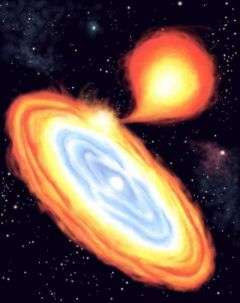
April 13, 2007 Accreting Neutron Star

Neutron star accreting matter from a red giant star. The red giant (on the upper right) is expanding and dumping material onto the neutron star. This material forms a disk and then finally falls to the neutron star surface. Credit: Tony Piro, U.C. Berkeley

A new theoretical thermometer built from heavy-duty mathematics and computer code suggests that the surfaces of certain neutron stars run significantly hotter than previously expected. Hot enough, in fact, to at least partially answer an open question in astrophysics -- how to explain the observed frequency of ultra-violent explosions known as superbursts that sometimes ignite on such stars' surfaces?

"This is the first model that goes into some reasonable detail about the nuclear physics that occur in the crusts of accreting neutron stars," said Hendrik Schatz, NSCL professor and co-author of a paper that will be published in The Astrophysical Journal in June. One of Schatz's co-authors, NSCL assistant professor Ed Brown, will present the results April 17 at a meeting of the American Physical Society in Jacksonville, Fla.

Superbursts emanate from binary systems in which a neutron star orbits a companion star. When the two stars get close enough together, a steady rain of material is sucked away from the companion star onto the surface of the neutron star.

Because a neutron star is so dense -- on Earth, one teaspoonful would weigh a billion tons -- the companion star material that reaches the neutron star surface is strongly compressed and heated. Eventually nuclear reactions trigger an explosion that burns through the surface layer of accumulated material, resulting in a burst of X-rays clearly detectable by ground- and space-based instruments.

X-ray bursts repeat every few hours to days, along the way fusing hydrogen and helium into a mixture of elements that is itself potentially reactive. In contrast, superbursts occur when, after many months, the accumulated "ashes" produced in the X-ray bursts ignite in a different, even more dramatic nuclear explosion.

The result is an outpouring of X-rays some 1,000 times as energetic as a standard X-ray burst. One superburst, which lasts only on the order of a few hours, releases as much energy as the sun will radiate in a decade.

Though hardly subtle astrophysical phenomena, superbursts remain shrouded in some mystery, largely because only twelve of the extreme events have ever been observed. This mystery is what attracted the attention of researchers participating in the Joint Institute for Nuclear Astrophysics, or JINA, project.

Working with colleagues at Los Alamos National Laboratory and the University of Mainz in Germany, JINA-affiliated NSCL scientists set out to build the most accurate model to-date of the crusts of accreting neutron stars. The team calculated that reactions in the stars' crusts release 10 times more heat than indicated by earlier models.

At least in part, this newly discovered heat helps to reconcile the work of theorists and experimentalists who study neutron stars. Prior to Schatz and Brown's research, theoretical astrophysicists predicted that superbursts should occur every ten years or so. Now, according the new calculation, theorists can explain why the gigantic explosions should occur every three or four years.

But more work remains to be done. According to observational data, superbursts occur roughly annually -- and scientists still aren't altogether sure why.

"So this doesn't quite solve the problem," Brown said. "It's still an open question as to how nature ignites superbursts."

Preprint of forthcoming Astrophysical Journal paper, "Heating in the Accreted Neutron Star Ocean: Implications for Superburst Ignition": http://arxiv.org/abs/astro-ph/0609828

Source: Michigan State University


print this article email this article download pdf blog this article bookmark this article     Stumble it Digg this share on Facebook retweet share on Reddit add to delicious
Rate this story - 4.4 /5 (19 votes)


April 13, 2007 all stories

Comments: 0

4.4 /5 (19 votes)
  • Stumble this up

  • Digg this

  • share this

  • hide
  • Related Stories

  • Astronomers explore 'last blank space' on map of the Universe
    created Oct 28, 2009 | popularity not rated yet | comments 0
  • Keck Study Sheds New Light on "Dark" Gamma-ray Bursts
    created Jun 08, 2009 | popularity not rated yet | comments 0
  • New Gamma-Ray Burst Smashes Cosmic Distance Record (w/Video)
    created Apr 28, 2009 | popularity not rated yet | comments 0
  • The Oddball Hosts of Gamma-ray Bursts
    created Oct 22, 2008 | popularity not rated yet | comments 0
  • A Brief Mystery: What are Short Gamma-ray Bursts?
    created Oct 21, 2008 | popularity not rated yet | comments 0


  • hide
  • Relevant PhysicsForums posts

  • Question about 2-body gravity
    created 9 hours ago
  • life on Mars
    created 11 hours ago
  • Semi-major axis from cartesian co-ordinates
    created Nov 23, 2009
  • Primary Mirror grinding
    created Nov 23, 2009
  • More from Physics Forums - General Astronomy

Other News

CO2 emissions continue significant climb

Space & Earth / Environment

created 10 minutes ago | popularity not rated yet | comments 0

The annual rate of increase in carbon dioxide emissions from fossil fuels has more than tripled in this decade, compared to the 1990s, reports an international consortium of scientists, who paint a bleak picture of the Earth's ...


Infrared Image of Circumstellar Disk Illuminates Massive Star Formation Process

Infrared Image of Circumstellar Disk Illuminates Massive Star Formation Process

Space & Earth / Astronomy

created 12 minutes ago | popularity not rated yet | comments 0

(PhysOrg.com) -- A team of astronomers from Ibaraki University, Japan Aerospace Exploration Agency, Kanagawa University, University of Tokyo, Academica Sinica, and National Astronomical Observatory of Japan ...


Cassini Captures Ghostly Dance of Saturn's Northern Lights

Cassini Captures Ghostly Dance of Saturn's Northern Lights (w/ Video)

Space & Earth / Space Exploration

created 1hour ago | popularity 5 / 5 (1) | comments 0

(PhysOrg.com) -- In the first video showing the auroras above the northern latitudes of Saturn, Cassini has spotted the tallest known "northern lights" in the solar system, flickering in shape and brightness ...


The e-waste dilemma

The e-waste dilemma

Space & Earth / Environment

created 1hour ago | popularity not rated yet | comments 0

(PhysOrg.com) -- Electronic devices could create significant environmental and health problems after they are thrown away. UC Irvine researchers are working with engineers, manufacturers and public health ...


First black holes may have incubated in giant, starlike cocoons, says CU-Boulder study

First black holes may have incubated in giant, starlike cocoons

Space & Earth / Astronomy

created 4 hours ago | popularity 4.9 / 5 (7) | comments 7

(PhysOrg.com) -- The first large black holes in the universe likely formed and grew deep inside gigantic, starlike cocoons that smothered their powerful x-ray radiation and prevented surrounding gases from ...